



|
Getting your Trinity Audio player ready...
|
By: Fern Sidman
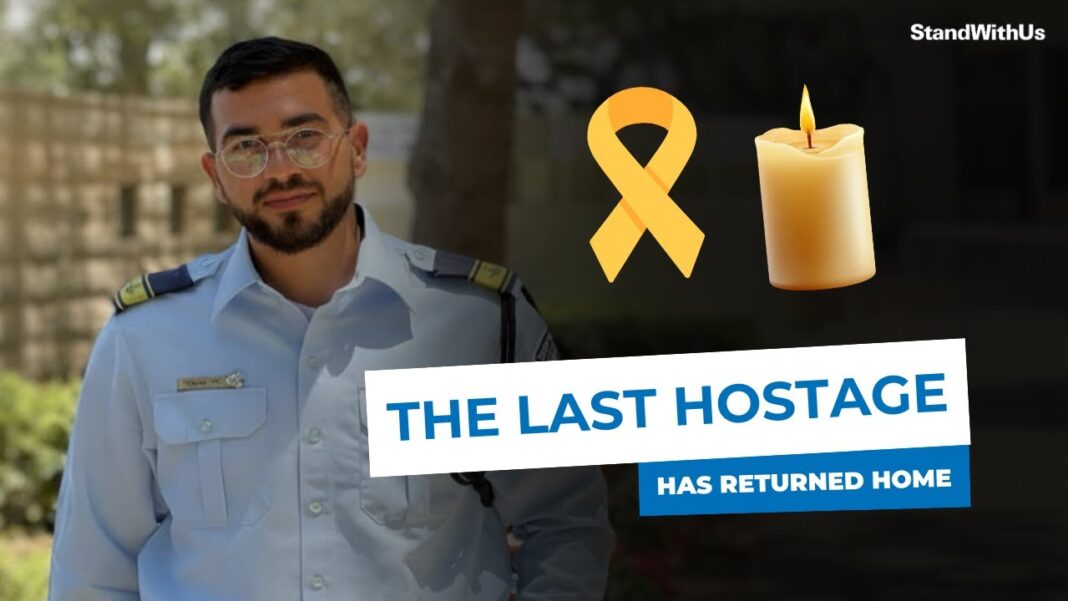
In a moment of profound national gravity, Israel on Wednesday laid to rest Staff Sergeant Major Ran Gvili, the final Israeli hostage to be returned from Gaza after 843 days in captivity. His funeral was not merely a burial; it was a historic reckoning, a collective exhale after more than two years of anguish, uncertainty, and unresolved grief. As reported on Wednesday in The Algemeiner, the ceremony in Meitar, Gvili’s hometown in southern Israel, marked the symbolic closure of the longest and most searing hostage crisis in the nation’s modern history.
From the earliest hours of the morning, Israel seemed to move in quiet unison. At the Shur Camp near Beit Shemesh in central Israel, an honor procession accompanied Gvili’s coffin as it departed the military base, draped in the national flag and escorted by uniformed soldiers, police officers, and security personnel. The atmosphere was heavy with reverence, grief, and solemn dignity. According to the report in The Algemeiner, this ceremonial passage represented not only a farewell to a fallen officer, but a national act of remembrance and moral closure.
The main memorial service unfolded in an open field near the Meitar sports complex, where more than 2,000 mourners gathered physically, while thousands more followed the ceremony via large outdoor screens erected for the public. Families, soldiers, government officials, religious leaders, and ordinary citizens stood shoulder to shoulder, united by a singular sorrow and a shared reverence for a young man whose final act was one of courage, self-sacrifice, and devotion to others.
Ran Gvili was not merely remembered as a hostage. He was remembered as a defender.
His mother, Taliq Gvili, spoke with a voice that carried both unbearable pain and luminous dignity. Her words cut through the silence with emotional force. She spoke not only of loss, but of hope — the hope that sustained her family for nearly two and a half years.
“I want to tell you, Ran,” she said, “that the hope that you could return to us standing, or even on just one leg, was what gave us the strength to get through this time.” Her voice did not tremble; it anchored the crowd in grief and resolve. “Because of you, all of Israel has been reminded that, despite our differences, we are one united and strong people. You went out to protect everyone, and all of us are worthy of your sacrifice.”
Her words transformed personal mourning into national meaning.
As The Algemeiner has chronicled, the recovery of Gvili’s remains was the result of months of painstaking intelligence work and military operations under Operation “Valiant Heart,” a classified IDF mission dedicated to locating hostages’ remains inside Gaza. The complexity of the operation reflected not only military precision but a moral commitment — the belief that no Israeli, living or dead, would be abandoned.
Approximately one month prior to the funeral, Israel’s Shin Bet security service executed a targeted operation in southern Gaza City, capturing a Palestinian Islamic Jihad operative. Under interrogation, he disclosed the location of Gvili’s burial site: Al-Batsh Cemetery in the Saja’iya neighborhood of northern Gaza. This intelligence breakthrough allowed Israeli forces to retrieve his remains and finally bring him home.
His father, Itzik Gvili, addressed the crowd with words that fused paternal love with national symbolism. “All of Israel knows your story,” he said. “The whole world has heard it. Everyone holds you close in their hearts — you are the son of all.” His voice carried pride as much as sorrow. “I am so proud to be your father. I miss you every single moment, and I love you deeply.”
The phrase “son of all” echoed across the field, capturing what Gvili had become: not only a child of one family, but a symbol of national courage, unity, and sacrifice.
The story of Ran Gvili’s final day remains one of the most haunting narratives of October 7, 2023. At just 24 years old, Gvili was recovering at home from a motorcycle accident, suffering from a broken shoulder and awaiting surgery. He was, by every measure, physically unfit for duty.
Yet when news broke of the Hamas-led invasion and massacre across southern Israel, he did not hesitate.
According to his father’s testimony, Ran simply said, “My men are fighting — do you think I should stay home?” He put on his uniform and left his house.
What followed reads like a chapter from ancient epic rather than modern history. Eyewitnesses later recounted that Gvili assisted the wounded, helped evacuate civilians, and rescued approximately 100 people fleeing the Nova Music Festival massacre. He reportedly killed 14 Hamas terrorists in direct combat. His final message to friends was chilling in its simplicity: he had been shot twice in the leg.
Then he disappeared.
For weeks, his fate remained unknown. Within two weeks, the IDF confirmed his abduction. By late January 2024, Israeli intelligence concluded that he had been killed during the October 7 atrocities and that his body was being held hostage in Gaza.
For 843 days, his family lived in a suspended reality — a liminal space between hope and mourning, between faith and despair. As The Algemeiner emphasized in its report, hostage families lived not only with grief, but with psychological torment: the absence of certainty, the cruelty of waiting, the brutality of not knowing.
Gvili’s sister, Shira, spoke with heartbreaking clarity. “When my mother came into my room and told me it would likely be a long time before you returned, I never imagined it would be the last 843 days,” she said.
Those words carried the unbearable weight of time — time suspended, time stolen, time frozen in trauma.
Israeli Prime Minister Benjamin Netanyahu attended the funeral, framing the moment not only as a personal tragedy but as a national turning point. “Ran, Israel’s hero, will be laid to rest in the Tomb of Israel,” he said. “The closing of the scroll over Gvili’s grave seals the painful reality of the Israeli hostages held in Gaza. We bring them all home, alive or dead, from enemy territory.”
His words, as reported by The Algemeiner, marked the formal end of the hostage chapter of the Gaza war — the first time since 2014 that Israel no longer had any hostages, living or deceased, held by terrorists in Gaza.
Yet Netanyahu made clear that the broader conflict remains unresolved. “This is not the end of the story,” he said. “We also remain committed to our other goals: disarming Hamas, demilitarizing the Gaza Strip, and we will achieve them.”
President Isaac Herzog also delivered remarks steeped in symbolism and reverence. “The ‘last hostage’ finally rests in the land of his home,” Herzog said. “The home he loved, the home he fought for alongside his comrades, the home he set out to defend with supreme courage and ferocity on that bitter and hurried day.”
Herzog’s words framed Gvili not merely as a fallen officer, but as a moral archetype — a figure whose life embodied the ethos of defense, responsibility, and sacrifice.
“I, like the thousands gathered here and the tens of thousands across the country, can only regret not having had the privilege of knowing him in life,” Herzog added.
As the ceremony concluded, Israel stood at a rare moment of national convergence — grief without division, mourning without politics, remembrance without argument. The return of Ran Gvili closed a chapter written in terror, bloodshed, resilience, and endurance.
Yet his legacy does not belong to the past.
As The Algemeiner report noted, the story of the hostages is not merely a wartime tragedy; it is a moral narrative about identity, solidarity, and national obligation. Ran Gvili’s life — and death — now occupies a permanent place in Israel’s historical memory, alongside names that define moments of national trial.
He did not die as a victim. He lived — and died — as a protector.
In bringing him home, Israel did not simply recover remains. It restored a son to his family, a soldier to his people, and a hero to history. And in doing so, a nation finally allowed itself to mourn fully, honestly, and together.
The last hostage has come home. But the memory of Ran Gvili will not leave.