



|
Getting your Trinity Audio player ready...
|
Edited by: TJVNews.com
As smoke clears over the Middle East, the world is left to assess the high cost and lasting consequences of the brief yet ferocious conflict now dubbed the “12-Day War” — a clash that not only redrew military calculations across the region but also exposed the precarious fault lines of diplomacy, deterrence, and nuclear brinkmanship.
Beginning in mid-June 2025 with a sudden escalation of hostilities between Israel and the Islamic Republic of Iran, and drawing in the United States in its most direct military involvement in the region in years, the 12-day exchange marked one of the most volatile chapters in the already fraught history of Israeli-Iranian tensions. It was a war punctuated by swift airstrikes, spiraling civilian tolls, and competing narratives of victory — but one whose outcome leaves far more questions than answers.
A Triangular Theater of War
The immediate origins of the conflict remain shrouded in the familiar haze of geopolitical ambiguity. What is clear, however, is that a sequence of strategic miscalculations — Iranian proxy activity in Syria, an alleged Israeli cyber attack on Iran’s underground Fordow nuclear facility, and the subsequent Iranian missile salvos into northern Israel — catalyzed an extraordinary military response.
Israel, long prepared for such a confrontation, unleashed precision strikes deep within Iranian territory, reportedly hitting missile factories, IRGC command centers, and critical components of Iran’s nuclear infrastructure in Natanz, Isfahan, and Fordow. Israel’s elite intelligence services, according to military officials, played a decisive role in identifying and targeting vulnerable points within Iran’s heavily fortified systems.
The United States, under President Donald Trump, followed suit just days later. In a surprise move that some analysts have compared to Operation Opera in 1981 and the 2003 invasion of Iraq, U.S. B-2 stealth bombers executed direct strikes on Iranian nuclear facilities. While the White House described the operation as “surgical and proportionate,” early reports suggest that the strategic effectiveness remains contested.
Despite the U.S. administration’s assertion that the strikes had “demolished” core components of Iran’s nuclear program, intelligence assessments leaked to Middle East Eye and The Washington Post claim that key elements survived and that the uranium enrichment program may only have been set back by several months — not years.
Claimed Victories, Tangible Losses
All sides, predictably, claimed victory.
In Jerusalem, Prime Minister Benjamin Netanyahu hailed the campaign as a triumph of Israeli deterrence, praising the IDF’s ability to “strike at the heart of the Iranian threat.” Israel’s air force reportedly decimated Iranian missile launch platforms and command-and-control infrastructure, and disrupted Tehran’s short-range weapons manufacturing.
For its part, Tehran insisted it had achieved a “strategic success” by enduring the Israeli and American assault while still launching retaliatory strikes that reached deep into Israel. Missiles rained down on Tel Aviv, Be’er Sheva, and Haifa. Though most were intercepted, several slipped through, striking residential neighborhoods and infrastructure — exposing vulnerabilities even within Israel’s vaunted Iron Dome and Arrow defense systems.
The toll, however, tells a story of devastation on both sides.
Iran reported over 610 deaths, most of them military personnel, and more than 4,700 injuries. Several missile factories and air defense systems were obliterated, severely degrading Iran’s immediate warfighting capacity. Reports also indicate substantial damage to critical components of Iran’s nuclear program, though the extent remains opaque.
Israel, while emerging with its core infrastructure intact, faced a staggering civilian injury toll of over 3,200 people, largely from missile shrapnel and resulting chaos. Hospitals in Tel Aviv and Haifa operated under emergency conditions for several days, with temporary field clinics erected to handle overflow.
The United States, though spared casualties, now finds itself ensnared more deeply in a region where it has long sought disengagement. Its strategic gamble — decisive intervention to degrade Iran’s nuclear capabilities — may have bought time, but at the cost of rekindling fears of entrapment in a wider regional conflagration.
Strategic and Tactical Takeaways
From a purely military perspective, Israel’s superior intelligence, cyber capabilities, and air power once again demonstrated the asymmetry of force between the two adversaries. Iran, however, proved it could still project significant power via its vast ballistic missile arsenal and network of regional proxies — from Hezbollah in Lebanon to militias in Iraq and Yemen.
But the war also revealed critical disadvantages. Israel’s strategic dependency on U.S. logistical and satellite intelligence support became increasingly evident. Meanwhile, Iran’s overreliance on static missile infrastructure made it particularly vulnerable to advanced Western surveillance and targeting technologies.
A Ceasefire on Shaky Ground
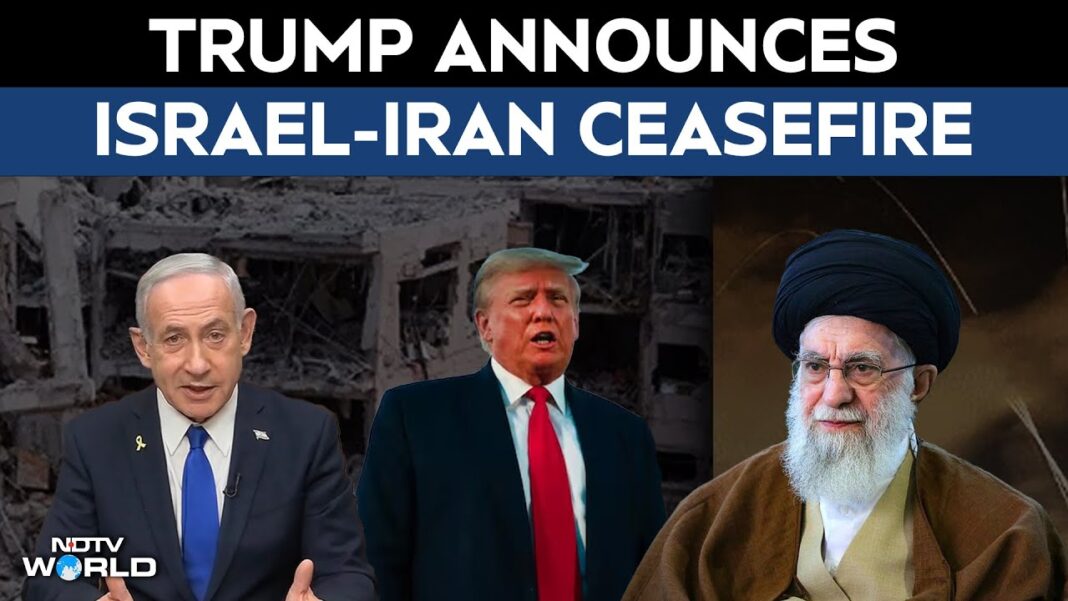
The ceasefire, brokered in dramatic fashion by President Trump and announced via a triumphant Truth Social post, remains tenuous. According to the framework described by Trump, Iran initiated a 12-hour unilateral cessation of hostilities, followed by an Israeli pause, culminating in a symbolic 24-hour truce to mark the end of the war.
Yet within days, violations were reported. Sporadic rocket fire from Iranian-backed militias in southern Lebanon and drone activity near Israel’s border with Syria have kept Israeli forces on high alert. Iranian media accuses Israeli cyber units of continuing “covert attacks,” while Israeli officials say Iranian disinformation is already undermining the fragile peace.
Lingering Shadows: Nuclear Ambiguities and Diplomatic Crossroads
Perhaps the most alarming postscript to the war is the revelation that over 400 kilograms of highly enriched uranium remain unaccounted for in Iran. Intelligence agencies in the West have warned that this stockpile could form the basis of a covert breakout program — a possibility that could reignite hostilities at any moment.
Diplomatic channels, meanwhile, remain stagnant. The Vienna nuclear negotiations — already in tatters before the war — are now politically unviable. European powers, caught between support for Israel and concerns over further destabilization, are reportedly floating a new regional framework involving Saudi Arabia and the UAE. But such overtures remain speculative.
As Trita Parsi, executive vice president of the Quincy Institute, recently observed, “The only true resolution to the Iranian nuclear question is diplomatic. Bombs can delay, but only diplomacy can defuse.”
Conclusion: War Without Resolution
The 12-Day War may have ended with missiles falling silent, but its reverberations continue to unsettle the Middle East and the wider world. While Israel can claim tactical superiority and the U.S. can point to its role in forcing a ceasefire, the deeper geopolitical and nuclear risks remain unmitigated.
With Iran bloodied but not broken, and a region simmering in uncertainty, the world now waits to see whether this was a prelude to wider conflagration — or a fleeting, violent pause before diplomacy finally reclaims the stage.
