



|
Getting your Trinity Audio player ready...
|
By: Fern Sidman
Few artifacts in human history have captured the imagination quite like the Aron Habris, the Ark of the Covenant—a gold-covered chest described in the Torah as the resting place of the Luchos Habris, the Tablets of the Covenant given to Moses at Mount Sinai. For centuries, the Ark has remained hidden, its fate unknown, sparking speculation, devotion, and relentless search across generations. Now, new discoveries at Tel Shiloh in Samaria may shed light on where the Ark once stood, if not on where it ultimately disappeared.
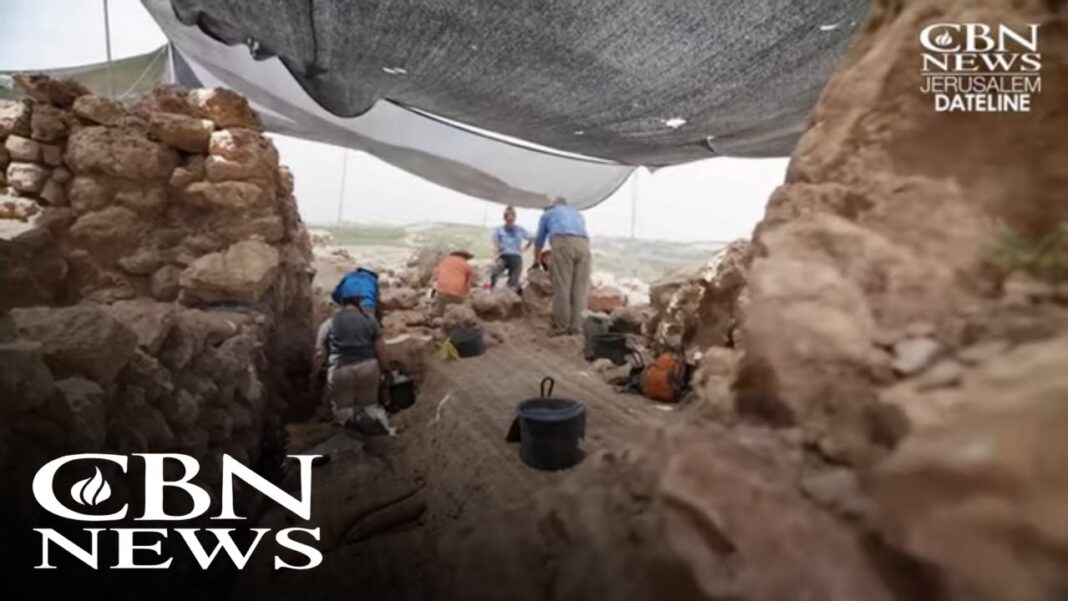
According to a report on VIN News, archaeologists led by Dr. Scott Stripling have uncovered the remains of a monumental structure in Shiloh, the very site identified in Tanach as Israel’s first religious capital. The dimensions, orientation, and design of the structure appear to match the biblical description of the Mishkan—the Tabernacle that once housed the Ark. For believers and scholars alike, the discovery is nothing short of extraordinary.
Shiloh occupies a unique position in the biblical narrative. Nestled in the hills of Samaria, it served as the spiritual and political hub of the nascent Israelite tribes following the conquest of Canaan. Here, according to Sefer Shmuel, the Mishkan stood for centuries, drawing pilgrims for festivals and sacrifices. It was in Shiloh that Hannah prayed for a child, vowing to dedicate him to divine service; her son Shmuel would grow up under the guidance of Eli the Kohen Gadol, ultimately becoming one of Israel’s greatest prophets and leaders.
The report at VIN News noted that tradition holds the Ark was placed within the sanctuary at Shiloh during this period. The site became synonymous with Israel’s first attempt to centralize worship before the building of the Beis Hamikdash in Jerusalem. When the Philistines captured the Ark during battle, as described in I Samuel 4, Shiloh’s central role came to an abrupt and tragic end.
Dr. Stripling, director of the Tel Shiloh Excavations, revealed that his team has uncovered a stone structure dating to the Iron Age I period—precisely when Shiloh was Israel’s religious capital. Its design is strikingly similar to the Mishkan’s specifications found in the book of Exodus 26.
“We uncovered a monumental structure from Iron Age I, whose dimensions match those of the Tabernacle as described in the Bible,” Stripling told reporters. “The structure is oriented east to west and divided in a 2:1 ratio, exactly as described in the scriptures.”
As the report at VIN News emphasized, the orientation and division suggest a deliberate design echoing the biblical Holy of Holies, separated by the Parochet (curtain) from the outer chamber. While no trace of the Ark itself has surfaced, the architectural parallels are difficult to dismiss.
Even more compelling than the structure are the ritual remains surrounding it. Stripling’s team uncovered over 100,000 animal bones, predominantly sheep, goats, and cattle—the precise animals used in biblical sacrifices. Most strikingly, the majority of these bones come from the right side of the animals.
This detail directly aligns with Vayikra (Leviticus) 7:32, which commands: “And the right thigh you shall give as a contribution to the priest from your peace offerings.”
“This is not a coincidence,” Stripling explained. “The evidence of sacrificial rituals here is overwhelming, and it perfectly matches the biblical description. It’s hard to ignore.”
Accompanying pottery shards date to the same era, strengthening the argument that this was no ordinary settlement but a site of ritual significance consistent with Shiloh’s biblical role.
The discoveries at Tel Shiloh extend beyond architecture and bones. Dr. Stripling has also suggested that his team may have identified the remains of the ancient city gate, a location tied directly to one of the Bible’s most dramatic narratives.
As recounted in I Samuel 4, when the Israelites brought the Ark into battle against the Philistines, hoping for divine deliverance, disaster struck. The Ark was captured, Eli’s sons—Hophni and Phinehas—were slain, and a messenger carried the tragic news back to Shiloh. There, at the city gate, the elderly and nearly blind Eli fell backward upon hearing of the Ark’s capture and the death of his sons, breaking his neck.
The report at VIN News observed that if the gate indeed corresponds to the biblical description, it provides one of the rare instances where archaeology appears to converge almost seamlessly with scripture, offering tangible evidence of a historical moment etched in Jewish memory.
The Ark of the Covenant disappeared from the biblical record long before the Babylonians destroyed the First Beis Hamikdash in 586 BCE. Its fate remains one of history’s great mysteries, inspiring endless theories: that it was hidden in tunnels beneath the Temple Mount, spirited away to Ethiopia, or buried secretly by priests before Jerusalem’s fall.
While the Tel Shiloh excavations cannot solve the mystery of the Ark’s disappearance, the VIN News report pointed out that the site may provide the clearest evidence yet of where the Ark once resided. For archaeologists and biblical historians, this represents an unparalleled opportunity to study Israel’s early religious practices in their original setting.
The significance of the Shiloh discoveries extends beyond science. For many Jews, Shiloh is not merely an archaeological site but a living testament to their ancient faith. Pilgrims still visit, prayers are offered, and the story of the Ark remains central to the community’s spiritual imagination.
As VIN News reported, the presence of ritual remains—combined with architectural features matching scriptural descriptions—creates a compelling narrative that reinforces the continuity of Jewish tradition. In a time when the legitimacy of biblical history is often challenged, Shiloh stands as a potent reminder of the enduring bond between faith and evidence.
Unsurprisingly, the findings at Tel Shiloh have ignited scholarly debate. Some archaeologists caution against drawing definitive conclusions, warning that religious enthusiasm should not eclipse scientific rigor. Others argue that the convergence of textual, ritual, and architectural evidence makes Shiloh one of the most convincing biblical sites discovered in decades.
The international academic community is following the excavation closely, with researchers from across the world analyzing each new find. The debate underscores the delicate balance between archaeology as a scientific discipline and its intersection with deeply held religious convictions.
Today, Shiloh lies in the hills of Samaria, part of the disputed territories that remain central to the Israeli-Palestinian conflict. For modern Israel, the site carries not only historical and religious significance but also profound political symbolism. The rediscovery of Shiloh’s sacred past resonates with Israel’s efforts to preserve its heritage in contested lands.
VIN News reported that local communities view the excavation as part of a broader mission to reconnect with Israel’s ancestral roots, reaffirming the enduring presence of the Jewish people in their ancient homeland.
Excavations at Tel Shiloh are far from over. Stripling and his team continue to sift through layers of soil, cataloguing bones, pottery, and architectural remains. Each season brings new revelations that deepen understanding of Shiloh’s role as Israel’s first religious capital.
Although the Ark itself has yet to be uncovered—and may never be—the discoveries thus far illuminate the world in which it once stood. The evidence paints a vivid picture of a community engaged in sacrificial worship, guided by scripture, and centered around a sacred structure that may have been the very Mishkan described in the Torah.
The significance of these findings cannot be overstated: they bridge the ancient and the modern, the textual and the physical, the faith of generations with the tools of contemporary science.
The search for the Ark of the Covenant has fascinated scholars, theologians, and adventurers for centuries. While its ultimate fate remains hidden, the discoveries at Tel Shiloh provide a tangible connection to the era when the Ark stood at the heart of Israelite worship.
As excavations continue, each new find adds to a growing body of evidence that Shiloh was not just a place of legend but a real, functioning sanctuary where the people of Israel encountered the divine. In the words of VIN News, the discoveries offer “renewed attention to the search for the most sacred object in the Bible” and invite all who visit to reflect on the enduring mystery and majesty of the Ark.
