



|
Getting your Trinity Audio player ready...
|
Tehran’s Terror from the Sky: Missile Strike Murders Six, Including Two Children, in Heart of Israel
By: Fern Sidman
In the predawn hours of Sunday morning, Israel was jarred awake by sirens wailing across its heartland. Air raid alerts echoed from Tel Aviv to Haifa, Rehovot to Tamra, as missiles and unmanned aerial vehicles (UAVs) were launched toward Israeli territory in a coordinated and unprecedented attack orchestrated by the Islamic Republic of Iran. Israel National News (INN) described the onslaught as one of the most significant direct missile threats to the Israeli home front in recent memory.
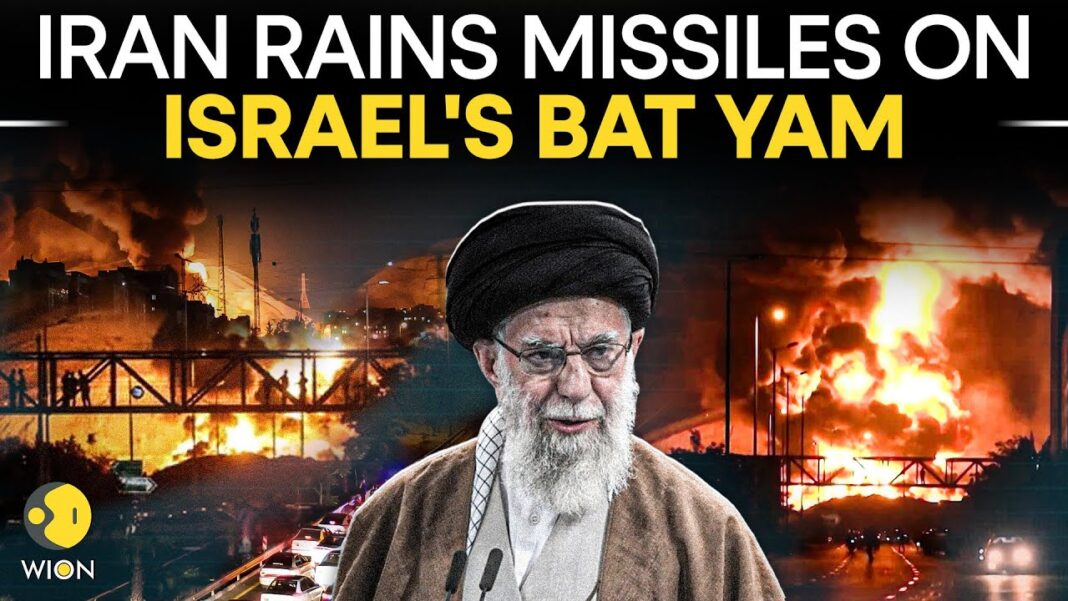
Among the worst-hit areas was the coastal city of Bat Yam, south of Tel Aviv, where a residential building took a direct hit, leading to a catastrophic loss of life. According to emergency response teams cited by INN, seven individuals were killed in the strike. The victims included three women, aged 69, 80, and 50, as well as a young man of 18, a ten-year-old boy, and an eight-year-old girl. Their names, still withheld pending family notifications, represent a tragic cross-section of Israeli civilian society.
Magen David Adom (MDA) reported to INN that 99 people received medical treatment at the site. Four victims were in serious condition, while seven were moderately wounded. An overwhelming number—88 people—sustained minor injuries, mostly from glass shards, falling debris, and shock. Rescue and fire brigade personnel toiled throughout the day to recover bodies trapped under the rubble.
Further north, the Arab-majority town of Tamra was also struck by a missile that obliterated a three-story home. The dead included a mother, her two daughters, and a female relative. As reported by INN, the scene was one of unspeakable devastation: twisted rebar, scorched furniture, and stunned neighbors mourning in silence amid the chaos.
In Rehovot, another urban center in central Israel, the attack caused severe infrastructural damage and multiple casualties. According to the information provided in the INN report and MDA updates, 37 individuals were injured: two critically, twelve moderately, and twenty-three with lighter wounds. Emergency medical personnel rushed the wounded to hospitals including Sheba-Tel Hashomer, Beilinson, Wolfson, Ichilov, Kaplan, and Assuta Ashdod.
A mass casualty event was declared at several facilities as emergency rooms reached capacity. Trauma teams, many of whom were already on high alert following heightened regional tensions, were mobilized in full force.
In a chilling indication of the widening regional conflict, the Israel Defense Forces confirmed the interception of a missile launched from Yemen, believed to be the work of the Iran-backed Houthi militia. The report at Israel National News emphasized the growing threat posed by Iran’s regional proxies, with potential attacks looming from Lebanon, Syria, Iraq, and now Yemen.
As missiles rained down, the Israeli Air Force (IAF) launched a broad and meticulously coordinated retaliation targeting key nuclear and defense installations deep inside Iran. The IDF announced the successful completion of a series of precision strikes on nuclear-linked assets in Tehran.
According to information released to INN, targets included the Iranian Ministry of Defense headquarters and the secretive SPND complex, widely regarded as the nerve center of Iran’s clandestine nuclear weapons project. These strikes are believed to have also impacted facilities where Iranian officials had hidden portions of the nation’s nuclear archive—infamously exposed in 2018 by Israeli intelligence.
Military officials told INN that the goal of this offensive was to delay, if not irreversibly cripple, Tehran’s nuclear ambitions and to send a clear message: any future attempts to threaten Israel with weapons of mass destruction will be met with overwhelming and surgical force.
The scale and nature of Iran’s attack mark a significant escalation in its longstanding campaign against the Jewish state. Unlike previous instances where Tehran relied on its proxies—Hezbollah, Hamas, and Islamic Jihad—this assault bore the unmistakable fingerprints of direct Iranian involvement.
As INN commentators have noted, the attack shifts the nature of the conflict from a shadow war into open hostilities between two nation-states, with profound implications for global diplomacy, nuclear nonproliferation, and regional stability.
Israeli Prime Minister Benjamin Netanyahu is expected to address the nation and the international community in a speech later this week. Sources within his office told INN that further retaliatory measures are “on the table,” depending on how Iran and its allies respond in the coming hours.
As rescue operations continued late into the night, scenes of heroism, anguish, and unity played out across the Israeli landscape. Volunteers delivered food and blankets to displaced families in Bat Yam, while blood donation centers reported record turnout.
Israel National News, reporting live from the front lines of these multiple crises, captured the prevailing mood best: “This is a country that has endured—through intifadas, wars, and missile barrages. But what we witnessed today is different. Iran has crossed a red line, and Israel has responded accordingly. The next chapter is being written not in the back rooms of diplomacy, but in the skies above Tehran and Tel Aviv.”
As the conflict continues to unfold, the world watches with bated breath. But for Israel, the war is already here—measured in lives lost, buildings shattered, and a people once again steeled by the test of survival.
