



|
Getting your Trinity Audio player ready...
|
By: Fern Sidman
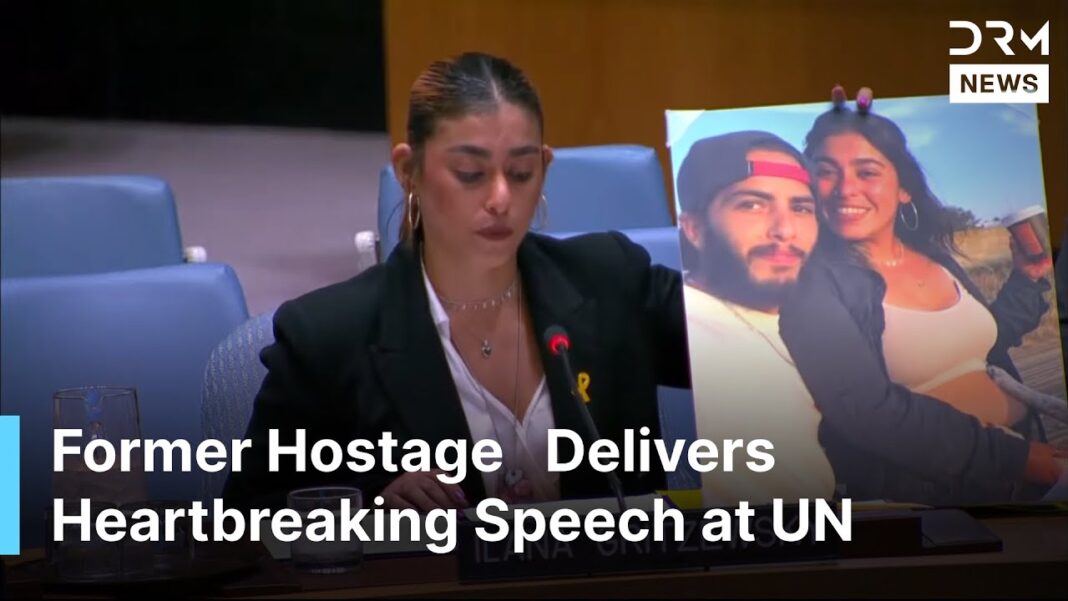
At the United Nations Security Council on Wednesday, Ilana Gritzewsky, a survivor of Hamas captivity and the partner of current hostage Matan Zangauker, delivered harrowing testimony that underscored the ongoing human toll of Hamas’s brutality. As VIN News reported on Wednesday, her account was a stark reminder of the cruelty inflicted upon those abducted during the October 7, 2023, massacre and of the urgent imperative to secure the release of those still held in Gaza.
Gritzewsky, who was kidnapped from her home in Nir Oz, described in visceral detail the violence and humiliation she endured at the hands of her captors. “I was torn from my home in an instant,” she recalled, describing how she was beaten and forced to walk through the streets of Gaza, used by Hamas operatives as a human shield to conceal her abduction. For 55 agonizing days, she said, she survived without basic necessities, sleeping on cold floors and enduring prolonged hunger and deprivation. “While the world talks about hunger in Gaza, we, the kidnapped, were the ones starving,” she told the chamber, her words echoing across the UN floor.
According to the report at VIN News, Gritzewsky’s ordeal included watching her captors consume full meals while she survived on scraps. The denial of food and medicine, she explained, was part of a broader system of psychological torment designed to break the hostages’ spirits. Yet her testimony revealed not only the cruelty of Hamas’s methods but also her own resilience. Despite being offered release before her partner, Matan, she refused to leave Gaza without him. “I left Gaza with a hole in my heart and a promise to do everything possible to bring him and the other hostages home,” she declared.
Her words cast a spotlight on Matan Zangauker and the dozens of others still languishing in Hamas tunnels. The image she presented — of hostages deprived of daylight, starved, and isolated — countered Hamas’s attempts to present itself as a resistance movement. Instead, as VIN News noted, her testimony exposed the terror group’s use of hostages as bargaining chips, exploiting their suffering to manipulate international negotiations.
Israel’s Ambassador to the UN, Danny Danon, called Gritzewsky’s remarks “heart-wrenching” and stressed the broader implications of her testimony. “Hamas continues to exploit hostages and humanitarian aid,” he warned, urging the Security Council to move beyond rhetoric and adopt decisive measures. “The world can no longer stand by. Hostages must be freed, and Hamas must be held accountable.”
The Security Council session came amid a broader debate over ceasefire proposals and humanitarian aid to Gaza. As the VIN News report observed, Israel has consistently warned that Hamas exploits humanitarian relief for its own military advantage, diverting supplies meant for civilians and embedding its operations within civilian infrastructure. Gritzewsky’s testimony reinforced that narrative by underscoring how even humanitarian discussions about food and medicine ring hollow while hostages remain starved and abused in underground captivity.
Her account also placed renewed pressure on international mediators. While ceasefire talks have intermittently advanced through channels in Qatar and Egypt, Gritzewsky’s vow not to abandon her partner highlighted the emotional toll borne by hostage families and underscored the inadequacy of partial or phased deals that leave captives behind. For the families, the issue is not merely diplomatic — it is existential.
Observers have noted that her testimony at the UN was also a direct challenge to the international community’s tendency to dilute responsibility. As the VIN News report explained, while many nations continue to call for restraint from Israel, Gritzewsky’s words redirected the focus to Hamas’s unrelenting atrocities. Her message was unequivocal: the suffering of hostages is not an abstraction but a lived reality that demands urgent action.
Beyond the specifics of her ordeal, Gritzewsky’s statement illuminated the profound psychological scars inflicted by captivity. She spoke of the enduring pain of separation from her partner and the helplessness of knowing he remains in Hamas hands. Yet she also spoke with determination — a determination that has become a hallmark of hostage families in Israel, who continue to mobilize and rally across the country.
The resonance of her testimony was further amplified by its timing. Nearly two years into the war sparked by Hamas’s October 7 atrocities, patience within Israel is fraying, with families and demonstrators pressing the government for swifter action. As VIN News has covered extensively, public frustration has mounted over the pace of negotiations and the perception that political considerations are eclipsing humanitarian urgency.
At the UN, however, Gritzewsky transformed that frustration into a global appeal. Her words cut through the familiar cycle of speeches, resolutions, and condemnations that characterize the chamber’s debates on Israel and Gaza. Instead, she forced diplomats to confront the raw human suffering caused by Hamas’s hostage-taking, reframing the conversation around moral responsibility rather than political calculus.
As Israel presses forward with military operations aimed at dismantling Hamas’s infrastructure in Gaza, Gritzewsky’s testimony has given a voice to those who cannot speak for themselves. Her vow to fight for Matan’s release — and for the release of all hostages — was both personal and symbolic, embodying the broader struggle of a nation still reeling from the October 7 attack.
The challenge now, as the report at VIN News noted, is whether the international community will respond with action rather than sympathy. Gritzewsky’s words laid bare the stakes: every delay prolongs suffering, every concession risks emboldening Hamas, and every failure to act undermines the credibility of institutions tasked with defending human rights.
In the end, her testimony at the UN was more than a personal account of survival. It was an indictment of global inaction and a rallying cry for justice. “I left Gaza with a hole in my heart,” she said, “but with a promise.” That promise — to bring the hostages home — now hangs over the halls of the UN, challenging the world to decide whether it will rise to meet it.

This is a mild version of what she said. Ms. Gritzewsky’s account is much more powerful and should be here instead.
Don’t expect any decent human emotions from the UN Nazis. The absurd idea of “humanitarian relief“ for an entire evil population without a single “righteous Muslim” among them is an abomination.