



|
Getting your Trinity Audio player ready...
|
Spain’s Sánchez Ignites Outrage, Claims Lack of Nukes Blocks His Efforts to Halt Israel in Gaza
By: Fern Sidman
Spanish Prime Minister Pedro Sánchez ignited fresh controversy with remarks suggesting that Spain’s lack of nuclear weapons prevents it from intervening more forcefully in the war in Gaza — a statement that The Algemeiner reported on Thursday has not only strained Madrid’s ties with Jerusalem but also exposed fractures within Sánchez’s own government.
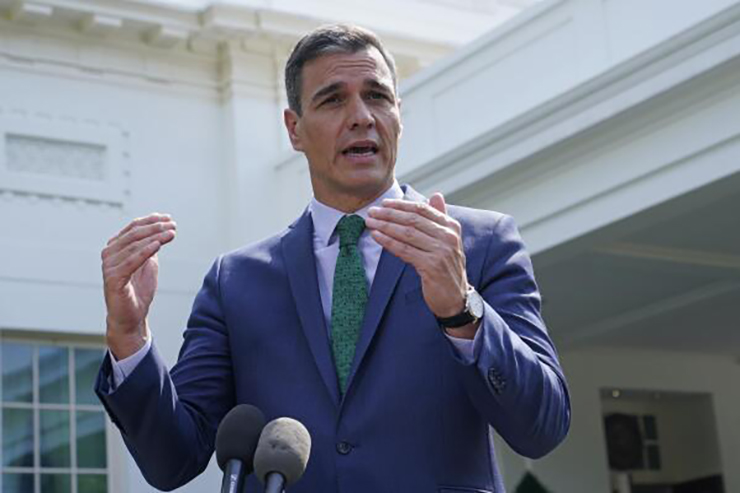
Speaking at a press conference on Monday, Sánchez remarked bluntly: “Spain, as you know, doesn’t have nuclear bombs, nor aircraft carriers, nor large oil reserves. We alone can’t stop the Israeli offensive. But that doesn’t mean we won’t stop trying, because there are causes that are worth fighting for, even if winning them isn’t in our sole power.”
The comments, widely interpreted as reckless, have drawn sharp condemnation across Spain’s political spectrum and provoked alarm in Israel. Critics argue the remarks fuel hostility, legitimize violent rhetoric, and expose Spain to charges of antisemitism.
According to the information provided in The Algemeiner report, Sánchez’s invocation of nuclear weapons struck a nerve among both allies and adversaries. Members of his own coalition worried aloud that framing Spain’s geopolitical limits in terms of atomic arsenals could embolden extremists while trivializing the existential threat faced by Israel.
The center-right Popular Party seized on the comments immediately. In a pointed rebuke, party officials asked: “A nuclear bomb on Tel Aviv? Is that what he intends to do?” Such language called attention to how Sánchez’s off-the-cuff remark was perceived; not as a metaphor but as a dangerous provocation.
The leader of the far-right Vox party, Santiago Abascal, went further, accusing Sánchez of aligning with terrorist movements and hostile regimes. “Sánchez would like to have nuclear weapons … but not to defend Spain. To defend Hamas. And probably Maduro as well,” Abascal wrote on X, referring to Venezuela’s Nicolás Maduro. “Cornered tyrants always end up losing their minds.”
Analysts cited in The Algemeiner report noted that Sánchez’s choice of words risks inflaming tensions not only with Israel but also with Spain’s NATO partners, who may see such rhetoric as irresponsible in the delicate context of nuclear deterrence.
The prime minister’s nuclear remark came on the heels of a series of aggressive measures unveiled last week targeting Israel. As The Algemeiner detailed, Sánchez announced: An arms embargo prohibiting all weapons sales to Jerusalem, a ban on certain Israeli goods, particularly those produced in West Bank communities, restrictions on air and sea routes, barring Israel-bound ships and aircraft carrying weapons from Spanish ports and airspace, and travel bans on Israeli officials accused by Madrid of complicity in “genocide,” including National Security Minister Itamar Ben-Gvir and Finance Minister Bezalel Smotrich.
Sánchez framed these steps as part of a moral obligation to “stop the genocide, pursue its perpetrators, and support the Palestinian population.”
For Jerusalem, however, these measures amounted to a wholesale diplomatic assault. The Algemeiner reported that Israel’s Foreign Minister Gideon Saar immediately recalled Spain’s ambassador and denounced Madrid’s actions as “hostile” and “antisemitic.”
In a sharply worded post on X, Saar wrote: “The government of Spain is leading a hostile, anti-Israel line, marked by wild, hate-filled rhetoric.” He accused Sánchez of attempting to distract from domestic corruption scandals by scapegoating Israel, a charge that has gained traction in Spain’s polarized political climate.
Israel also responded with retaliatory sanctions, barring Spain’s Deputy Prime Minister and Minister of Labor Yolanda Díaz and Minister of Children and Youth Sira Rego from entering the country or engaging with Israeli officials. Saar alleged that both ministers had propagated antisemitic rhetoric in the wake of the October 7, 2023, Hamas-led massacres in southern Israel, citing statements that called for Israel’s destruction and praised violence against civilians.
As The Algemeiner report highlighted, Israel’s diplomatic counterpunch illustrated the severity with which Jerusalem views Spain’s shift — no longer as criticism from a partner nation but as open alignment with Israel’s enemies.
Spain’s posture toward Israel has been steadily deteriorating since Hamas’s October 7 atrocities. While most Western democracies expressed solidarity with Israel in the aftermath, Madrid took the unusual step of suspending arms shipments from its defense industries to Israel and spearheading a diplomatic campaign to limit Israel’s military response.
In 2024, Sánchez’s government formally recognized a Palestinian state — a move that The Algemeiner report described as a “reward for terrorism” in the eyes of many Israeli officials. The decision, Sánchez argued, was intended to accelerate peace, but for Israel it amounted to legitimizing Hamas’s tactics of hostage-taking and massacre.
This latest round of sanctions and rhetoric represents, according to the report in The Algemeiner, the culmination of a year-long policy trajectory: Spain has positioned itself not merely as a critic of Israel but as one of its fiercest antagonists on the global stage.
Observers within Spain suggest Sánchez’s moves may be motivated as much by domestic politics as by foreign policy. With his coalition weakened by corruption allegations and mounting economic pressures, Sánchez appears to be rallying his base by championing causes popular among Spain’s far left.
According to the information contained in The Algemeiner report, his rhetoric mirrors the talking points of leftist parties and activist groups that have staged mass demonstrations against Israel in Madrid, Barcelona, and Valencia. By adopting maximalist positions, Sánchez bolsters his credentials among younger, progressive voters who increasingly sympathize with the Palestinian cause.
Yet this strategy carries significant risks. Analysts warn it alienates Spain’s Jewish community, estimated at around 45,000, and strains relations with Washington, where bipartisan support for Israel remains strong despite domestic debates over the Gaza war.
Sánchez’s remarks reverberated beyond Spain’s borders. The European Union, already struggling to maintain a common position on the Gaza conflict, now faces another rift. Brussels has sought to balance humanitarian concerns with recognition of Israel’s security imperatives, but Spain’s unilateral sanctions and extreme rhetoric undermine that effort.
The Algemeiner report noted that U.S. officials were particularly disturbed by Sánchez’s nuclear comment, interpreting it as an irresponsible flirtation with a taboo subject in international diplomacy. While Washington has not issued formal sanctions, insiders suggest that Spain’s credibility as a mediator in Middle East affairs has been severely compromised.
Commentators also pointed out the stark contrast between Spain’s current posture and the solidarity it received two decades ago after the March 11, 2004, Madrid train bombings, which killed nearly 200 people. Then, the international community rallied to Spain’s side, much as Israel expected solidarity after October 7.
Instead, Sánchez’s government has not only failed to stand with Israel but has sought to punish it — an inversion that The Algemeiner report described as “a profound betrayal of the shared struggle against Islamist terrorism.”
The controversy also fits into what The Algemeiner has frequently described as a broader pattern: the rise of “new antisemitism” in European politics, where Israel becomes the surrogate target for hostility that ultimately spills over into attacks on Jewish communities.
Spain has already seen a rise in antisemitic incidents linked to the Gaza conflict. Jewish organizations warn that Sánchez’s rhetoric, particularly invoking nuclear weapons and accusing Israel of genocide, legitimizes extremist narratives that put Jews at risk.
By invoking nuclear weapons in the context of Gaza, Prime Minister Pedro Sánchez has taken Spain’s anti-Israel rhetoric to new and dangerous levels. His comments, coupled with sweeping sanctions, bans, and diplomatic broadsides, have cemented Spain’s position as one of Israel’s fiercest critics in Europe.
As The Algemeiner has reported, the fallout has been swift: condemnation from Spain’s opposition parties, denunciations from Israel, and unease among Spain’s allies. For Sánchez, the political dividends at home may be fleeting, but the long-term damage to Spain’s credibility as a responsible international actor could endure.
For Israel, the message is clear: even in the heart of Europe, antisemitic hostility cloaked in the language of humanitarianism remains a potent threat. And as long as Spain’s government continues down this path, the prospect of constructive engagement between Jerusalem and Madrid seems more remote than ever.
“Sánchez would like to have nuclear weapons … but not to defend Spain. To defend Hamas. And probably Maduro as well,” Well said!