



|
Getting your Trinity Audio player ready...
|
By: Fern Sidman
In the hours after U.S. special forces carried out a stunning overnight operation to seize Venezuelan strongman Nicolás Maduro and his wife, the reaction from Jerusalem was swift, effusive and unmistakably historic. According to a report on Saturday at i24News, Israel’s senior leadership closed ranks behind President Trump, hailing the mission as a decisive blow for democracy and a moment of moral clarity in a world increasingly dulled by authoritarian impunity.
“This was not merely an arrest,” Israeli Foreign Minister Gideon Sa’ar declared in a statement carried prominently by i24News. “It was an act of leadership by the leader of the free world.” His words crystallized what many in Jerusalem were privately thinking: that Trump’s decision to deploy American power to dismantle one of the Western Hemisphere’s most entrenched narco-dictatorships may come to be remembered as a hinge moment in modern geopolitics.
As i24News reported throughout Saturday, the operation unfolded with cinematic precision. In a coordinated pre-dawn maneuver, U.S. special forces penetrated Caracas, extracted Maduro and Cilia Flores, and removed them from the capital before loyalist security units could react. By the time Venezuelans awoke, their long-feared ruler had vanished into U.S. custody.
Within hours, Trump appeared before reporters at his Mar-a-Lago estate, visibly energized. “This was one of the most stunning, effective and powerful displays of American military might and competence in American history,” he said, a remark broadcast repeatedly on i24News’ international feed.
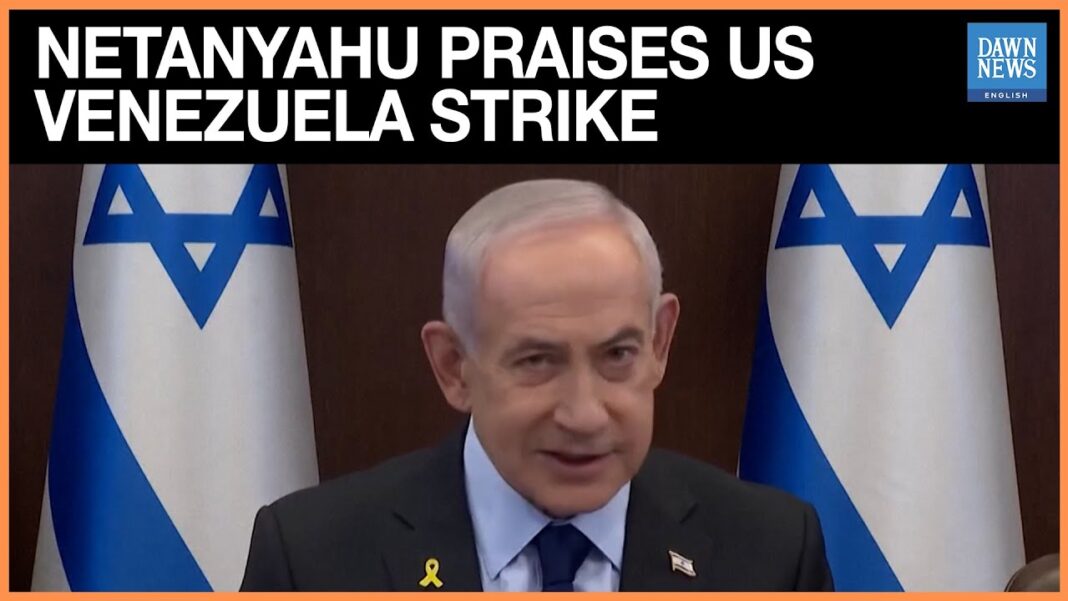
The Israeli reaction was immediate. Prime Minister Benjamin Netanyahu issued a message of personal praise to Trump, describing the operation as “bold and historic leadership on behalf of freedom and justice.”
“I salute your decisive resolve and the brilliant action of your brave soldiers,” Netanyahu said, according to the report at i24News. The prime minister’s language was not accidental. It deliberately echoed Israel’s own tradition of high-risk, morally framed counterterrorism and counter-dictatorship operations, from Entebbe to the capture of Adolf Eichmann.
For Jerusalem, Maduro’s removal was not a distant Latin American drama but a chapter in the global struggle between democratic sovereignty and what Israeli officials increasingly describe as a transnational axis of drugs, terror and corruption.
Foreign Minister Sa’ar articulated this connection with unusual bluntness, stating that Maduro had “led a network of drugs and terror” and that Israel “stands alongside the freedom-loving Venezuelan people, who have suffered under his illegal tyranny.” The phrasing, emphasized repeatedly by i24News, cast the Venezuelan crisis in language Israelis reserve for their own regional adversaries.
To Israeli ears, Maduro’s alliance with narco-cartels, Iranian proxies and Hezbollah cells operating in South America had long represented a festering strategic threat. As i24News has documented over the years, Venezuelan passports were allegedly sold to Middle Eastern terrorists, Iranian oil tankers docked in Venezuelan ports under sanction evasion schemes, and cocaine revenues coursed through opaque financial channels tied to the regime.
Trump’s operation, therefore, was perceived not only as a humanitarian intervention but as a surgical excision of a node in the global extremist ecosystem.
Perhaps the most striking element of the Israeli reaction was the revival of a phrase many thought had disappeared from the diplomatic lexicon: “leader of the free world.”
Sa’ar explicitly invoked it in his praise of Trump, a formulation highlighted in flashing chyrons on i24News. In doing so, Israel repositioned the American president not merely as a national actor but as a civilizational one.
This rhetorical elevation is especially noteworthy given the often-fraught nature of U.S.–Israeli relations over the years. Yet, as i24News analysts observed, Jerusalem has consistently found Trump to be uniquely attuned to Israel’s strategic worldview: a skepticism toward multilateral paralysis, a willingness to deploy force decisively, and a conviction that moral clarity must trump diplomatic timidity.
The implications of Maduro’s capture reverberated far beyond Venezuela and Israel. As one senior Israeli official told i24News on condition of anonymity, “Every autocrat who believes geography protects him from accountability just learned otherwise.”
In this sense, the operation was not merely punitive but pedagogical. It conveyed to Tehran, Damascus, Moscow and other authoritarian capitals that the United States—backed vocally by allies like Israel—is prepared to translate indictments into arrests, and resolutions into action.
Netanyahu’s language underscored this point. By praising the “decisive resolve” of Trump and the “brilliant action” of American soldiers, he effectively endorsed a doctrine of active enforcement of international criminal law, rather than its perpetual deferment.
i24News devoted significant airtime to the reactions of Venezuelan expatriates in Miami, Madrid and Jerusalem, many of whom celebrated openly in the streets. For years, they had watched their homeland implode under hyperinflation, food shortages, political repression and the systematic dismantling of democratic institutions.
Now, as Sa’ar put it, there was hope for “the return of democracy to the country and for friendly relations between the states.” The phrase was deliberate: Israel is already looking beyond the spectacle of Maduro’s fall toward a future strategic partnership with a post-dictatorship Venezuela.
For Trump, Netanyahu and Sa’ar alike, this was not merely a bilateral victory but the emergence of what one i24News commentator termed a “new axis of democratic resolve.” Unlike the rhetorical coalitions of past decades, this alignment is grounded in concrete action—military, legal and symbolic.
Trump’s praise for the mission as “one of the most stunning” in American history was mirrored by Netanyahu’s description of “historic leadership.” The convergence of language across Washington and Jerusalem signaled a shared understanding: that the era of impunity for tyrants is being deliberately, methodically dismantled.
As Maduro and his wife face the prospect of trial on U.S. soil, the world is left grappling with the magnitude of what has occurred. Yet for Israel, the moral verdict is already settled.
“This is a moment when the free world remembered who it is,” one Israeli diplomat told the network late Saturday night. “And when it acted accordingly.”
In that sense, the praise from Jerusalem was not merely diplomatic courtesy—it was a declaration of ideological kinship, a reminder that in an era of ambiguity and appeasement, there remain leaders willing to define tyranny as tyranny, and to do something about it.