



|
Getting your Trinity Audio player ready...
|
By: Fern Sidman
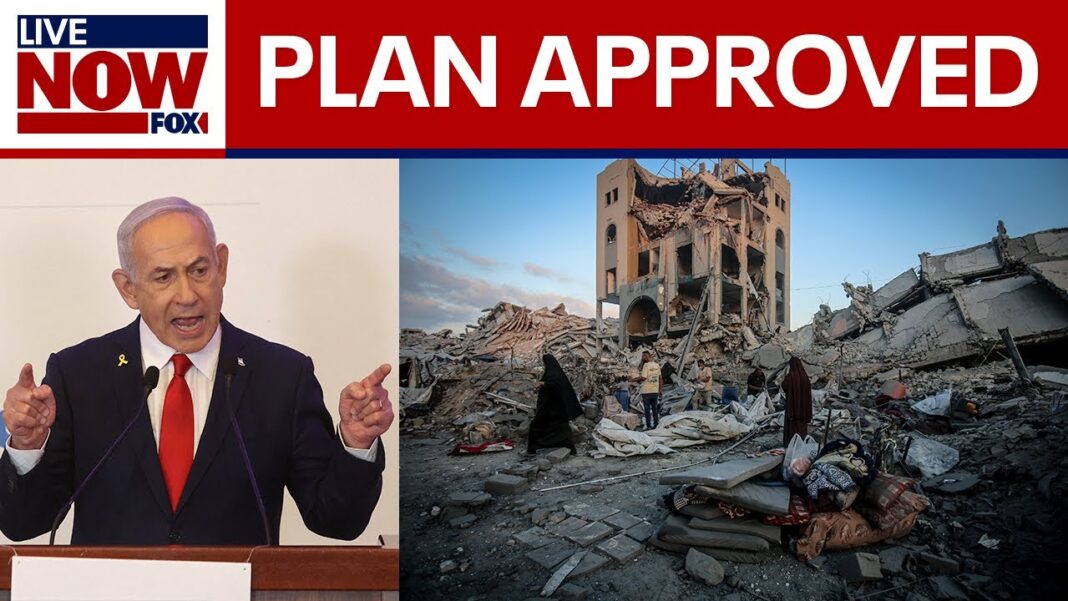
Shortly before dawn on Friday, the Prime Minister’s Office announced that the Israeli Security Cabinet had voted by what it described as a “decisive majority” to endorse Prime Minister Benjamin Netanyahu’s strategic plan to secure victory over Hamas — a plan that includes the Israel Defense Forces (IDF) taking direct control of Gaza City. The decision, according to the premier’s office, follows weeks of intense deliberations over how best to dismantle the terrorist group’s operational infrastructure while securing the release of hostages held since the October 7 attacks.
In a statement reported by The Jewish News Syndicate (JNS), Netanyahu’s office said the Cabinet had reviewed alternative proposals but concluded that “the alternative plan that had been submitted to the Security Cabinet would neither achieve the defeat of Hamas nor the return of the hostages.” The decision marks one of the most significant shifts in operational posture since the onset of the current conflict.
Under the approved plan, the IDF will begin preparations to take control of Gaza City — the largest urban center in the Strip and a longstanding Hamas stronghold — while simultaneously coordinating the distribution of humanitarian assistance to civilians located outside designated combat zones. According to the JNS report, Israeli officials emphasized that aid delivery would be tightly managed to ensure resources do not reach Hamas operatives.
One immediate logistical challenge stems from the fact that the U.S.-funded Gaza Humanitarian Foundation currently has no aid distribution facilities in Gaza City. This absence will require the establishment of new supply lines and secure delivery mechanisms capable of operating alongside IDF combat activities.
Netanyahu’s office outlined five guiding principles that were put to a vote and adopted as part of the Cabinet’s resolution. The JNS report indicated that they include disarming Hamas by dismantling its weapons stockpiles, manufacturing capabilities, and smuggling networks. It also includes returning all hostages – both living and deceased – to Israel, demilitarizing Gaza by removing any capacity for future large-scale attacks, ensuring that security threats are neutralized before they materialize and the establishment of an alternative civil administration – one that is neither Hamas nor the Palestinian Authority, but a governance structure considered non-hostile to Israel.
As the JNS report noted, these principles reflect the Israeli government’s dual objective of neutralizing Hamas militarily while shaping a post-war Gaza that cannot serve as a launchpad for future terrorist campaigns.
Earlier on Thursday, during an interview with Fox News anchor Bill Hemmer, Netanyahu confirmed that Israel intends to take control of the entire Gaza Strip in order to remove Hamas from power and then transfer civilian authority to a governance body not aligned with anti-Israel agendas.
When pressed directly on whether Israel planned to take control of all of Gaza, Netanyahu was unequivocal: “We intend to, in order to ensure our security.”
He added that the continuation of the war would focus on “removing Hamas there, enabling the population to be free of Gaza, and to pass it to civilian governance that is not Hamas and not anyone advocating the destruction of Israel.”
Framing the campaign as both a national and humanitarian imperative, Netanyahu told Fox News: “We want to liberate ourselves and liberate the people of Gaza from the awful terror of Hamas.”
The prime minister reiterated that Israel has no long-term interest in governing Gaza. “We want to have a security perimeter,” he explained. “We don’t want to be there as a governing body. We want to hand it over to Arab forces that will govern it properly, without threatening us, and giving Gazans a good life. That’s not possible with Hamas.”
The Security Cabinet’s decision comes amid a broader international environment that is increasingly complex. As JNS has reported, some Western allies — notably the United Kingdom, Canada, and France — have signaled reservations about extended Israeli operations in Gaza, while others in the European Union, such as the Czech Republic and Hungary, have remained firmly supportive of Israel’s right to act decisively against Hamas.
Domestically, the decision reflects a convergence among most Cabinet ministers on the necessity of an assertive military approach, though operational details and timelines will depend on the IDF’s ongoing assessments of battlefield conditions.
David Friedman, who served as U.S. ambassador to Israel during the Trump administration, highlighted the enduring consistency of Israel’s strategic objectives since the war began. Speaking to JNS, Friedman said: “Israel’s objectives in Gaza have been the same since Oct. 7 — defeat Hamas, such that it no longer threatens Israel or the people in Gaza, and recover all the hostages. These goals have not changed even for a single day.”
Friedman challenged critics of the decision to temporarily control Gaza, pointing to the absence of viable alternatives. “To those who criticize Netanyahu’s decision to control Gaza temporarily, what else should he do? There is no hostage deal on the table, and there is no willingness by Hamas to surrender. And the abandonment of Israel by the United Kingdom, Canada, and France, along with 27 Democrat senators, gives Hamas no incentive to make a deal.”
Military analysts cited by JNS have noted that seizing Gaza City would represent a major operational milestone, but one fraught with challenges. The urban density of the city, combined with the extensive network of tunnels and fortified positions constructed by Hamas, makes ground operations inherently risky and potentially prolonged.
Securing the city while ensuring that humanitarian aid reaches non-combatants will require precision planning and close coordination between military units and civilian agencies. The IDF will also need to manage the transition phase carefully to prevent a power vacuum that could be exploited by residual militant factions or criminal elements.
Netanyahu’s plan envisions the creation of a new civil administration for Gaza, drawn from Arab entities that are neither aligned with Hamas nor the Palestinian Authority. As JNS has previously reported, Israel’s leadership views this as a way to foster stability without directly assuming the burdens of governance, while ensuring that security threats are kept in check through continued Israeli oversight.
This approach mirrors, in part, the security framework that Israel maintains in Judea and Samaria, though the prime minister has emphasized that Gaza’s governance will ultimately be the responsibility of regional partners willing to uphold non-hostile policies.
From a strategic standpoint, the decision to move on Gaza City signals a shift from containing Hamas to seeking its outright dismantlement. The JNS report observed that this posture aligns with Israel’s long-term deterrence doctrine, which holds that security is best maintained through the elimination of immediate threats and the prevention of their resurgence.
It also sends a message to other hostile actors in the region, particularly Hezbollah and Iran, that Israel remains prepared to act unilaterally to secure its national interests, even amid international political pressures.
As the IDF prepares for the next phase of operations, the Security Cabinet’s decision represents a defining moment in Israel’s current campaign. By committing to take control of Gaza City within the framework of its five strategic principles, the government has set a clear course for both military and political objectives.
Whether this plan achieves its stated aims — the defeat of Hamas, the return of hostages, the demilitarization of Gaza, and the establishment of a viable post-conflict administration — will depend not only on battlefield outcomes, but also on Israel’s ability to navigate the complex humanitarian, diplomatic, and security challenges that lie ahead.
The coming weeks are expected to bring intensified military action, high-stakes diplomacy, and a critical test of Israel’s capacity to balance its security imperatives with the demands of international scrutiny and regional stability.
