



|
Getting your Trinity Audio player ready...
|
By: Fern Sidman
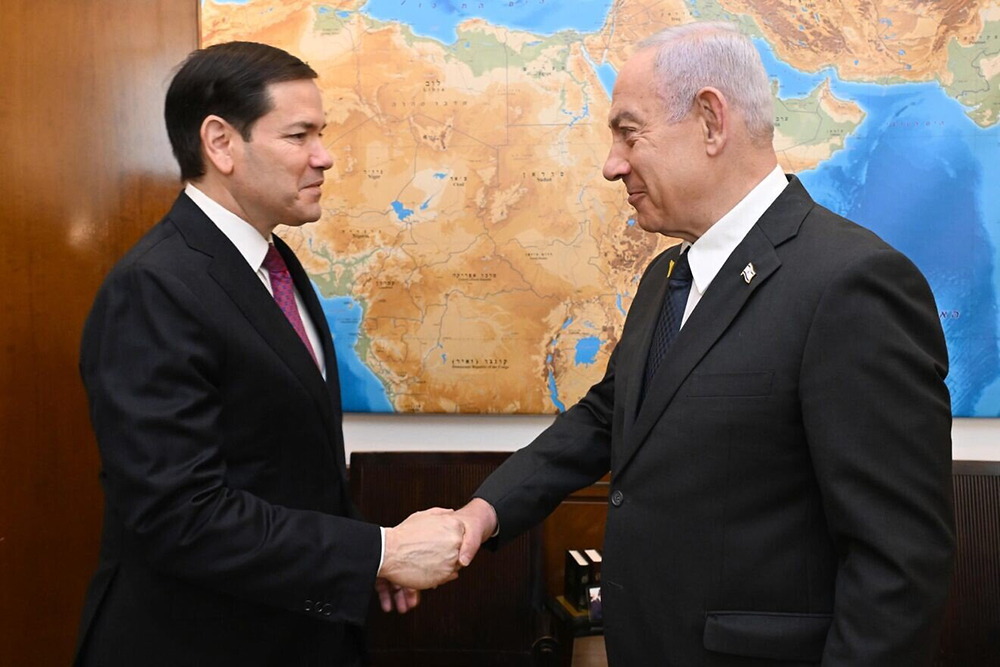
Secretary of State Marco Rubio landed in Israel on Sunday for a closely watched diplomatic mission, seeking to reaffirm Washington’s commitment to the Jewish state while navigating disagreements over recent Israeli military actions. The visit, which included a symbolic prayer at the Western Wall alongside Prime Minister Benjamin Netanyahu, underscores what observers describe as the enduring strength of the U. S.-Israel alliance under President Donald Trump’s administration.
According to a report on Sunday at The Jewish News Syndicate (JNS), Rubio made clear before departing Washington that his trip would focus on three core objectives: securing the release of the remaining hostages held by Hamas, ensuring humanitarian aid reaches civilians in Gaza, and addressing the ongoing threat posed by Hamas itself. “Hamas cannot continue to exist if peace in the region is the goal,” he declared, framing the group as the central obstacle to long-term stability.
Rubio’s first major stop came on Sunday afternoon in Jerusalem’s Old City, where he visited the Western Wall in the company of Netanyahu and U. S. Ambassador to Israel Mike Huckabee. The visit carried not only religious resonance but also political symbolism. As JNS reported, the two leaders offered a joint prayer for the hostages’ safety and added a special prayer in honor of President Trump, whom Netanyahu described as “a true friend of the Jewish people and the State of Israel.”
“The resilience and strength of the U. S.-Israel alliance is as enduring and strong as the stones of the Western Wall we just touched,” Netanyahu remarked. “Under President Trump, Secretary Rubio and all their team, this alliance has never been stronger, and we greatly appreciate it. Not only on behalf of the people of Israel today, but also on behalf of the generations of Jews who came before us, with the hope that we will rebuild our nation with friends like you.”
After their prayers, Rubio and Netanyahu placed handwritten notes in the Wall’s crevices before touring the archaeological tunnels below the ancient plaza, a tradition that foreign dignitaries often undertake to underscore solidarity with Israel’s historic and spiritual roots.
Tommy Pigott, principal deputy spokesperson for the State Department, told reporters that Rubio’s agenda is broader than the immediate crisis in Gaza. “He will convey America’s priorities in the Israel-Hamas conflict and broader issues concerning Middle Eastern security, reaffirming U. S. commitment to Israeli security,” Pigott said in comments reported by JNS.
Among the key talking points: America’s opposition to what Rubio termed “anti-Israel actions,” including international attempts to unilaterally recognize Palestinian statehood. He was also expected to raise the issue of lawfare, as Israel is currently battling simultaneous cases at The Hague — with the International Criminal Court issuing arrest warrants against Netanyahu and former Defense Minister Yoav Gallant, and the International Court of Justice hearing South Africa’s allegations of genocide against the Jewish state.
According to the information provided in the JNS report, Rubio will also use his meetings to reiterate U. S. opposition to any moves that would “reward Hamas terrorism,” warning that premature recognition of a Palestinian state could embolden extremists rather than promote peace.
Despite the clear alignment on most strategic objectives, Rubio did not shy away from acknowledging tensions. Speaking to reporters ahead of his departure, he admitted that Washington was “not happy” about the Israeli strikes in Doha that targeted Hamas leaders. “Obviously, we’re concerned that events last week — President Trump didn’t like the way it went down,” Rubio said.
Nevertheless, he emphasized that this disagreement would not fracture the bilateral alliance. “Sometimes things happen or come up in those relationships that perhaps we’re not 100 percent aligned with, or unhappy. But it’s not going to change the nature of our relationship with the Israelis,” Rubio explained. The critical question, he added, is how the strike will impact negotiations for the release of hostages and the prospects for a ceasefire.
According to the JNS report, this careful balance — recognizing U. S. discontent with the strike while reaffirming unwavering support for Israel’s security — reflects the delicate diplomacy Rubio must manage on this trip.
For Rubio, the key to any future peace lies in dismantling Hamas. “At the end of the day, when all is said and done, there is still a group called Hamas, which is an evil group that still has weapons and is terrorizing,” he said. “There are still 48 hostages that deserve to be released immediately, all at once. And there is still the hard work ahead of, once this ends, of rebuilding Gaza in a way that provides people a quality of life that they all want.”
His comments highlight the dual challenge Israel faces: the immediate priority of freeing hostages, and the longer-term task of shaping Gaza’s postwar reality. Rubio noted that key questions remain unresolved: who will oversee reconstruction, who will finance it, and what governance structures will replace Hamas once it is dismantled.
Rubio’s trip comes amid mounting international pressure on Israel. As the JNS report observed, several European countries — including France and Britain — are moving toward recognizing a Palestinian state, a step Israel has vehemently opposed. Netanyahu has warned that such recognition would amount to “a prize for terror” and undermine any prospects for a negotiated solution.
Rubio echoed those concerns, warning that unilateral moves by international actors risk emboldening Hamas. “We need to ensure that recognition of Palestinian statehood is not used as a reward for terror or violence,” he said.
The secretary’s itinerary reflects the regional stakes: after his meetings in Israel, Rubio is scheduled to travel with President Trump to Britain for talks, and later participate in high-level discussions at the United Nations General Assembly in New York, where debates over Palestinian recognition are expected to dominate.
Rubio’s presence at the Western Wall carried a personal weight as well. For American officials, especially those in Republican administrations, visits to holy sites in Jerusalem often serve as both expressions of faith and demonstrations of solidarity. By praying alongside Netanyahu and Ambassador Huckabee, Rubio sought to visibly project unity at a time when Israel faces isolation on the international stage.
According to the information contained in the JNS report, Netanyahu framed the moment as a reminder that Jewish hopes for security and sovereignty have always relied on alliances with steadfast partners. “With friends like America, under leaders like President Trump and Secretary Rubio, we stand stronger,” the prime minister said.
On Monday, Rubio is expected to meet separately with Israeli President Isaac Herzog and Foreign Minister Gideon Sa’ar. These sessions are expected to delve into both security and diplomatic issues, from the daily realities of the war to Israel’s strategy for handling growing international criticism. JNS noted that Herzog, in particular, has taken a leading role in articulating Israel’s case to the global community, serving as a bridge between Netanyahu’s government and foreign capitals.
Rubio’s discussions with Sa’ar are likely to focus on legal and diplomatic challenges at the ICC and ICJ, as well as strategies to blunt Palestinian efforts to win recognition at the UN.
This is Rubio’s second trip to Israel in 2025, following his February visit as part of a broader Middle East tour. That journey laid the groundwork for discussions on regional cooperation, but the situation has since deteriorated, with renewed fighting in Gaza, escalations on the Lebanese front, and Israel’s controversial strike in Qatar.
As the JNS report emphasized, the timing of this second visit underscores Washington’s determination to remain engaged at the highest levels, even as disagreements arise. “Rubio’s presence in Jerusalem signals that the U. S. sees the outcome of the Israel-Hamas conflict as central to its broader Middle Eastern strategy,” the outlet observed.
Secretary of State Marco Rubio’s visit is at once a gesture of solidarity and a mission of delicate diplomacy. His prayers at the Western Wall, his public embrace of Israel’s security concerns, and his candid acknowledgment of differences over recent Israeli actions reflect the complexity of an alliance that is both deeply rooted and constantly tested.
Rubio’s message is clear: disagreements will arise, but the U. S.-Israel partnership remains unshakable. The focus now turns to whether his meetings in Jerusalem can deliver tangible progress on the most urgent issues — the return of hostages, the defeat of Hamas, and the blueprint for a postwar Gaza.
