



|
Getting your Trinity Audio player ready...
|
By: Fern Sidman – Jewish Voice News
In newly released footage broadcast by Channel 13 News, Israel has been offered a rare and gripping glimpse into the battlefield valor of Roman Gofman—the man set to become the next head of the Mossad. The video, stark and unembellished in its raw clarity, documents Gofman’s direct confrontation with Hamas terrorists during the October 7 attacks—an episode that Israel National News described in a report on Sunday as “exemplary of field leadership under the most extreme duress.”
Worthy Leader: Israeli media has published footage of Roman Gofman – recently tapped to be the head of the Mossad – battling Hamas forces at Shaar Hanegev Junction during the October 7th massacre. @RomanGofman2 @mossad #October7Massacre #Hamas @Israel pic.twitter.com/veRLArGLip
— The Jewish Voice (@TJVNEWS) December 7, 2025
On that horrific morning, Gofman was serving as commander of the National Ground Training Center (MLI) at the Tze’elim military base. The footage, reviewed by Israel National News, captures the decisive moment when he charged toward an armed terror cell at the Sha’ar Hanegev intersection. Without hesitation, and in full recognition of the mortal danger ahead, Gofman raised his weapon and opened fire, eliminating several terrorists in a rapid exchange that speaks volumes about his instincts, his courage, and his profound sense of responsibility.
The Sha’ar Hanegev intersection was one of many points where Hamas operatives sought to push deeper into Israeli communities, committing massacres whose brutality the world continues to grapple with. According to the information provided in the Israel National News report, Gofman’s actions came at a critical moment when the terrorists were moving to expand their assault corridor. Instead of retreating or calling for cover, the incoming Mossad chief launched into a full-force counterattack.
Security footage aired by Channel 13 News and cited in the INN report shows Gofman sprinting across open ground, rifle shouldered, firing with precision. The scene is chaotic: terrorists duck for cover behind vehicles, gunfire ricochets across the asphalt, and smoke thickens the air. Yet the future intelligence chief advances with unmistakable resolve.
During the firefight, Gofman was struck by enemy fire. Despite his injuries, he continued fighting until additional responders arrived—an act that the Israel National News report characterized as “consistent with a military career defined by utter devotion to the mission and to the safety of Israeli civilians.”
The man who saved the life of Israel’s next Mossad director was not a soldier, but a paramedic: Moshe Weizman, an ambulance driver and veteran of Ihud Hatzalah—one of Israel’s most indispensable emergency response organizations.
In an interview carried by Israel National News, Weizman offered rare details from the rescue. When he reached Gofman, the commander was wounded but conscious, introducing himself simply as “Roman” and identifying his position at the Tze’elim base. Weizman immediately began treating him while coordinating with dispatch, all under the threat of continued terrorist gunfire in the area.
“He had a gunshot wound,” Weizman recalled. “I kept him conscious throughout the evacuation.”
The rescue was anything but routine. Weizman was forced to navigate a chaos-ridden landscape while maintaining continuous communication with United Hatzalah headquarters. Assistance arrived from medic Elyashiv Mizrahi, who had just dropped off wounded Israelis at Barzilai Hospital using his private car—an act that the Israel National News report praised as emblematic of the improvisational heroism seen across the country on that day.
Together, Mizrahi and Weizman stabilized Gofman and brought him to Barzilai Hospital in Ashkelon, where the wounded commander underwent emergency treatment. Both rescuers later suffered injuries themselves during the prolonged aftermath of the terror onslaught.
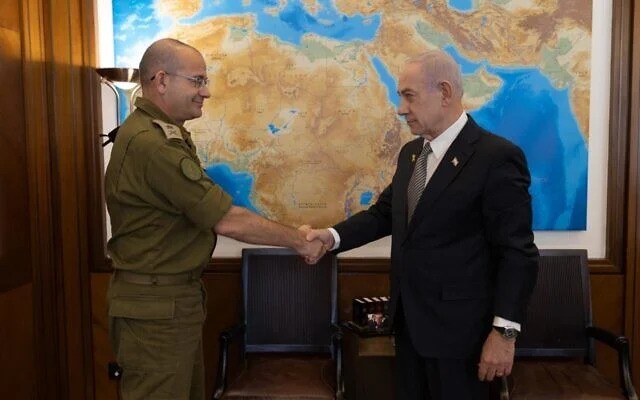
Israel’s announcement that Roman Gofman would be appointed the next director of the Mossad has drawn significant national interest—not only because of the Mossad’s critical role, but because of the newly surfaced footage demonstrating that the incoming chief did not merely supervise defenses from afar on October 7. He fought.
The Israel National News report emphasized that at a moment when Hamas terrorists sought to penetrate Israeli communities in a coordinated wave of murder, kidnapping, and arson, Gofman was not behind a desk managing the crisis from a secure facility. He was in the line of fire, rifle in hand, acting on instinct and duty.
This positioning matters. Israel’s intelligence agencies operate under immense pressure, often tasked with anticipating and preventing the unimaginable. Leadership of the Mossad—a position that requires a blend of strategic insight, moral clarity, operational daring, and psychological stamina—demands more than polished credentials. It demands lived experience in confronting threats at their most brutal and immediate.
For many Israelis, the video aired by Channel 13 has cemented Gofman’s reputation as a leader who understands firsthand the nature of the enemy Israel continues to face.
The October 7 attacks stand as a watershed moment in modern Israeli history. The assault, the deadliest day for Jews since the Holocaust, exposed vulnerabilities in Israel’s defense apparatus and triggered a deep national reckoning. In the months since, Israelis have expressed widespread frustration with political leaders, intelligence assessments, and military preparedness.
Against this backdrop, Gofman’s documented bravery serves not only as a personal testament but as a symbolic counterpoint: a reminder that amid the failures of institutions, individual heroism still emerged with unmistakable clarity. The Israel National News report framed his battlefield leadership as an example of “courage that cannot be manufactured, predicted, or taught—only revealed.”
Perhaps the most poignant testament to Gofman’s character came from the man who carried him from the battlefield. Weizman, still recovering from injuries of his own, expressed deep respect for the wounded commander, even though the two have not spoken since that day.
“I wish him great success in his new role,” Weizman told reporters—a sentiment that resonates across much of Israel. The fact that the rescuer himself has been unable to return to duty due to his own rehabilitation only deepens the emotional weight of his words.
As Gofman prepares to assume leadership of the Mossad, the release of this footage has fundamentally altered public perception of him. No longer is he simply a name on an appointment list or a figure emerging from military anonymity. He has become a symbol—of fortitude, of presence under fire, and of leadership forged in moments of existential peril.
The Israel National News report indicated that his actions are emblematic of the spirit Israel seeks in its top security leadership amid ongoing threats from Hamas, Hezbollah, Iran, and regional proxies. His firsthand confrontation with terrorists on October 7 is expected to influence not only his command style but also the national expectations placed upon him.
The video captured at the Sha’ar Hanegev intersection reveals more than a commander under pressure. It reveals a man who embodies the qualities Israelis most need in this era of volatility: courage, decisiveness, and unwavering commitment.
As the Israel National News report observed, Roman Gofman’s battlefield actions “foreshadow the kind of leadership Israel requires in the years ahead—unyielding in the face of terror and grounded in the lived reality of defending the Jewish state.”
And for a nation still healing from October 7, the emergence of such a leader could not be more timely.