



|
Getting your Trinity Audio player ready...
|
By: Fern Sidman
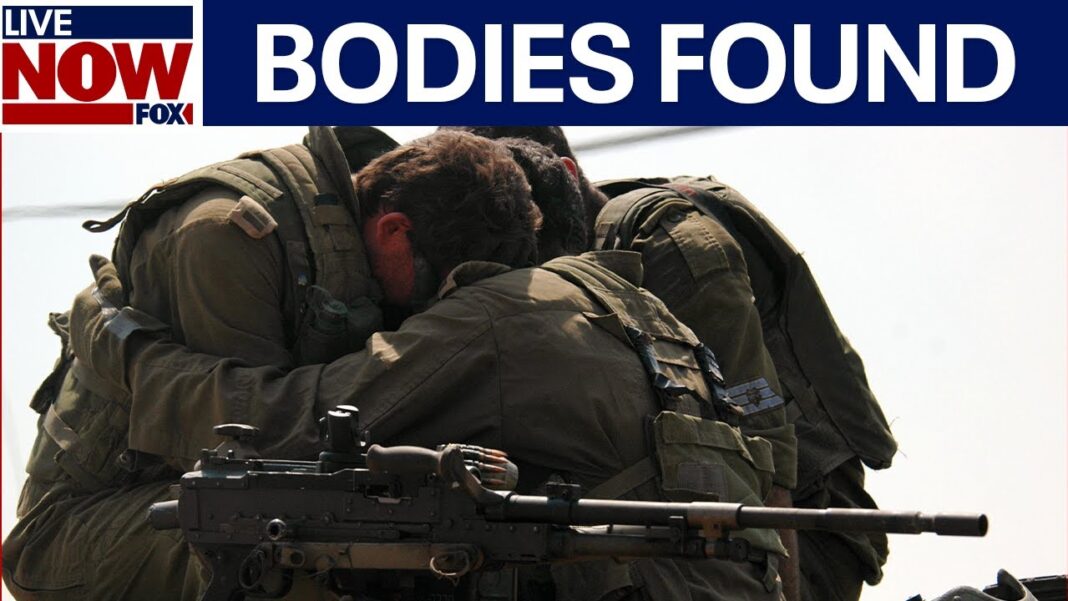
As Israel finds itself entangled in a complex and widening regional war, the discovery and recovery of the bodies of three Israeli hostages taken by Hamas has drawn the nation’s collective gaze sharply back to the war in Gaza. The Israeli government announced on Sunday that the remains of Yonatan Samerano, Ofra Keidar, and Shay Levinson, all abducted during the October 7 massacre, had been retrieved and identified. Their deaths—confirmed months after their families were left in limbo—have reignited painful memories of Hamas’s brutal attack and the staggering human toll still being reckoned.
As The New York Times reported on Sunday, the announcement has cut through the fog of escalating geopolitical developments—chiefly Israel’s intensifying confrontation with Iran—to re-center public discourse on the emotional and strategic heart of the Gaza conflict: the unresolved fate of the hostages. The war in Gaza, now overshadowed by missile exchanges and diplomatic ruptures with Tehran, has not ceased; it has simply slipped from the headlines. These three recovered bodies, the government’s announcement made clear, are a grim reminder that the original trauma has not yet ended.
The Israeli military confirmed that Yonatan Samerano, 21, was among those killed and abducted on October 7. A young man with a passion for music, he had been attending the Tribe of Nova music festival—an event transformed into a killing field by Hamas gunmen. As The New York Times reported in its initial coverage of the attack, hundreds were gunned down that day in a massacre that became emblematic of Hamas’s deliberate targeting of civilians.
Samerano fled the festival with friends, seeking safety in nearby Kibbutz Be’eri, only to be pursued and killed. Graphic security footage reviewed by Israeli investigators—and referenced by The New York Times—shows Hamas operatives shooting into the vehicle in which he was hiding, and later dragging his body into a van. His fate had remained unknown until now.
Also among the dead was Ofra Keidar, 70, a retired teacher and beloved member of the Be’eri community. She had gone out for her morning walk, unaware that Hamas militants had already infiltrated the kibbutz. Her husband, Shmuel Keidar, was murdered in their home. Both were among the roughly 100 people killed in Be’eri, according to figures corroborated by The New York Times.
The third victim, Shay Levinson, 19, was an active-duty Israeli tank commander. His body was recovered with the others in what the Israel Defense Forces described as a targeted and intelligence-driven operation. Levinson, who held dual German-Israeli citizenship, was commemorated on Sunday by German Ambassador Steffen Seibert, who wrote on social media: “Our hearts are with his family and all others waiting for their loved one’s return. There must be a deal to get them out and end this war.”
While attention in recent weeks has shifted to the rapidly deteriorating standoff between Israel and Iran, the war in Gaza has continued without pause.
Hamas’s ongoing use of civilian areas for military operations has drawn continued criticism from Israeli officials, who argue that the group’s strategy is designed to maximize civilian casualties for propaganda purposes. Despite international pressure, The New York Times reported that Israel has resumed offensive operations in the southern Gaza Strip following the breakdown of a two-month cease-fire in March.
That earlier truce had resulted in the release of 30 Israeli hostages and the recovery of eight bodies, in exchange for the release of more than 1,000 Palestinian prisoners, many of them affiliated with Hamas. But efforts to negotiate a new deal—spearheaded in part by the Trump administration—have largely collapsed. According to The New York Times report, while the U.S. successfully secured the release of Edan Alexander, the last living American hostage, hopes for a broader agreement evaporated amid Hamas’s intransigence.
The recovery of these three bodies has only intensified the national anguish over the fate of the approximately 50 hostages still believed to be held in Gaza. Israeli officials estimate that roughly 20 are alive, while the rest are presumed dead. For many Israelis, the hostage issue has come to embody the moral urgency of continuing military operations in Gaza.
As The New York Times editorialized earlier this year, the hostage crisis is a profound stain on the conscience of the international community. While critics have assailed Israel for its conduct in Gaza, there has been comparatively little global outrage over Hamas’s deliberate kidnapping, concealment, and exploitation of civilians—including children, women, and the elderly.
For Israel, the existence of these hostages—dead or alive—remains not only a national trauma but also a strategic vulnerability. Hamas has consistently used their bodies, both living and dead, as bargaining chips, thwarting efforts at humanitarian resolution and using civilian suffering as leverage.
Sunday’s announcement has prompted a renewed wave of grief and remembrance in Israel, even as air-raid sirens continue to wail in the country’s north and the specter of a wider war looms large. In cities and towns across the country, impromptu memorials have emerged for Samerano, Keidar, and Levinson—three lives representing the breadth of Hamas’s indiscriminate cruelty.
As The New York Times noted in its Sunday coverage, “The war in Gaza may be eclipsed by broader regional tensions, but for the families of the hostages—and for a nation still trying to make sense of October 7—the suffering has never receded. It has simply been buried, waiting to resurface.”
Indeed, the return of these three bodies serves as a stark reminder that the war in Gaza is not a distant campaign or a forgotten headline. For Israel, it remains deeply personal—a war not just of survival, but of memory. And in that war, every hostage, every name, and every home left empty is a battle that has yet to be resolved.
