



|
Getting your Trinity Audio player ready...
|
By: Fern Sidman
President Donald Trump has once again placed himself squarely at the center of escalating tensions between Washington and Tehran, asserting that direct U.S. pressure has already altered the behavior of Iran’s embattled leadership. In a series of interviews this week, Trump claimed that Iranian authorities canceled hundreds of planned executions after he warned of overwhelming American military retaliation, a revelation that has intensified global scrutiny of Iran’s internal crackdown and revived debate over the effectiveness—and risks—of coercive diplomacy.
According to a report on Wednesday at Israel National News, Trump’s remarks came amid visible U.S. military movements in the Middle East, including the repositioning of aircraft carriers and F-15 fighter jets, moves widely interpreted as signals of deterrence rather than preparation for immediate conflict. Yet the president’s language, blunt and characteristically unvarnished, left little doubt about the stakes he believes are involved.
In an interview with CNBC on Wednesday, Trump was asked whether the redeployment of American military assets represented a prelude to further action against Iran. His response focused not on military maneuvers but on what he described as a dramatic reversal by Tehran following his warnings. “We hope there’s not going to be further action,” Trump said, as quoted by Israel National News. “They were shooting people indiscriminately on the streets and they were going to hang 837, mostly young people.”
Trump claimed that those executions were halted after he made clear that the United States would “hit them very hard” if Iranian authorities continued harming protesters. While the White House has not released independent confirmation of the alleged cancellation of executions, the assertion itself has reverberated widely, adding a new layer to the already volatile confrontation between the Trump administration and the Islamic Republic.
The claim also underscores Trump’s long-standing belief in the power of unmistakable threats as a tool of statecraft—an approach he has defended repeatedly as more effective than prolonged diplomacy or multilateral pressure alone.
Beyond Iran’s internal repression, Trump used the CNBC interview to reiterate a core demand of his foreign policy toward Tehran: an end to its nuclear ambitions. “They gotta stop with the nuclear,” he said bluntly, according to the Israel National News report.
The statement aligns with Trump’s broader posture since withdrawing the United States from the Joint Comprehensive Plan of Action (JCPOA), the 2015 nuclear deal, during his first term. Trump has consistently argued that Iran’s nuclear program represents an existential threat not only to Israel but to regional and global stability—and that Tehran exploits negotiations to buy time while advancing its capabilities.
Israel National News has repeatedly reported on Israeli officials’ parallel concerns that Iran’s nuclear program, combined with its regional proxy network, poses an unprecedented strategic danger. Trump’s renewed emphasis on the nuclear issue signals that, even amid domestic unrest inside Iran, Washington remains focused on preventing Tehran from crossing the nuclear threshold.
Trump’s rhetoric sharpened further in a separate interview Tuesday night with NewsNation, where he addressed reports that Iranian authorities continue to employ extreme violence against protesters and have issued threats against his own life.
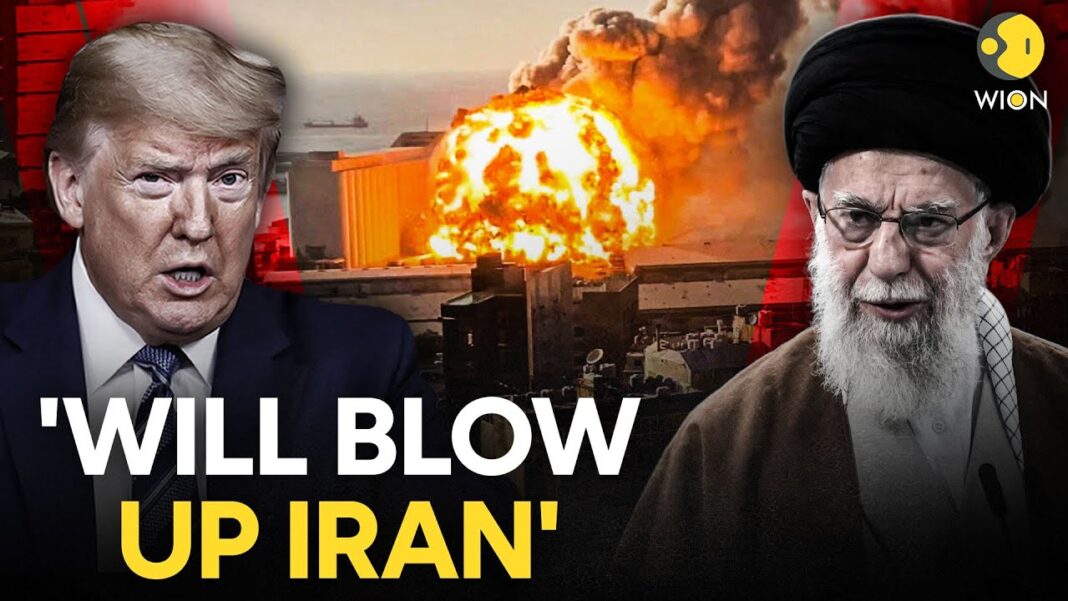
Asked by host Katie Pavlich about allegations that Iranian forces were burning protesters alive and about reports of an assassination threat against him, Trump responded with language that left little room for ambiguity. “Well, they shouldn’t be doing it,” he said, according to the Israel National News report, before adding: “I’ve left notification: Anything ever happens, the whole country is going to get blown up.”
He went further still, stating that he had issued “very firm instructions” that if Iran acted on any assassination threat or escalated its violence, “they’re going to wipe them off the face of this earth.”
Such remarks, while shocking in tone, are consistent with Trump’s long-standing strategy of deterrence through maximal clarity. Supporters argue that this approach has, in the past, constrained adversaries by removing any doubt about U.S. resolve. Critics counter that such language risks escalation and miscalculation, particularly in a region already prone to conflict.
As Trump made his claims, Iran’s state television released its first official figures regarding the death toll from the mass protests that have swept the country. According to the report, a total of 3,117 people have been killed, including 2,427 civilians and members of the security forces.
The announcement marked a rare acknowledgment by Iranian authorities of the scale of unrest and violence. Yet the figure stands in stark contrast to estimates from human rights organizations, which have long argued that the true number of deaths is significantly higher.
Israel National News has reported that independent verification of casualty figures remains nearly impossible due to Iran’s severe restrictions on media access, its intermittent internet shutdowns, and the intimidation of families and witnesses. Human rights groups claim that many deaths go unreported, particularly in provincial areas where protests have been met with especially brutal force.
The discrepancy between official and independent figures has become emblematic of the broader information war surrounding Iran’s crisis—a war in which narratives are as contested as facts.
Trump’s comments have reignited debate over the so-called “Trump Doctrine” in foreign policy: a belief in overwhelming deterrence, public red lines, and a willingness to personalize state-to-state conflict in ways previous administrations avoided.
Israel National News has frequently analyzed how this approach resonates in Jerusalem, where leaders have long warned that ambiguity toward Iran invites aggression. From this perspective, Trump’s explicit threats—however incendiary—are seen as reinforcing a deterrent posture that Iran understands and fears.
Indeed, Trump’s assertion that Iran canceled mass executions because of U.S. pressure, if accurate, would represent a striking example of deterrence affecting internal policy rather than external behavior alone. Even if disputed, the claim has already shaped international discourse, forcing observers to consider whether rhetorical force can, under certain conditions, restrain even the most ideologically rigid regimes.
The implications of Trump’s remarks extend far beyond Washington and Tehran. Israel National News has noted that regional actors—including Israel, Gulf states, and European governments—are watching closely to see whether Iran moderates its behavior or doubles down in defiance.
For Israel, the convergence of Iran’s internal instability, its nuclear ambitions, and its hostility toward the Jewish state represents a volatile and potentially transformative moment. Israeli officials have repeatedly stated that a weakened or distracted Iranian regime could either reduce immediate threats or, conversely, act more recklessly to reassert control.
For Europe, Trump’s warnings complicate already strained efforts to salvage diplomatic engagement with Tehran. European leaders, wary of both Iranian repression and regional war, now face the challenge of navigating between Trump’s confrontational stance and their own preference for multilateral restraint.
At its core, Trump’s strategy appears to rest on a calculated gamble: that Iran’s leadership, confronted with unmistakable consequences, will choose survival over escalation. Israel National News has pointed out that this gamble has precedent in Trump’s previous dealings with adversaries such as North Korea, where dire threats were followed by unprecedented diplomatic engagement.
Whether a similar trajectory is possible with Iran remains deeply uncertain. The ideological foundations of the Islamic Republic, its entrenched security apparatus, and its revolutionary self-image distinguish it sharply from other adversaries Trump has confronted.
As protests continue, death tolls remain contested, and military assets shift across the region, one reality is clear: the confrontation between the United States and Iran has entered a new and dangerous phase.
Trump’s claims—that executions were halted, that nuclear ambitions must cease, and that retaliation would be absolute—have set unmistakable red lines. Whether those lines deter further violence or precipitate escalation will shape not only the future of Iran’s protest movement but the stability of the Middle East itself.
For now, the world watches an uneasy standoff—one defined by firebrand rhetoric, human suffering, and the enduring question of whether fear or diplomacy will ultimately dictate Iran’s next move.
