



|
Getting your Trinity Audio player ready...
|
Edited by: TJVNews.com
Public discontent over Prime Minister Benjamin Netanyahu’s management of the ongoing hostage crisis has reached a new high, according to recent polling and widespread demonstrations, with criticism centering on both his refusal to accept personal responsibility for the events of October 7th and his handling of subsequent military and diplomatic efforts.
As reported by Jewish Breaking News, a new survey conducted by the Israel Democracy Institute reveals that 87% of Israelis believe Netanyahu should take personal responsibility for the catastrophic intelligence failures that allowed Hamas to launch its deadly attack. Nearly half of respondents — 48% — believe the prime minister should resign immediately, while an additional 25% say he should step down once the current war concludes. Only 10% expressed confidence that his current strategy in Gaza would yield a favorable outcome.
The poll results indicate that dissatisfaction extends beyond Netanyahu’s critics on the left. Jewish Breaking News notes that even within the prime minister’s political base, a significant portion of Likud supporters — 61% — would endorse a hostage-release agreement that included a full withdrawal from Gaza. Netanyahu, however, has consistently rejected such a condition, maintaining that any military pullback would undermine Israel’s long-term security and embolden Hamas.
According to the information provided in the Jewish Breaking News report, tensions within Israel’s leadership reached a boiling point late Friday night during a tense 10-hour meeting of the security cabinet. The session concluded with the approval of a plan granting Netanyahu full military control over Gaza City. The decision reportedly came over the objections of IDF Chief of Staff Lt. Gen. Eyal Zamir, who expressed deep concern for the safety of the hostages should such an operation proceed.
The meeting’s outcome has further inflamed public debate, as critics argue that Netanyahu is prioritizing military objectives over the urgent need to secure the hostages’ release. Proponents of a negotiated agreement warn that military escalation could diminish any remaining leverage Israel holds in its delicate talks with Hamas and other mediators.
In the wake of the cabinet decision, Jewish Breaking News documented large-scale protests in Tel Aviv on Saturday night, with thousands of demonstrators taking to the streets waving Israeli flags and carrying placards bearing the faces of those still held captive in Gaza. Many protesters directed their appeals to President Donald Trump, urging him to step in and broker a resolution to the crisis.
Among those making a public plea was former hostage Eliya Cohen, whose emotional testimony has resonated widely. “President Trump, thank you for bringing me home, but please, help us get a deal that brings everyone home now,” Cohen told the crowd. He recounted his 505 days in captivity alongside fellow hostages Eli Sharabi, Or Levy, and Alon Ohel, the latter of whom remains in Hamas custody.
“When Eli, Or, and I were released from captivity, you were all shocked,” Cohen said, recalling the images that circulated worldwide of their frail and emaciated condition. “The world trembled when you saw our pain-filled eyes. We spoke about the hunger, the conditions. We pleaded for help for those left behind — for Alon Ohel, whom I left alone in the tunnel, wounded. I was the last person to look him in the eyes and promise him, ‘Until we meet again in Israel, this isn’t over.’”
Perhaps the most politically damaging finding for Netanyahu is that most Israelis credit Trump rather than their own prime minister for securing the release of hostages in recent months. The survey shows an overwhelming 85% of respondents believe Trump played a major role in bringing captives home, compared with just 41% who attribute similar credit to Netanyahu.
The data underscores a growing perception that Netanyahu’s diplomatic maneuvering has been ineffective, particularly when contrasted with the high-profile interventions credited to Trump. This perception persists even among some of Netanyahu’s long-standing supporters, suggesting a shift in public sentiment that could have lasting political implications.
The Jewish Breaking News report also highlighted a nuanced view among Israelis regarding Trump’s steadfastness as an ally. Roughly half of those surveyed believe Trump is unlikely to turn against Israel even if disagreements arise over specific policy matters. However, nearly 40% of respondents say there is a real possibility that future policy clashes could prompt a reassessment of U.S. support.
This dual perception reflects both a deep appreciation for Trump’s role in the hostage negotiations and a pragmatic recognition of the shifting geopolitical landscape in which Israel must operate. For Netanyahu, it also presents a strategic challenge: balancing the reliance on international partners — particularly Washington — with domestic expectations for decisive, independent leadership.
As the Jewish Breaking News report emphasized, the growing unrest represents one of the most serious challenges to Netanyahu’s political standing in recent years. The combination of public anger over the October 7th attack, dissatisfaction with the ongoing war strategy, and frustration over the unresolved hostage crisis has created a rare alignment of criticism across the political spectrum.
For many Israelis, the prime minister’s refusal to acknowledge personal accountability for the intelligence failures that preceded the Hamas assault has become a focal point of discontent. Political analysts note that in times of national crisis, public confidence often hinges on leaders’ willingness to own mistakes — a quality Netanyahu’s critics say has been conspicuously absent.
Meanwhile, the situation on the ground in Gaza remains fluid. With the Israeli military expanding operations in and around Gaza City, the risk to hostages increases, and the window for a negotiated settlement narrows. Jewish Breaking News reported that humanitarian concerns, international diplomatic pressure, and internal political divisions are all converging to shape the next phase of the conflict.
Looking forward, the prime minister faces a delicate balancing act. He must contend with an increasingly restive public demanding action on the hostages, while also pursuing his stated military objectives in Gaza. The divergence between his approach and the preferences of a majority of Likud voters — as reflected in the Jewish Breaking News poll — suggests that political fallout could extend well beyond the conclusion of the war.
Whether Netanyahu will adapt his strategy to address these mounting pressures remains to be seen. What is clear, as the Jewish Breaking News report observed, is that the hostage crisis has evolved into a defining test of his leadership, one that will likely shape both his legacy and Israel’s political trajectory in the months to come.

I don’t believe any of it. The sources are well-recognized fake news. The “poll” cited is from “Dr. Eran Shamir-Borer”, a left-wing activist. The “Center for Security and Democracy at the Israel Democracy Institute”, for whom he works, is generally portrayed by Haaretz as the leftist counterweight to the Kohelet Policy Forum. *Sommer, Allison (2023-04-09). “The Think Tank on the Front Lines of the Battle for Israel’s Democracy”. Haaretz.
If the poll was legitimate, Netanyahu would long ago have been ousted from power instead of being the choice of the vast majority of Israelis, and yet he is still the Prime Minister of Israel.
Who wrote the incendiary headline? I could not locate it anywhere on the Internet. I have tried to find the original author of this news report “edited” by TJV, thus far without success. It incorporates a number of different videos, the first being from AP (with years of anti-Israel propaganda) of Israeli leftist demonstrations against Israel’s government and Netanyahu, presented to look much bigger than they are.
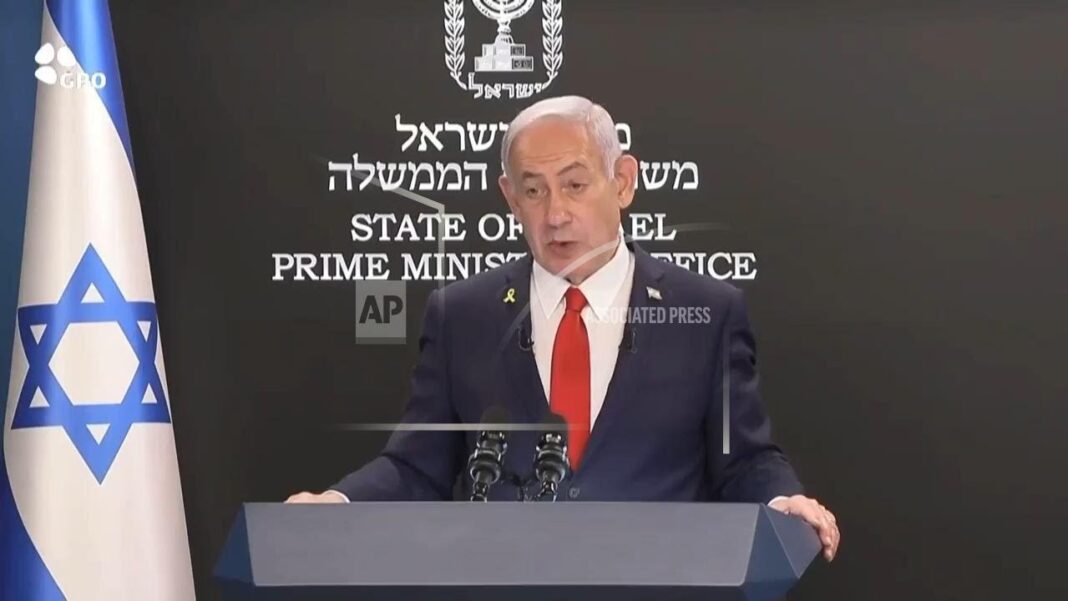
The embedded videos of the Prime Minister is censored, from the original 9 1/2 minutes to small fragments (under two minutes by AP). The full video could have been easily included.
I have heard from those with family in Israel that the news there is very different from the news here.
I found the source of the story at “Jewish Breaking News” of which I have never heard. It is more in the nature of an editorial rather than professionally sourced news:
https://jewishbreakingnews.com/1d46
“Public Trust in Israeli Prime Minister Benjamin Netanyahu Plummets as Thousands Take to the Streets in Protest”
The owner of JBN lives in America. “Jewish Breaking News“ is rated for bias and credibility:
https://mediabiasfactcheck.com/jewish-breaking-news/ as follows:
“Although Jewish Breaking News utilizes credible sources such as the New York Times and CBS News, they also publish poorly sourced opinion pieces with loaded headlines.”
The rating is patently untrustworthy since it claims that the notorious NYTimes and CBS are “credible sources”.
This supports my opinion that this article should not have been republished as news.
Prime Minister Benjamin Netanyahu is solely responsible for the decisions he makes. Don’t need 22 months to get the job done. Crush the enemy or get out. All Arabs must go one way or another. Israel could be there for 10 years. If the policy doesn’t change, Israel is back to square one. Why doesn’t the ‘Great Rabbis’ state their opinions? Just because the issues are not money or the draft doesn’t mean they should be silent.