



|
Getting your Trinity Audio player ready...
|
By: Fern Sidman
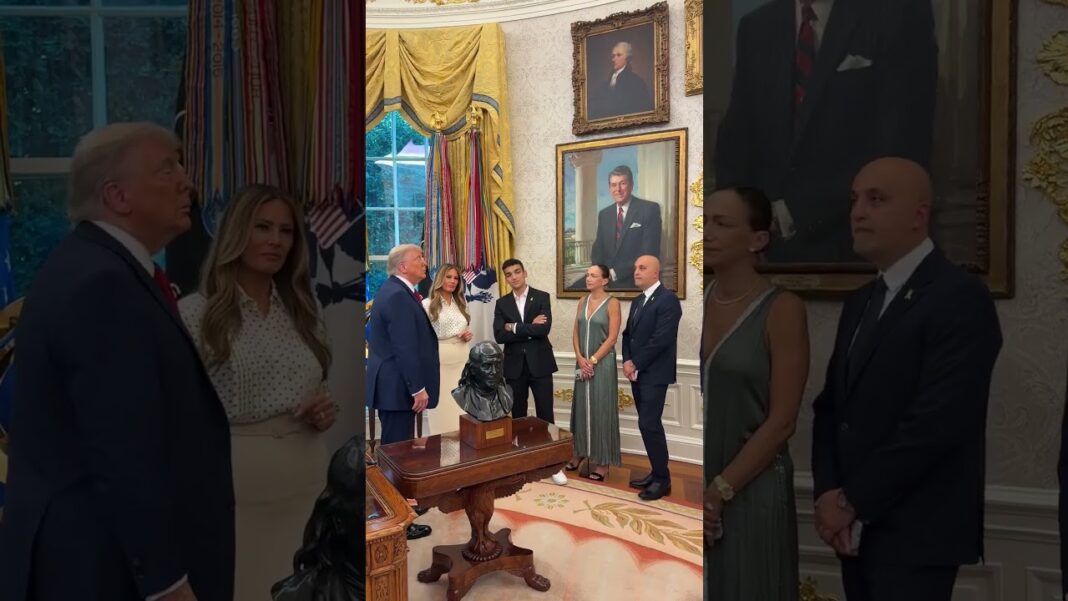
In a solemn and deeply symbolic moment at the White House on Thursday, President Donald Trump met privately with Edan Alexander, a 21-year-old American-Israeli dual citizen who was released in May after enduring 584 harrowing days in Hamas captivity. The meeting, held in the Oval Office and captured in part on video, was a powerful gesture that emphasized both personal compassion and geopolitical resolve—hallmarks of Trump’s reengagement in Middle East diplomacy.
As reported by The Washington Free Beacon, the President warmly greeted Alexander, who was visibly moved by the occasion. “We’re very proud that I got to help you,” Trump told him, adding that First Lady Melania Trump had taken a strong personal interest in his plight. The former hostage, believed to have been the last American citizen held in the Hamas-controlled Gaza Strip, sat beside the President as they discussed his experience and the ordeal his family endured during his prolonged absence.
Alexander, born and raised in New Jersey, made aliyah after graduating from high school and enlisted in the Israel Defense Forces. According to the information provided in The Washington Free Beacon report, he was taken hostage on October 7, 2023, during the Hamas-led massacre that left over 1,200 Israelis dead and sparked Israel’s ongoing military campaign in Gaza. During his captivity, Alexander was subjected to severe torture and solitary confinement deep within Hamas’s underground tunnel network.
His release on May 12, 2025—after more than 19 months in captivity—was hailed by U.S. and Israeli officials as a major breakthrough. As The Washington Free Beacon report noted, Alexander’s freedom came as part of broader negotiations that have since culminated in a tentative 60-day ceasefire agreement between Israel and Hamas.
Shortly after his release, Trump spoke to Alexander by phone in a call widely covered by The Washington Free Beacon and other outlets. “You’re an American, and we love you,” Trump told him at the time. “We’re going to take good care of you. And your parents are incredible. I saw your mother. She was pushing me around a little bit—putting a lot of pressure on me.”
That anecdote, delivered with characteristic candor, reflected the behind-the-scenes lobbying that has become increasingly central to Trump’s foreign policy approach. Alexander’s mother, part of a broader network of hostage families who advocated fiercely for U.S. intervention, had reportedly met with Trump in March, when the President hosted eight other hostages that were held in Hamas captivity at the White House.
The Thursday Oval Office visit also marked a continuation of what The Washington Free Beacon has described as Trump’s “hostage diplomacy”—a strategic blend of moral clarity, personal outreach, and backchannel negotiation. In March, Trump’s hosting of former hostages drew both praise and criticism, with supporters lauding his hands-on approach and critics questioning the broader implications of politicizing hostage releases.
Yet the Alexander meeting felt different—less a spectacle, more a solemn acknowledgment of individual suffering and national commitment.
According to the information contained in The Washington Free Beacon report, the meeting was deliberately low-key, devoid of press fanfare, and focused largely on Alexander’s health, family, and reintegration. It comes amid the announcement that Israeli Prime Minister Benjamin Netanyahu will meet with Trump at the White House on Monday—talks expected to solidify the terms of the newly brokered ceasefire and coordinate on regional security matters.
Alexander’s return to the United States last month triggered emotional scenes across his hometown in New Jersey. As reported by the New York Post, hundreds of neighbors and supporters lined the streets in the pouring rain to welcome him home. IDF veterans embraced him. Children waved American and Israeli flags. One community member said, “This is what a miracle looks like.”
Trump, according to the report in The Washington Free Beacon, viewed Alexander’s return not only as a personal victory, but as proof that the U.S. government must take a proactive role in protecting its citizens abroad—even in the most volatile regions of the world.
During the Thursday meeting, Trump reaffirmed that view, calling Alexander’s rescue a “moral imperative” and praising the coordination between U.S. and Israeli intelligence that made it possible.
The timing of Alexander’s visit is not coincidental. As The Washington Free Beacon report emphasized, it comes just days after Israel signaled its acceptance of the terms of a 60-day ceasefire with Hamas—a framework that includes the phased release of hostages and the transfer of bodies. Trump’s role as guarantor of that agreement has not gone unnoticed in diplomatic circles, with some analysts suggesting it marks his reemergence as a dominant voice in Middle Eastern affairs.
“This isn’t just about Edan,” a senior official told The Washington Free Beacon. “It’s about what America stands for. It’s about showing that no matter who you are or where you are, if you’re an American being held by terrorists, we will come for you.”
Though Trump’s presence in the political arena remains polarizing, his efforts on behalf of American hostages have drawn rare bipartisan acknowledgment. “This is what leadership looks like,” said one Democratic congressional aide, speaking anonymously to The Washington Free Beacon. “When an American is held hostage, party lines vanish. This is about human decency.”
The Oval Office meeting concluded with a quiet photo, a firm handshake, and a promise: that the United States—under this administration—will leave no American behind.
