



|
Getting your Trinity Audio player ready...
|
By: Fern Sidman
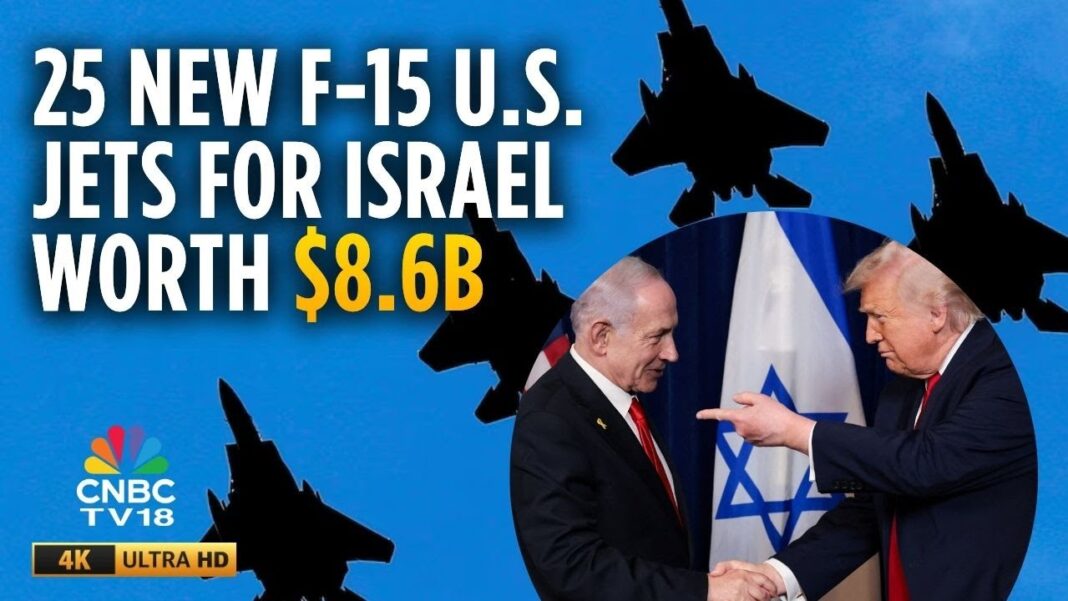
When the Pentagon quietly confirmed this week that Boeing had secured an $8.6 billion contract for the next phase of the F-15 Israel Program, the announcement reverberated far beyond the corridors of the US Department of Defense. According to a report that appeared on Tuesday in The Times of Israel, the contract came on the heels of Prime Minister Benjamin Netanyahu’s meeting with President Donald Trump at Mar-a-Lago, underscoring once again how closely military procurement, diplomatic choreography and regional strategy are entwined.
The deal provides for the design, integration, testing and delivery of 25 new F-15IA fighter jets for the Israeli Air Force, with an option for 25 more — effectively doubling the size of Israel’s future fleet of the newest F-15 variant. The aircraft, known in Israel as the F-15IA, is the local adaptation of the American F-15EX, the most advanced incarnation of a platform that has served Israel faithfully for nearly half a century.
As The Times of Israel report noted, Israel first signed a $5.2 billion agreement last November for 25 of these aircraft, with deliveries scheduled to begin in 2031 at a pace of four to six jets per year. Monday’s announcement expands that commitment to a full 50 aircraft, which will join an already formidable inventory of 66 older F-15 variants in the Israeli Air Force’s hangars.
The F-15IA is not simply an incremental upgrade. It is the culmination of decades of combat experience, particularly Israel’s recent campaigns against Iranian assets in Syria, Hezbollah infrastructure in Lebanon and Houthi missile sites in Yemen. The Times of Israel has repeatedly highlighted that the F-15 remains Israel’s workhorse for deep-strike missions, prized for its payload capacity, extended range and survivability in hostile airspace.
Unlike the stealth-centric F-35, the F-15IA is designed to dominate the upper spectrum of air power: carrying heavy munitions, advanced sensors, electronic warfare suites and Israeli-specific avionics. Its ability to integrate locally developed weapons systems gives the IDF operational autonomy rarely afforded to air forces dependent on foreign platforms.
By the time the full 50-jet complement is delivered, Israel will possess one of the most robust heavy-strike capabilities anywhere in the world — a fact The Times of Israel analysts note is particularly relevant as Tehran works to restore portions of its battered military infrastructure following last year’s brief but intense conflict.
Yet the story does not end with Israel’s procurement triumph. During the same press conference in Florida, President Trump surprised many observers by announcing that he is “very seriously” considering the sale of F-35 stealth fighters to Turkey.
As The Times of Israel report indicated, Washington expelled Ankara from the F-35 program in 2019 after President Recep Tayyip Erdogan finalized the purchase of Russian S-400 missile defense systems — a move that raised acute security concerns within NATO. The re-entry of Turkey into the F-35 orbit would represent a dramatic policy reversal.
Trump, who has cultivated a personal rapport with Erdogan despite the Turkish leader’s harsh rhetoric toward Israel, brushed off fears of future confrontation. “I promise they’ll never use them on Israel,” he said, according to The Times of Israel report, as he left the room. “We’re not going have a problem.”
The assurance, however, did little to calm Israeli unease. For years, Jerusalem has insisted on preserving its “qualitative military edge” — the guarantee that Israel’s technology and training will outstrip that of any potential regional adversary. The introduction of Turkish F-35s into the Middle Eastern theater would inevitably complicate that calculus.
Israel currently operates 45 F-35s and has another 30 on order, making it the only Middle Eastern country with a stealth fighter capability. That exclusivity is already eroding. As The Times of Israel reported earlier this year, the Trump administration has green-lit the sale of F-35s to Saudi Arabia, albeit in a downgraded configuration designed to preserve Israel’s edge.
Reuters has cited US officials insisting the Saudi jets will be stripped of some advanced features, but Israeli defense planners are acutely aware that technology spreads and political alliances shift. What is unthinkable today may become tomorrow’s strategic headache.
For Boeing, the expanded F-15IA order is a rare bright spot in an otherwise challenging year. The aerospace giant has struggled with manufacturing setbacks and public confidence issues, making the Israeli contract a much-needed vote of confidence.
The Times of Israel report noted that this is more than a commercial transaction; it is a strategic partnership. Israeli engineers will collaborate closely with Boeing’s design teams, ensuring that the aircraft reflects Israel’s unique operational doctrine — from desert endurance to electronic warfare dominance.
The juxtaposition of Israel’s F-15 expansion and America’s renewed courtship of Turkey highlights the delicate balancing act at the heart of US Middle East policy. On one hand, Washington continues to deepen its security partnership with Jerusalem, delivering advanced hardware that cements Israel’s aerial supremacy. On the other, it is cautiously reopening doors to regional powers whose interests do not always align neatly with Israel’s.
The Times of Israel has repeatedly framed this duality as the central tension of the post-Abraham Accords era: cooperation without illusion, alliance without complacency.
The expanded F-15IA program ensures that Israel will retain a decisive conventional deterrent well into the 2040s. It also signals to adversaries — particularly Iran — that any attempt to reconstitute offensive capabilities will be met with overwhelming force from the skies.
Yet the broader picture is one of transformation rather than stability. As Turkey inches back toward the F-35, Saudi Arabia steps into the stealth age and Israel doubles down on heavy-strike power, the Middle East airspace is becoming more crowded, more lethal and more politically charged.
For now, as The Times of Israel report observed, Israel’s edge remains intact — reinforced by 50 gleaming F-15IAs that will soon join its fleet. But in a region where today’s friend can become tomorrow’s rival, the roar of new engines over the Negev is not merely a celebration of strength. It is a reminder that supremacy must be continually earned.