



|
Getting your Trinity Audio player ready...
|
By: Fern Sidman
As Israeli flags wave across the skyline of the eternal capital, the people of Israel mark Yom Yerushalayim (Jerusalem Day) with unparalleled pride and spiritual joy. On this historic day, the nation commemorates the miraculous reunification of Jerusalem during the 1967 Six-Day War—a moment in Jewish history that restored access to the holiest sites in Judaism and reaffirmed the eternal bond between the Jewish people and their ancient capital.
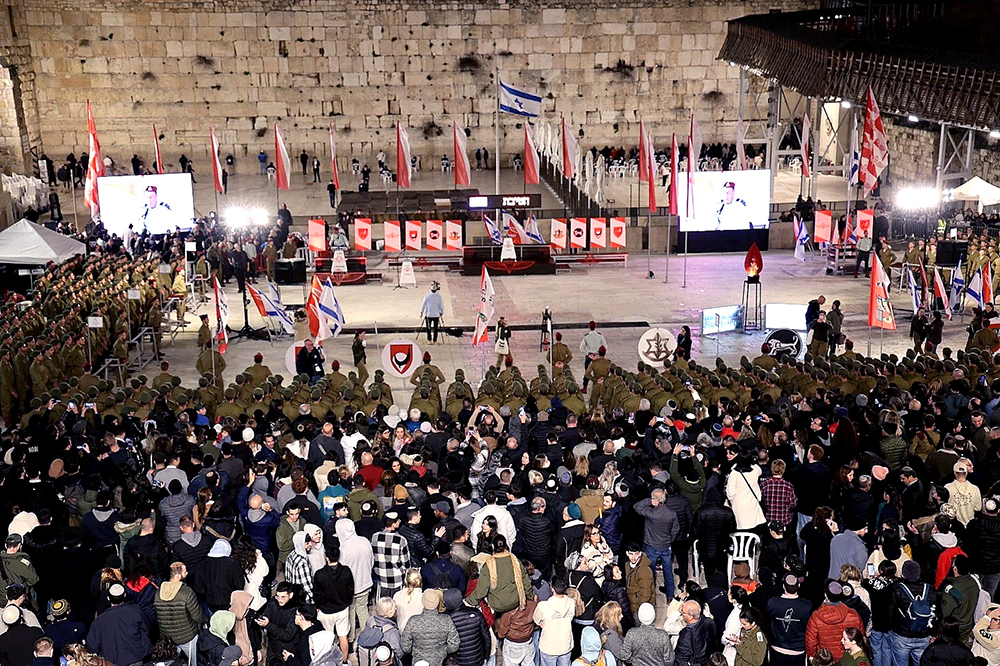
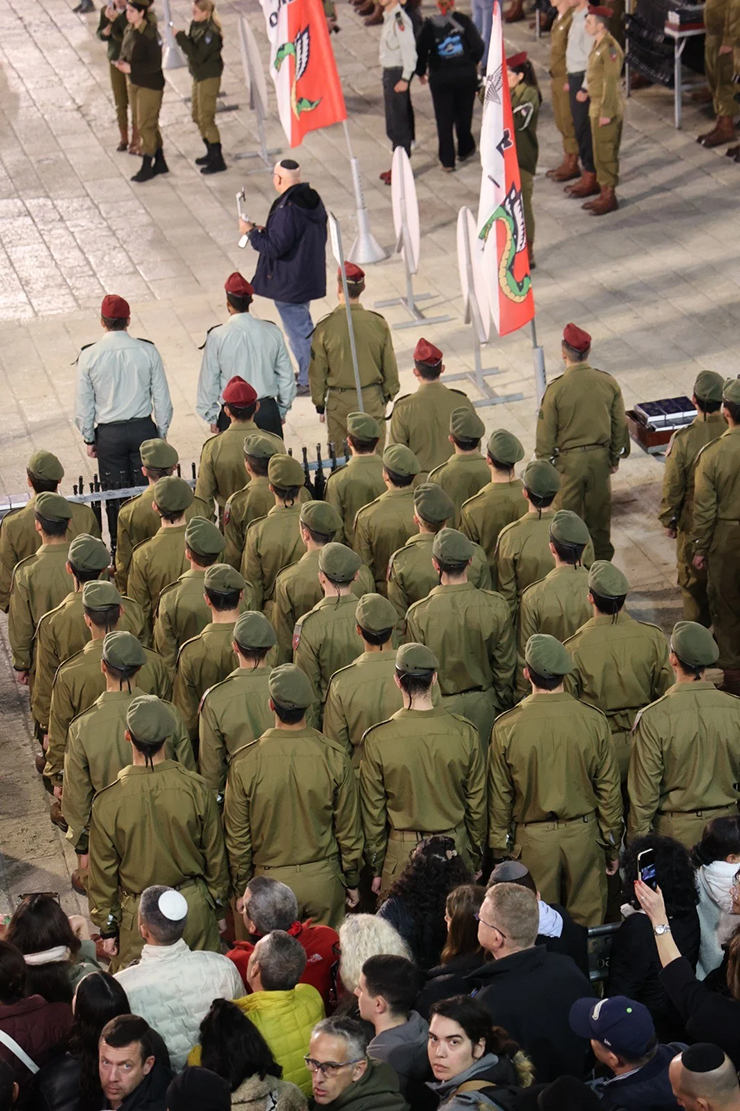
This year’s observance is particularly poignant, as it coincides with a stirring modern symbol of national resilience and continuity: the swearing-in ceremony of 800 new recruits from the IDF Paratroopers Brigade, held last week at the Western Wall Plaza. These young men and women, clad in red berets and full military uniform, stood before the most sacred remnant of the Jewish Temple and pledged allegiance to the Israel Defense Forces and the State of Israel.
As they sang “Hatikvah”—“The Hope”—beneath the towering limestone wall, they embodied the living heartbeat of a people who, through centuries of exile, persecution, and survival, never abandoned their dream of return and restoration. Now, they take their place as defenders of that dream, inheriting a legacy forged in blood, bravery, and spiritual unbreakability.
The Paratroopers: A Legacy Forged in Fire
The IDF Paratroopers Brigade (Tzanhanim) is one of Israel’s most storied and elite infantry units, known not only for their tactical prowess and rigorous training, but for the indelible mark they have left on the modern history of the Jewish state.
Formed in the early 1950s, the Paratroopers Brigade quickly became synonymous with daring operations behind enemy lines and strategic battlefield victories. Their early reputation was cemented during reprisal operations in the 1950s against fedayeen infiltrators and hostile Arab forces, often deep inside hostile territory. The unit became a model of agility, discipline, and moral clarity in combat.
But it was during the Six-Day War in June 1967 that the Paratroopers carved their name into the heart of Israeli history and the Jewish collective memory.
The Battle for Jerusalem: Reunifying the Eternal Capital
In the spring of 1967, Israel faced existential threats from all directions. The armies of Egypt, Syria, and Jordan had amassed on its borders. Egyptian President Gamal Abdel Nasser had closed the Straits of Tiran to Israeli shipping and mobilized a pan-Arab coalition calling for Israel’s destruction. The sense of looming catastrophe was palpable.
Yet in six miraculous days, the outnumbered and outgunned Israel Defense Forces launched a preemptive strike and crushed its adversaries on three fronts. Among the most profound victories was the liberation of the Old City of Jerusalem, then under Jordanian control since 1948. For 19 years, Jews had been denied access to their holiest site, the Western Wall (Kotel), and synagogues in the Old City had been desecrated or destroyed.
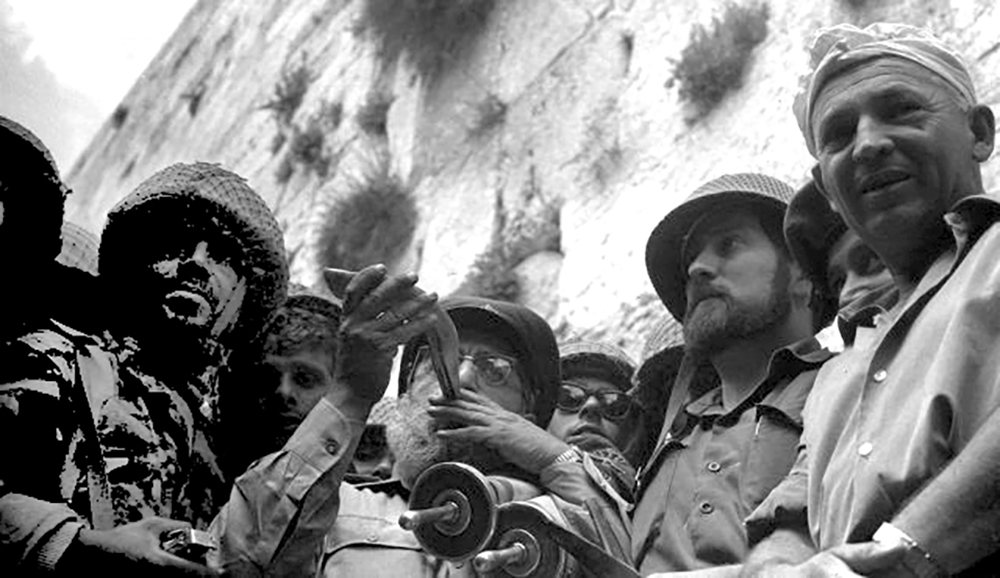
On June 7, 1967, soldiers from the 55th Paratroopers Brigade, under the command of Mordechai “Motta” Gur, breached the Lion’s Gate and entered the Old City. Gunfire echoed through the narrow alleys, but soon gave way to an eternal silence. The voice of Commander Gur crackled over the radio: “Har HaBayit b’yadeinu” — “The Temple Mount is in our hands.”
As the paratroopers stood before the Western Wall, many wept. Secular and religious soldiers alike touched the stones, kissed them, and whispered ancient prayers—some for the first time in their lives.
This moment was not just a military victory; it was a redemptive homecoming. Jerusalem was once again whole, and Jewish sovereignty over its eternal capital was reasserted for the first time in nearly two millennia. The image of paratroopers standing before the Wall, their rifles slung over their shoulders and eyes full of awe, became a defining photograph of modern Jewish identity.
Jerusalem Day 2025: A Living Celebration of Victory and Faith
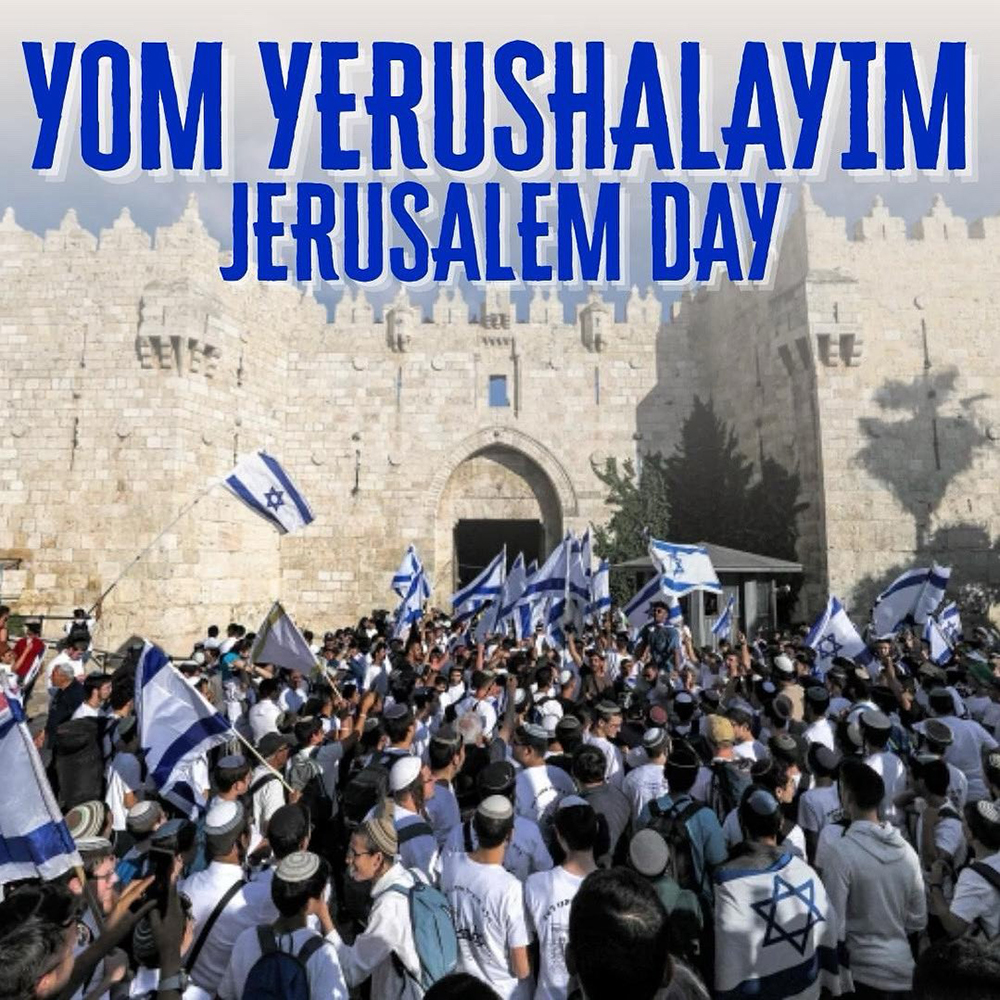
On Sunday evening and Monday, Israel rejoiced in that enduring miracle. From the hills of Mount Scopus to the plazas of the Old City, Yom Yerushalayim is marked by processions, musical performances, torchlight parades, prayer services, and educational events that celebrate Jerusalem’s reunification and its spiritual centrality to the Jewish people.
This year’s festivities included a mass prayer service at the Western Wall, with thousands gathering under tight security. Flags were waved by schoolchildren and veterans alike, and festive singing filled the air. Religious and secular Israelis came together in unity, joined by visitors from around the world who came to celebrate the city’s holiness and historical significance.
One of the night’s most symbolic moments came during a special ceremony featuring the massive unfurling of a 28-by-46-meter Israeli flag across the Kotel Plaza, paying homage to the bravery of the paratroopers who liberated the city in 1967.
American dignitaries were also present, including U.S. Homeland Security Secretary Kristi Noem, who became the first U.S. cabinet member to participate in Jerusalem Day celebrations. In a note placed in the Wall, she wrote: “Israel & God’s chosen people — We stand with you.” Her words echoed the sentiments of many American allies who see Israel’s stand against terrorism and its unwavering moral code in warfare as a beacon in a darkened world.
The Paratroopers Today: Defending Israel in Gaza
As the dancing and singing of Yom Yerushalayim carry on, many paratroopers are absent from the festivities—deployed in combat in the ongoing war against Hamas terrorists in Gaza, following the October 7, 2023 massacre in which more than 1,200 Israelis were slaughtered and 250 taken hostage.
The Paratroopers Brigade is once again on the front lines, spearheading operations in dense urban environments, uncovering terror tunnels, neutralizing rocket launchers, and engaging in house-to-house combat to dismantle Hamas’s military infrastructure. Their mission is as difficult as it is noble: to defend Israeli citizens from relentless rocket fire and barbaric attacks, and to restore safety to the communities of the south.
Despite the complex nature of modern urban warfare, the IDF continues to be guided by the most stringent moral code of any army in the world. Soldiers operate under the principle of “Purity of Arms” (Tohar HaNeshek), which requires restraint and humanity even in the face of grave danger. The IDF is the only military known to issue pre-strike warnings via phone calls, leaflets, and text messages, often forfeiting the element of surprise to safeguard enemy civilians.
“There is no army in the world more moral than the Israel Defense Forces,” Prime Minister Netanyahu has repeatedly stated. “While our enemies target civilians, we do everything possible to avoid harming them.”
A Living Hope
As Israel celebrates 58 years of a united Jerusalem, the legacy of the Paratroopers Brigade serves as a powerful symbol of continuity, courage, and commitment. From the blood-stained alleyways of 1967 to the urban battlefields of Gaza, Israel’s paratroopers have stood as pillars of the nation’s security and moral conscience.
On Yom Yerushalayim 2025, Israelis remember the past, celebrate the present, and pray for a future of peace—made possible by those who are willing to defend it with integrity, faith, and the strength of their convictions.
In Jerusalem today, the eternal city lives and thrives, not just in stone and history, but in the spirit of a people who never gave up—and in the soldiers who continue to ensure they never will.
Prime Minister Convenes Special Cabinet Meeting
Against the backdrop of ancient stones that echo with the voices of prophets and kings, Israeli Prime Minister Benjamin Netanyahu convened a special Cabinet meeting on Monday in the City of David, symbolically and strategically reaffirming Israel’s historic and unbreakable bond to its eternal capital—Jerusalem.
The event, held as part of Yom Yerushalayim (Jerusalem Day) observances, marked 58 years since the reunification of Jerusalem during the 1967 Six-Day War, a transformative moment in Jewish history. The location—just south of the Temple Mount, and considered the original nucleus of biblical Jerusalem—served as a living testament to the city’s centrality in Jewish identity and statehood.
As reported by the Jewish News Syndicate (JNS) on Monday, Netanyahu used the occasion to send a resolute message of continuity, resilience, and defiance in the face of both terrorism and international pressure.
“Our enemies called the massacre they committed ‘The Al-Aqsa Flood,’” Netanyahu said, referencing the barbaric October 7, 2023 Hamas-led attacks that killed more than 1,200 Israelis. “Today, they understand very well the magnitude of the flood and the destruction that has befallen them. We will preserve a united and complete Jerusalem and safeguard Israel’s sovereignty.”
The City of David: Where History and Destiny Converge
The City of David, the ancient stronghold from which King David established Jerusalem as the capital of the unified tribes of Israel more than 3,000 years ago, is one of the most archaeologically rich sites in the country. Its selection as the venue for the Cabinet meeting underscored what Netanyahu and his government framed as a sacred duty: ensuring the capital remains indivisible and under permanent Israeli sovereignty.
“The stones of Jerusalem are not silent—they speak to us from across the millennia,” Netanyahu said. “Here lie the foundations of our identity as an ancient nation. There is no Zionism without Zion, and no Israel without Jerusalem.”
As noted in the JNS report, the Prime Minister also shared a personal anecdote about his grandfather, Rabbi Nathan Milikowsky, an early Zionist who opposed the notion of a Jewish homeland in British East Africa—commonly known as the Uganda Plan—arguing that only the Land of Israel could fulfill the historic and prophetic promises of Jewish restoration.
“To abandon Jerusalem would have made Jewish history meaningless,” Netanyahu said. “If, God forbid, we give up on Jerusalem, we will face not only another massacre, but the destruction of the nation. We will not allow that to happen.”
A Capital for the Ages—and the Future
In a declaration of forward-looking governance, Netanyahu announced a series of new government initiatives aimed at bolstering Jerusalem’s infrastructure and development.
“In recent years, we have increased international recognition of Jerusalem as our capital and encouraged embassies to relocate here,” he said. “We’re investing billions in transportation, housing, healthcare, education, tourism, and heritage preservation.”
These investments are part of a long-term strategy to ensure that Jerusalem not only remains Israel’s undivided capital in theory but thrives as such in practice. The city has already seen significant upgrades in public transportation, particularly the expansion of light rail networks and highway access points.
Netanyahu’s statement also spotlighted the diplomatic success initiated under President Donald Trump, who in 2018 moved the U.S. Embassy from Tel Aviv to Jerusalem—becoming the first world leader to formally recognize the city as Israel’s capital. As the JNS report noted, since then, Guatemala, Honduras, Papua New Guinea, and Paraguay have followed suit.
“Jerusalem’s magnificent history is now matched by the bright future we are building—together with the full partnership of the Israeli government,” said Jerusalem Mayor Moshe Lion. “The decisions being made today are laying the foundation for the capital’s continued growth.”
The Temple Mount: Contested Sovereignty, Defiant Presence
Earlier in the day, National Security Minister Itamar Ben-Gvir visited the Temple Mount, Judaism’s holiest site and one of the most politically charged pieces of real estate on earth. His visit drew sharp condemnation from Jordan, which accused Israel of violating the fragile “status quo.”
But as JNS reports, Ben-Gvir remained undeterred. “Jewish presence on the Temple Mount is a legitimate expression of our sovereignty,” he said. “We will not be intimidated by threats or diplomatic pressure.”
The Temple Mount, while under Israeli sovereignty since 1967, remains administered by the Islamic Waqf under Jordanian supervision, and access is tightly regulated. Still, a growing number of Israeli officials and citizens assert that Jewish prayer rights on the Mount are long overdue, and visits by ministers such as Ben-Gvir are increasingly common, despite fierce international backlash.
A Warning and a Promise
Netanyahu’s speech carried a tone both celebratory and sobering. While lauding the progress Israel has made, he warned of the existential stakes still looming on the horizon—particularly from enemies such as Iran, Hezbollah, and Hamas.
“If we surrender Jerusalem, we surrender our soul,” he warned. “And in doing so, we invite our enemies not to negotiate, but to destroy.”
Yet Netanyahu also issued a promise—one echoed in the hearts of Israelis waving flags, singing “Hatikvah,” and walking the ancient streets of Jerusalem.
“We will never relinquish Jerusalem. Not now. Not ever. Because in Jerusalem, the past and the future are one. And we, the people of Israel, are its eternal guardians.”
