



|
Getting your Trinity Audio player ready...
|
By: Fern Sidman
In what Israeli defense officials are calling a historic military success and a critical turning point in the long-simmering shadow war with Iran, the Israel Defense Forces announced on Saturday that it has eliminated more than 20 senior Iranian commanders, including some of the Islamic Republic’s most influential military and intelligence figures, in the opening days of “Operation Rising Lion.”
According to a report that appeared on the Jewish News Syndicate (JNS) web site, the strikes—conducted with extraordinary precision by Israeli Air Force (IAF) fighter squadrons—targeted Iran’s military elite in a sweeping, multi-phase operation aimed at dismantling both the Islamic Republic’s nuclear and ballistic missile capabilities, and the strategic command structures that underpin them.
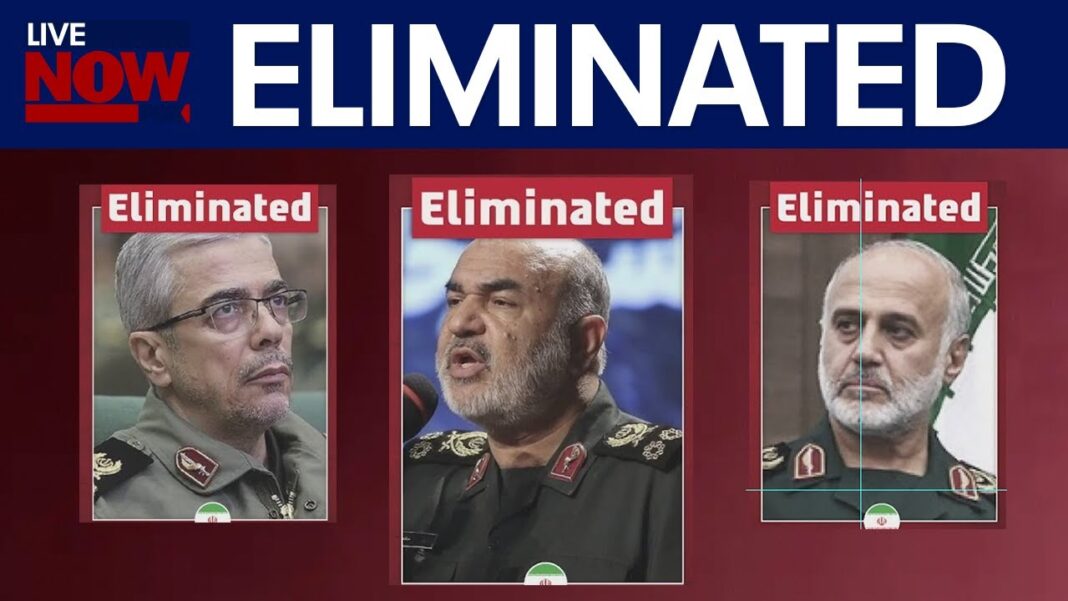
This latest update builds on Friday’s confirmation by the IDF that several high-ranking Iranian generals—including the heads of the Armed Forces and the Islamic Revolutionary Guard Corps (IRGC)—were killed in the early hours of the campaign.
At the heart of Israel’s high-value target list was Brig. Gen. Gholam-Reza Merhabi, the head of military intelligence for the Iranian Armed Forces General Staff. As reported by JNS, Merhabi was one of the regime’s most trusted strategists, directly overseeing operational planning and intelligence coordination for attacks on Israel and regional allies. His death marks a devastating blow to Tehran’s command continuity and its forward-facing military doctrine.
Merhabi perished alongside his close ally Maj. Gen. Mohammad Hossein Bagheri, the chief of staff of the Iranian Armed Forces, during an Israeli precision strike on a fortified underground command center in Tehran, where senior IRGC and army officials had reportedly convened to finalize plans for additional assaults on Israeli territory.
Among the other prominent figures confirmed killed by the IDF, as detailed in the JNS report were Brig. Gen. Amir Ali Hajizadeh, commander of the IRGC Aerospace Force and long suspected of coordinating Iran’s growing missile arsenal; Mohammad Bagheri, commander of Iran’s surface-to-surface missile programs (distinct from the armed forces chief of staff of the same name); Maj. Gen. Hossein Salami, the commander of the IRGC and one of the regime’s most vocal hardliners; and Maj. Gen. Gholamali Rashid, head of Tehran’s Emergency Command and a key architect of Iranian mobilization strategy.
The strikes also eliminated senior officials responsible for aerial operations, including Brig. Gen. Daoud Shihyan, commander of Aerial Operations, and Taher Pur, chief of the IRGC’s UAV forces—both critical to the Islamic Republic’s recent drone and missile offensives.
“These slain commanders were not only strategic planners but direct implementers of Iran’s campaign of aggression across the region,” an Israeli defense source told JNS. “Their removal significantly impairs Iran’s ability to coordinate missile, UAV, and proxy operations.”
The IDF also confirmed that nine senior Iranian nuclear scientists were killed in separate IAF strikes on Friday, each of whom had played pivotal roles in Tehran’s clandestine nuclear weapons program.
According to the information provided in the JNS report, those eliminated included Fereydoun Abbasi, a former head of Iran’s Atomic Energy Organization, and Mohammad Mahdi Tehranshi, among others who had served as senior researchers and engineers for decades. Israeli intelligence described them as “critical knowledge centers”—individuals whose technical expertise was irreplaceable in Iran’s quest for a nuclear arsenal.
“Their elimination represents a significant blow to the Iranian regime’s ability to acquire weapons of mass destruction,” the IDF said, as cited by JNS.
These scientists were targeted near nuclear research facilities in Isfahan and Fordow, both long suspected of housing Iran’s most advanced uranium enrichment and weaponization efforts. Strikes reportedly destroyed laboratories, infrastructure for enriched uranium conversion, and metallic uranium production facilities, crippling the regime’s immediate capacity to resume weapons-grade nuclear development.
Speaking on Saturday, Prime Minister Benjamin Netanyahu delivered an unambiguous message from Jerusalem. “In the very near future, you will see Israeli Air Force planes over the skies of Tehran—we will strike at every site and every target of the Ayatollahs’ regime,” he declared, as reported by JNS.
This pronouncement follows Israel’s success in establishing aerial superiority over large portions of Iranian airspace—an achievement made possible by systematic attacks on radar installations, anti-aircraft systems, and command-and-control nodes.
Following the sweeping losses among Iran’s top brass, Supreme Leader Ayatollah Ali Khamenei swiftly appointed new leadership: Maj. Gen. Abdolrahim Mousavi as head of the armed forces and Brig. Gen. Mohammad Pakpour as the new IRGC commander.
But Israeli officials view these moves as symbolic at best.
“The damage has already been done. This isn’t about replacing names; it’s about dismantling capabilities,” IDF Spokesperson Brig. Gen. Effie Defrin told reporters. “We are striking across Iran as part of Operation Rising Lion. These strikes are being carried out to meet the operation’s objective: eliminating the existential Iranian threat to the State of Israel—the nuclear and missile threat.”
JNS analyst and former British Army commander Col. (ret.) Richard Kemp described the Israeli strikes as a masterclass in military precision and strategic clarity. “No other country in the region could have executed such an operation on this scale, with this level of impact,” Kemp said. “This is not just a tactical victory—it’s a signal to the entire Middle East, and perhaps to the international community, that Israel is no longer waiting for permission to defend itself.”
Kemp further suggested the operation may catalyze regional realignments. Arab states wary of Iran’s regional ambitions may be emboldened to pursue closer ties with Israel—a development that could advance the normalization momentum of the Abraham Accords, including the long-anticipated possibility of formal relations between Saudi Arabia and Israel.
“This may bring us closer to expanding the Abraham Accords,” Kemp told JNS, “which may, in fact, be the most strategically consequential outcome of all.”
As Israeli jets continue to strike high-value targets and intelligence assessments indicate a disrupted but not yet dismantled Iranian military infrastructure, Israeli officials remain cautious but resolved.
“Rome wasn’t built in a day,” Brig. Gen. (res.) Yosef Kuperwasser told JNS. “We’ve achieved more in 36 hours than many thought possible—but we know the Iranian threat is multilayered and deeply entrenched.”
The next phase of Operation Rising Lion, Israeli analysts suggest, will likely focus on neutralizing Iran’s remaining missile infrastructure and degrading the command systems that support its proxy network—from Hezbollah in Lebanon to the Houthis in Yemen.
But for now, the message from Israel is resounding: the cost of aggression will be borne at the highest levels—and no bunker is beyond reach.
