



|
Getting your Trinity Audio player ready...
|
By: Fern Sidman
In a breathtaking display of technological mastery, military coordination, and strategic secrecy, the United States launched a pre-dawn strike on June 21 that targeted three of Iran’s most fortified nuclear facilities. The unprecedented operation—dubbed Operation Midnight Hammer—was meticulously planned over several weeks and executed with such stealth and speed that Iran’s air defenses were never even triggered. As USA Today reported in exclusive detail, the Pentagon’s most powerful conventional munitions were deployed for the first time, delivering a decisive blow that may reshape the trajectory of Iran’s nuclear ambitions.
According to the information provided in the USA Today report, the multi-pronged assault was orchestrated using more than 125 U.S. military assets, including B-2 stealth bombers, attack submarines, and fourth- and fifth-generation warplanes. The strikes were calibrated to evade detection, destroy deeply buried targets, and avoid escalation—though Pentagon officials acknowledged that the entire region now sits on a razor’s edge.
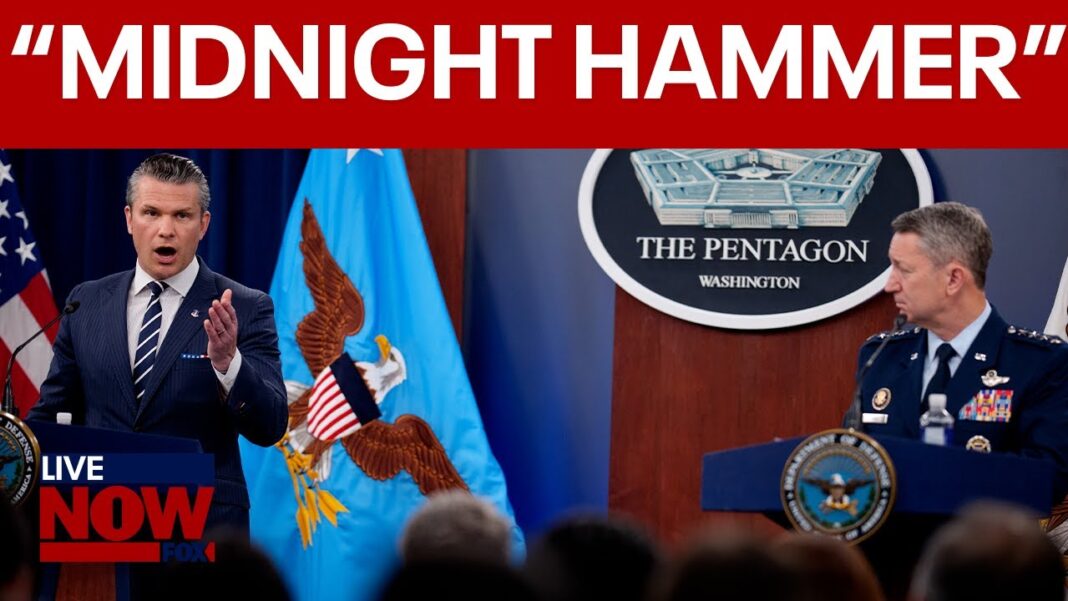
Air Force General Dan Caine, Chairman of the Joint Chiefs of Staff, outlined the contours of the mission to reporters just hours after the attack. As the USA Today report highlighted, the operation began with a deception maneuver—B-2 bombers took off from Whiteman Air Force Base in Missouri and flew westward over the Pacific Ocean in what appeared to be a routine training mission.
“This was a deception effort known only to an extremely small number of planners and key leaders in Washington and at Central Command in Tampa,” said Caine, underscoring the mission’s unprecedented operational security. Even Congress was informed after the fact, a point that reflects the high level of classification and executive oversight involved in the mission.
At the heart of the operation were seven of the Air Force’s 19 B-2 Spirit bombers, each flown by two-person crews who maintained minimal communication during their 18-hour flight into Iranian airspace. The bombers were refueled midair several times—a logistical ballet involving KC-135 and KC-46 tankers coordinated in absolute silence.
As the report in USA Today emphasized, the attack was a symphony of modern warfare, blending stealth technology, long-range firepower, and deceptive choreography. “We retained the element of surprise,” Caine affirmed.
At approximately 6:40 p.m. ET—just after 2 a.m. in Iran—the leading B-2 aircraft reached their primary target: Fordow. This hardened underground enrichment facility, buried deep in Iran’s mountainous terrain, had long been considered nearly impenetrable. Not anymore.
As the USA Today report detailed, the bombers dropped 14 GBU-57 Massive Ordnance Penetrators (MOPs), the Pentagon’s heaviest conventional bomb, weighing in at 30,000 pounds. These bunker busters are designed to slice through hundreds of feet of reinforced concrete and steel before detonating—an ordnance previously held in reserve for only the most hardened targets.
“The use of GBU-57s marks a significant escalation in the Pentagon’s willingness to deploy its most secretive and powerful non-nuclear weapons,” wrote USA Today. “This was the bomb’s battlefield debut—and its impact was devastating.”
Initial reports from intelligence sources, as cited by USA Today, suggest “extremely severe damage and destruction” across all three targeted sites, including Isfahan and Natanz. The full scope of the operation’s success, however, may take weeks to verify as satellite imagery and on-the-ground assessments continue.
A striking element of the operation, as noted in the USA Today report, is that Iran’s defenses appeared to remain completely inert. Iranian fighter jets never took off, and surface-to-air missile systems were silent. This silence, U.S. officials believe, was not a sign of restraint but a result of being utterly blindsided.
“The Iranians didn’t see us,” Caine said flatly. “Their radar was either suppressed or evaded entirely.”
But the mission’s success has not come without strategic cost. Iran has vowed retaliation, and the Pentagon has placed 40,000 U.S. troops in the region on high alert. Two aircraft carrier strike groups have been stationed nearby, and missile defense systems in Israel, the UAE, and Saudi Arabia are now operating under elevated threat levels.
Perhaps the most impressive element of Operation Midnight Hammer, as USA Today consistently noted in its coverage, was the airtight operational security surrounding the mission. The lessons learned from earlier intelligence leaks shaped the planning environment: In March, Defense Secretary Pete Hegseth’s messages regarding strikes on Iranian proxies in Yemen were leaked, prompting the firing of National Security Adviser Mike Waltz.
This time, secrecy was sacrosanct. “I am particularly proud of our discipline related to operational security,” Caine said, crediting President Trump, Secretary Hegseth, CENTCOM Commander General Kurilla, and the intelligence community for maintaining total silence in the weeks leading up to the strike.
While USA Today acknowledged the tactical brilliance of the operation, its broader strategic implications remain uncertain. The attack raises serious questions about the future of diplomacy with Iran, the potential for regional conflagration, and whether Tehran’s nuclear ambitions have been delayed or only driven further underground—literally and metaphorically.
Critics will ask whether a mission of this magnitude could provoke a wider war. Supporters will argue it was a necessary preemptive strike that neutralized a grave and imminent threat. What is beyond dispute, however, is that the United States has now demonstrated that even the most fortified targets are vulnerable—and that its reach, both strategic and technological, remains formidable.
As USA Today concluded in its analysis, “Operation Midnight Hammer was not merely a military strike. It was a statement. One written in stealth, silence, and steel—and heard, even in its silence, across the world.”
