



|
Getting your Trinity Audio player ready...
|
By: Fern Sidman
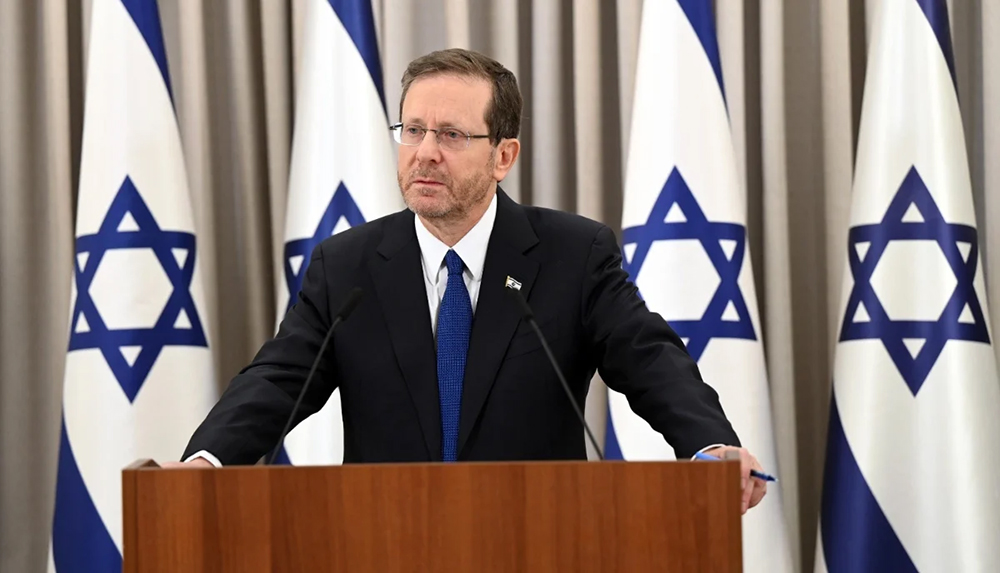
In a speech that blended moral clarity, historical memory, and political confrontation, Israeli President Isaac Herzog delivered one of the most forceful addresses of his presidency at the International Conference to Combat Antisemitism, issuing a direct rebuke to New York City Mayor Zohran Mamdani and framing the denial of Jewish self-determination as a modern expression of antisemitism. According to a report on Tuesday at by the Tazpit Press Service (TPS), Herzog’s remarks were among the most uncompromising statements ever delivered by an Israeli head of state on the subject of global antisemitism, Zionism, and the moral boundaries of political discourse.
The conference, held on Tuesday in Jerusalem on International Holocaust Remembrance Day, brought together international leaders, diplomats, scholars, and civil society figures to address the accelerating crisis of antisemitism worldwide. Among the attendees was Albanian Prime Minister Edi Rama, underscoring the global scope of the gathering and the urgency of its mission. Yet it was Herzog’s address, captured and disseminated TPS, that defined the emotional and political center of the event.
Standing before an audience shaped by memory, trauma, and history, Herzog delivered a sentence that reverberated far beyond the conference hall: “Denying the right of the Jewish people—and only the Jewish people—to self-determination in their national home is antisemitism. Even if you are the mayor of the city with the largest number of Jews outside of Israel.”
The reference to Mayor Mamdani was unmistakable. New York City, home to more than 1.1 million Jews, represents the largest Jewish population outside the State of Israel. By invoking that demographic reality, Herzog was not merely making a political point; he was drawing a moral boundary, insisting that identity, office, or constituency does not absolve leaders from responsibility when they cross into ideological delegitimization of Jewish nationhood.
As TPS reported, Herzog framed his remarks not as partisan rhetoric, but as a civilizational warning. He described what he called an “axis of hatred” stretching across continents and ideologies, linking state actors like Iran, terror organizations such as Hamas, institutionalized antisemitism in international forums, and the normalization of harassment on Western campuses. In Herzog’s formulation, these were not isolated phenomena but interconnected expressions of a single historical pathology.
“The same ancient plague has returned to our societies,” Herzog said, according to the TPS coverage. “The justification may be different, but the poison is the same. It has taken many forms, but it has always borne one name: antisemitism.”
The speech situated contemporary antisemitism within a long historical arc. Herzog’s rhetoric moved seamlessly from ancient blood libels to modern ideological campaigns that deny Jewish national legitimacy. In doing so, he reframed the discourse: antisemitism, he argued, no longer requires caricatures or explicit slurs. It can manifest through the denial of Jewish collective rights while affirming those same rights for every other people.
The address also carried profound emotional weight through Herzog’s reference to Police Master Sgt. Ran Gvili, the final Israeli hostage whose remains were returned from Gaza just one day earlier. As the TPS report documented, Herzog spoke of Gvili not simply as a fallen soldier, but as a symbol of moral courage and national resilience.
“Ran—who did not hesitate for a moment on October 7 and charged straight into the fire to protect his country, its citizens, and human beings everywhere—has finally returned home,” Herzog said. “His return marks a significant turning point. For the first time since 2014, not a single Israeli citizen, living or dead, is being held in Gaza as a human bargaining chip.”
The symbolism of the moment was unmistakable. On a day dedicated to Holocaust remembrance, Herzog linked historical memory to contemporary suffering, collective trauma to national endurance, and mourning to renewal. According to the report by TPS, the hall fell silent as he described Gvili’s return as a moral threshold, a closing of one chapter of grief even as new uncertainties remain.
Herzog publicly thanked the institutions and leaders involved in securing the return, including the Israel Defense Forces, the Israeli government, and the United States. He extended specific gratitude to President Donald J. Trump and his advisers, Steve Witkoff and Jared Kushner, framing the moment as not merely diplomatic success but a foundation for national healing.
“My special thanks go to President Donald J. Trump and his advisors, Steve Witkoff and Jared Kushner. May this moment mark the beginning of a path to healing and rebuilding,” Herzog said, as reported by TPS.
Yet the most haunting and historically resonant passage of Herzog’s speech emerged when he invoked his father, Chaim Herzog, a former Israeli president and British army officer who entered Bergen-Belsen following its liberation in 1945. According to the information provided in the TPS report, Herzog recounted how his father addressed the survivors of the camp, telling them: “There are more Jews.”
“My father shouted to his bruised and tortured brothers and sisters: ‘There are more Jews!’” Herzog said. “My friends, there are more Jews. We are here. The people of Israel are alive. Not by the grace of others, but by virtue of our labor, our strength, our courage, our determination, our faith in God, and our deep faith in life.”
The line captured the philosophical core of the address. Jewish survival, Herzog insisted, is not a product of tolerance granted by others but of self-determination forged through endurance, identity, and collective will. It was a direct rejection of dependency narratives and a reaffirmation of sovereignty as a moral necessity rather than a political preference.
The broader context of the conference amplified the gravity of Herzog’s message. International Holocaust Remembrance Day, marked annually on January 27, commemorates the liberation of Auschwitz-Birkenau by Soviet forces in 1945. Six million Jews across Europe and North Africa were systematically murdered by Nazi Germany and its collaborators. According to the TPS report, Herzog deliberately anchored his remarks in this historical reality, warning that the erosion of moral boundaries begins not with violence but with ideological delegitimization.
In this framing, the denial of Jewish self-determination is not a political critique but a form of cultural erasure. It removes Jews from the category of legitimate peoples entitled to nationhood, sovereignty, and historical continuity. Herzog’s intervention therefore sought to redefine the parameters of acceptable discourse in international politics and civil society.
As TPS analysis noted, the president’s speech marks a strategic shift in Israel’s diplomatic rhetoric. Rather than responding defensively to accusations, Herzog articulated a normative doctrine: that anti-Zionism which uniquely targets Jewish national existence is not separate from antisemitism but structurally identical to it.
The implications extend far beyond Israel’s borders. In Western democracies, where discourse increasingly separates Jewish identity from Jewish nationhood, Herzog’s declaration challenges a prevailing ideological framework. It asserts that Jewish peoplehood is not merely religious or cultural, but national, historical, and political in the same sense as any other people.
For the Jewish communities of New York City, Europe, and beyond, Herzog’s words carried both warning and reassurance. Warning, that antisemitism has evolved rather than disappeared. Reassurance, that Jewish identity remains rooted not in victimhood but in resilience.
According to the TPS report, diplomats and community leaders present at the conference described the address as “defining,” “historic,” and “transformative.” It did not merely condemn hatred; it redefined its modern forms, mapped its global networks, and articulated a moral doctrine of resistance grounded in sovereignty and dignity.
In Jerusalem, on a day consecrated to memory, Herzog transformed remembrance into resolve. His message was not confined to mourning the past but confronting the present. Antisemitism, he declared, is no longer only the ideology of extremists—it is embedded in institutional frameworks, political language, and cultural narratives that deny Jewish legitimacy in their own land.
And yet, the speech ended not in despair, but in affirmation. “There are more Jews,” Herzog said. Not as defiance alone, but as declaration of continuity. Not as resistance only, but as renewal.
As the TPS report observed, the address stands as one of the most significant moral statements delivered by an Israeli president in a generation—binding Holocaust memory, contemporary geopolitics, Jewish identity, and the future of self-determination into a single, unambiguous declaration: the Jewish people are here, they are sovereign, and their existence is not subject to ideological negotiation.

The return of a body is the least of our concerns, and resolves nothing. The Jewish people’s focus must be on the actual full destruction of “Palestinianism”, leaving the arabs in Gaza and Judea/Samaria crushed and despondent, with no claim or hope of survival or revival. The same must be true of their supporters, including among American “Jews”, the most vile supporters of Muslim scum Mamdani.