



|
Getting your Trinity Audio player ready...
|
By: Carl Schwartzbaum
From his office in Jerusalem, amid the lingering echoes of a multi-front war that has reshaped Israel’s strategic environment and rattled the conscience of the world, U.S. Ambassador to Israel Mike Huckabee speaks with an unflinching confidence rarely heard in modern diplomacy. Hamas will be disarmed, he insists—not as a hypothetical aspiration, but as an inevitability. And beyond Gaza, the Middle East itself, he believes, is on the cusp of a broader realignment, with new nations poised to join the Abraham Accords in the coming year.
In an extensive and deeply candid interview with The Jewish News Syndicate (JNS), Huckabee laid out a sweeping vision of what lies ahead: the enforcement of red lines against terrorist groups, the consolidation of a fragile ceasefire into something more durable, the expansion of Arab-Israeli normalization, and a blistering indictment of what he views as a global media ecosystem hostile to Israel and indifferent to truth. Throughout the conversation with JNS, Huckabee returned again and again to a central theme—clarity of purpose—arguing that consistency, not caution, is the currency of successful statecraft.
“The challenge of getting Hamas disarmed is not a goal that has been abandoned,” Huckabee told JNS in the exclusive interview, conducted inside the U.S. Embassy in Jerusalem. His tone was neither rhetorical nor speculative. “The president has been very clear: They have to disarm and recognize they have no future in Gaza.”
Those remarks come as President Donald Trump’s Gaza ceasefire plan is expected to move into its second phase next month, following an anticipated meeting between Trump and Israeli Prime Minister Benjamin Netanyahu in Florida after Christmas. As JNS has reported, the transition to phase two is fraught with uncertainty, particularly in light of Hamas’s public refusal to surrender its weapons—a stance that has led many observers to question whether the ceasefire can endure.
Huckabee does not dismiss those concerns. “Am I concerned? Of course,” he said to JNS. “But do I feel it won’t happen? No.” His confidence, he explained, rests on two pillars: the unambiguous messaging from President Trump and the steadfast alignment of regional Arab partners behind the same core demand.
“No one has backed off on that,” Huckabee told JNS. “Everyone still agrees to that.”
He framed the moment as a test of resolve rather than diplomacy alone. “It is absolutely going to happen,” he said. “President Trump said they can do it the easy way or the hard way.” Drawing a pointed analogy, Huckabee referenced Iran, noting that Tehran had once dismissed similar warnings—only to suffer severe consequences. “They took the hard way,” he said.
Since the Oct. 10 ceasefire went into effect, the situation on the ground has stabilized, though not without friction. Huckabee acknowledged to JNS that intermittent skirmishes have continued, but emphasized that the overall trajectory is positive. Recruitment is underway for an international security force to help stabilize Gaza, and humanitarian aid is flowing into the enclave on a daily basis.
“We are definitely in a much better place than we were two months ago,” Huckabee told JNS, offering fulsome praise for President Trump’s role in brokering the ceasefire. “It’s the first time in two years that Israelis can go to bed without anticipation of missiles.”
That sense of relative calm, fragile as it may be, has created diplomatic space for broader planning—particularly around the composition of the proposed international security force. Huckabee acknowledged that Israel retains what he described as “somewhat of a veto role” over which nations participate, a reflection of Jerusalem’s hard-earned security sensitivities.
Turkey’s potential involvement remains one of the thorniest issues. While the United States favors a broad coalition, Israel has expressed deep reservations about Ankara’s role. Huckabee suggested that compromise is possible. “We recognize Israel has a right to say—somewhat of a veto power on certain participation,” he said. “It doesn’t mean that the Turks can’t have some role.”
As the JNS report noted, U.S. Middle East envoy Steve Witkoff held talks in Miami with senior officials from Qatar, Egypt, and Turkey as efforts continue to push the ceasefire into its next phase.
Beyond Gaza, Huckabee offered a strikingly optimistic forecast for the region as a whole. He told JNS that he expects additional countries to normalize relations with Israel next year under the framework of the Abraham Accords.
“I’m just an ambassador, not a prophet,” Huckabee said, “but based on everything I’m seeing and being a part of, I do anticipate that we will see the expansion of the Abraham Accords [in 2026].”
Perhaps most striking was his suggestion that the next breakthroughs could come from Israel’s immediate neighborhood. “I would not be overwhelmingly surprised if you didn’t see something that would happen very close to Israel, in Syria, Lebanon,” he told JNS—a statement that illustrates how dramatically the regional conversation has shifted since the accords were first signed.
Huckabee acknowledged that the situation remains “fragile to be sure,” but argued that pragmatic self-interest is increasingly overriding ideological hostility. “Neighboring countries increasingly understand that there is far more to be gained from normalization with Israel than to be at odds with the Jewish state,” he said.
Once again, he returned to Trump’s role. “President Trump is in a very good place to help deliver that,” Huckabee said. “I don’t think anybody else could do that. He has an uncanny ability to do things that everybody said cannot be done.”
While Huckabee’s assessment of regional diplomacy was measured and hopeful, his critique of global media coverage was anything but restrained. One of his greatest frustrations has been watching what he views as relentlessly hostile and misleading reporting about Israel throughout the war.
“There is an enormous level of evil in the world and a lot of it gets printed on the pages of what once were respected newspapers and sites,” Huckabee said. “I think for the most part journalism is dead. What we have now is an international opinion market.”
He cited claims—some originating from U.S. allies such as the United Kingdom—that Israel deliberately prolonged the war or intentionally starved Gazans. Huckabee dismissed such allegations as outright falsehoods. “Gullible people soaked [them] in like poisons,” he told JNS.
“It has been so frustrating to watch this from a front-row seat right in the middle of this,” he added.
Huckabee was equally scathing about anonymous leaks and unnamed sources—often amplified in the Israeli press—purporting to reveal tensions between the Trump administration and the Netanyahu government. Such reporting, he said, is driven by agenda rather than fact.
“If there was some major dustup between the U.S. or President Trump and the prime minister of Israel, don’t you think his representative in Israel would be informed of that?” Huckabee asked JNS. “It’s absurd.”
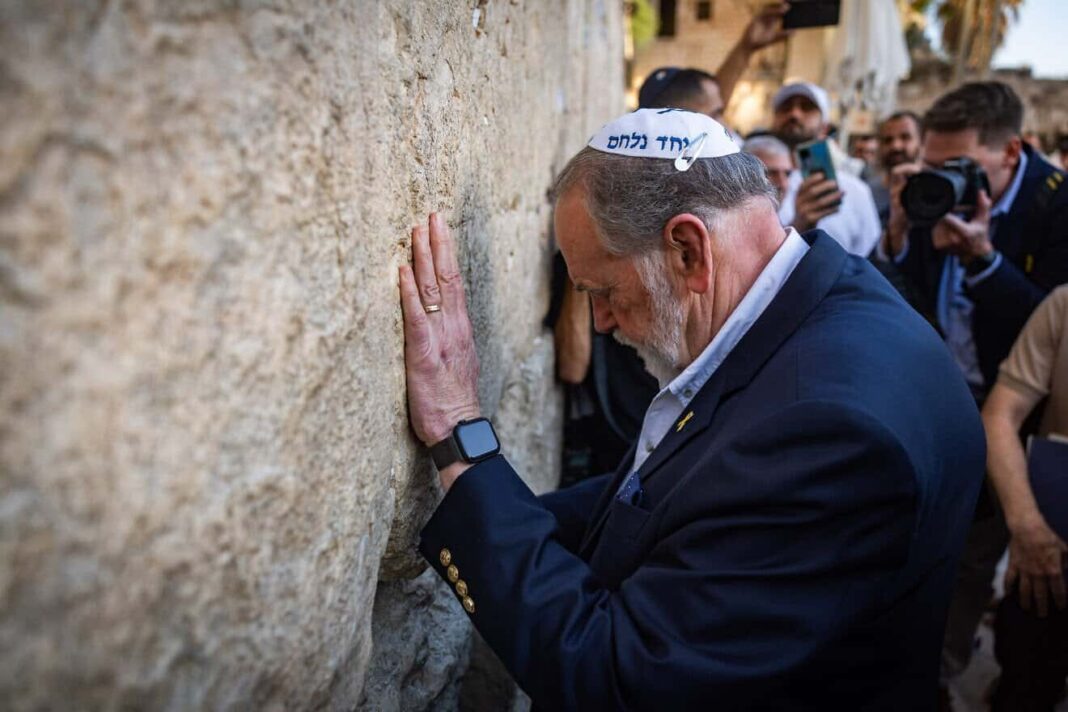
At 70 years old, Huckabee brings a singular personal history to his role. A Baptist pastor, former Arkansas governor, television host, and two-time Republican presidential candidate, he has visited Israel scores of times since his first trip just before the 1973 Yom Kippur War. He has led thousands on solidarity tours and openly refers to himself, half-seriously, as a modern “Maccabee.”
From his embassy perch in Jerusalem, Huckabee lived through six months of a multi-front war after taking up his position in April. “I haven’t seen this much war since the Baptist Convention in 1982,” he joked. Yet he expressed palpable relief that nightly dashes to bomb shelters have subsided. “My wife no longer has her ‘missile clothes’ at the foot of the bed,” he said.
Still, his concern has shifted outward—to the surge of antisemitism worldwide. Huckabee blasted what he described as an atmosphere of “irrational Jew-hatred,” noting with particular anguish that such sentiments have appeared even within his own political party.
“I am constantly saying to my fellow Christians that every enemy that Israel has and the Jewish people has is ultimately the enemy of the Christian people and of America,” he told JNS. “Our value systems are based on the same platform.”
He emphasized what he called the shared Judeo-Christian foundation of both nations. “Without the heritage of Abraham, Isaac and Jacob there would be no Israel,” Huckabee said, “but there would also be no America.”
Despite the intensity of the job, Huckabee describes his ambassadorship as deeply fulfilling. A recent visit back to Arkansas only reinforced that sentiment. “We went back home…for five-and-a-half days,” he told JNS. “It was great to see the grandkids, friends and neighbors.”
But when it came time to return, the decision felt natural. “As we were packing up…my wife and I looked at each other and said it is time to come back home,” he said—referring not to the United States, but to Israel.
For Huckabee, Israel is no longer merely a diplomatic posting; it is, in his words, “the assignment of a lifetime.” And as he told JNS repeatedly throughout the interview, the stakes—moral, strategic, and civilizational—could not be higher.
