



|
Getting your Trinity Audio player ready...
|
By: Fern Sidman
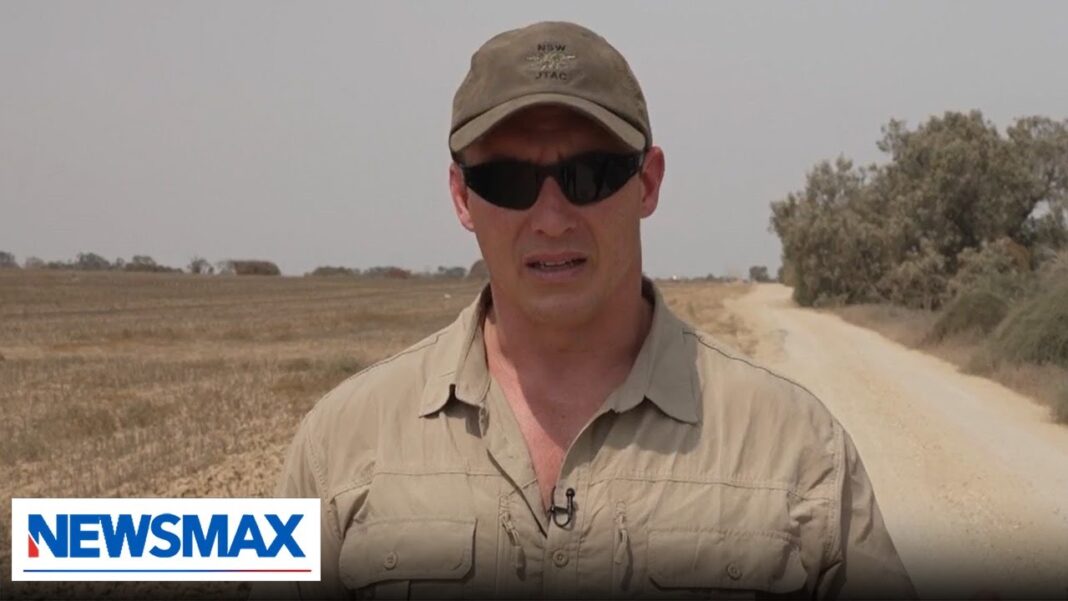
From the edge of the Gaza war zone, amid the thud of artillery and the echo of distant airstrikes, Newsmax host Carl Higbie delivered a searing assessment of the United States’ role in enabling Hamas’ rise to power on Tuesday. Speaking on special assignment for Carl Higbie FRONTLINE, Higbie said that billions of dollars in U.S. aid — funneled into Gaza over decades — strengthened the terrorist group’s hold on the enclave, while humanitarian relief meant for civilians was hijacked and repurposed to serve Hamas’ military and political objectives.
Higbie detailed how, starting with the Clinton administration, the U.S. Agency for International Development (USAID) and other programs directed vast sums to Gaza under the banner of humanitarian assistance. Citing Newsmax reporting, he said that before President Donald Trump cut off the funding stream, USAID alone had sent $2.1 billion into Gaza. Of that, $200 million was categorized for “miscellaneous foreign awardees” in Judea and Samaria and Gaza — a label Higbie said lacked any transparency or clear accountability.
“What does that even mean?” Higbie asked during his broadcast. “There was no transparency at all for any of these receipts, and that goes directly to Hamas.”
The absence of detailed oversight, Higbie charged, allowed Hamas to appropriate U.S. taxpayer dollars to construct the infrastructure and political control mechanisms that now give it dominance over every aspect of life in Gaza. According to the report on Tuesday at Newsmax, this system has facilitated the group’s ability to intercept, divert, and weaponize humanitarian aid intended for ordinary civilians.
Higbie also underscored the concurrent role of Iran, which he said poured weapons, training, and other material support into Hamas over the same period. As Newsmax reported, the combination of American aid without stringent controls and Iranian military backing created a dual pipeline — one financial and one strategic — that left Hamas in a position to not only resist Israeli military pressure but also to control humanitarian access as a tool of coercion.
By blending financial capture with physical intimidation, Higbie argued, Hamas has maintained a stranglehold on Gaza’s population while projecting itself internationally as a victimized resistance movement.
In his field report from the Israeli-Gaza border, Higbie sought to correct what he described on Newsmax as a persistent misrepresentation in international media: that Israel is causing mass starvation in Gaza. From his vantage point, he described witnessing Israeli trucks delivering shipments of aid to Arab drivers, who then transported the goods into the territory.
“The actual aid that’s intended for the real victims — the people who don’t have any means to flee — Hamas steals most of it,” Higbie said. “Once it gets to the intended recipients, they tell people not to take it in the streets at gunpoint.”
This control over distribution, Newsmax reported, effectively ensures that aid serves Hamas’ strategic purposes — rewarding loyalty, maintaining dependency, and reinforcing the group’s dominance over local communities.
Higbie’s most pointed assertion concerned the reality of starvation inside Gaza. While international coverage frequently highlights malnutrition among the general population, Higbie insisted — as Newsmax emphasized — that “the only people starving in Gaza right now are the hostages.”
Israeli intelligence believes roughly 50 hostages remain in Hamas captivity, with about 20 confirmed alive. These individuals, Higbie said, are being held in concealed underground locations, deprived not only of their freedom but of basic sustenance. Their plight, he argued, has been eclipsed in global discourse by a narrative that minimizes Hamas’ responsibility for their condition.
Throughout his reporting, Higbie contrasted the narrative presented in much of the international press with what he witnessed on the ground. As relayed in Newsmax broadcasts, he described an environment where the supposed humanitarian catastrophe is heavily mediated by Hamas’ political and military priorities, where access to aid is a bargaining chip, and where foreign assistance without direct accountability has long contributed to the group’s resilience.
The Newsmax correspondent’s remarks challenge the framing of the Gaza conflict as a unilateral humanitarian crisis inflicted by Israel, instead placing responsibility on Hamas for both the human suffering of civilians and the ongoing threat to the hostages.
Higbie’s commentary also carried an implicit critique of U.S. foreign policy across multiple administrations. By tracing the funding timeline back to the Clinton years and including administrations of both parties, he suggested that the entrenched nature of Hamas’ control is partly the result of a bipartisan failure to condition aid on strict monitoring, recipient verification, and end-use oversight.
As Newsmax has reported in previous segments, Trump’s decision to halt USAID funding to Gaza was framed by his administration as a necessary measure to prevent American tax dollars from indirectly financing terrorist operations. Higbie’s latest on-the-ground assessment appears to bolster that policy rationale, connecting past funding decisions to present-day battlefield realities.
By broadcasting from the edge of the conflict zone, Higbie and Newsmax aimed to bring U.S. audiences unfiltered visuals and direct accounts of how aid transfers take place, how Hamas intercepts supplies, and how the hostage crisis persists out of the public spotlight. The network’s emphasis on physical presence in conflict areas is designed to contrast with second-hand narratives drawn from official statements or non-governmental organization reports.
Higbie’s framing, supported by Newsmax’s editorial coverage, places the humanitarian and military dimensions of the Gaza war within a broader geopolitical context — one where funding channels, foreign influence, and propaganda narratives intersect in ways that shape both local suffering and international perceptions.
As the conflict continues, Higbie’s field reporting for Newsmax suggests that the debate over humanitarian aid to Gaza will remain contentious, particularly regarding its potential diversion to terrorist purposes. His assessment implies that without systemic reform in how aid is delivered, monitored, and verified, future funding — regardless of intent — risks reinforcing the very structures that perpetuate both violence and human misery.
The Newsmax host’s conclusion from his reporting was clear: aid, as currently handled, does not reach its intended targets in a meaningful way, the humanitarian crisis is exploited for political leverage, and the gravest humanitarian emergency — the hostages — remains unresolved and underreported.