



|
Getting your Trinity Audio player ready...
|
By: Fern Sidman
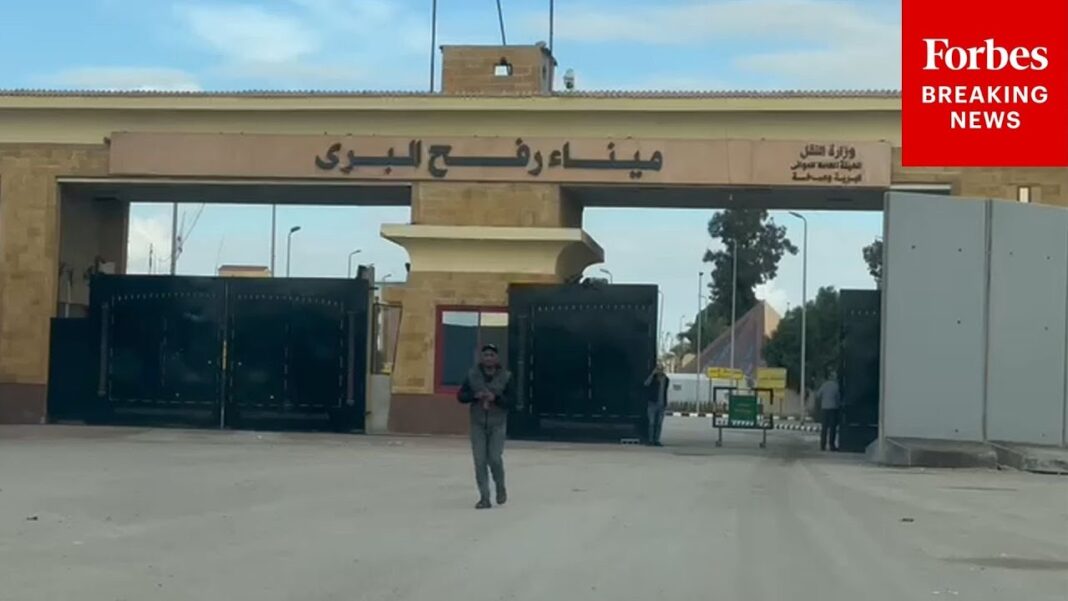
In a development freighted with humanitarian urgency and security calculation, the Israel Defense Forces on Sunday unveiled video footage of a newly established military checkpoint in southern Gaza’s Rafah area, offering the clearest picture yet of how Israel intends to manage the partial reopening of the Rafah Border Crossing after more than a year of near-total closure. As detailed in a report that appeared on Sunday at VIN News, the facility—known as the “Regavim” checkpoint—represents a hybrid model of direct Israeli control, remote technological oversight, and international supervision, reflecting both the fragility of the ceasefire arrangements and the enduring mistrust that defines Israel’s relationship with Hamas-run Gaza.
The checkpoint sits in territory firmly under Israeli military control, just outside the Egypt–Gaza crossing. According to the Israel Defense Forces, its purpose is straightforward in theory but complex in execution: Palestinians returning from Egypt will undergo Israeli security screening before they are permitted to proceed into Hamas-administered areas of the enclave. The screening process, the military says, will involve identity verification against approved lists compiled by Israel’s defense establishment, alongside thorough inspections of luggage and personal effects. Only those who clear these checks will be allowed to pass onward.
For Israel, this arrangement is presented as a necessary compromise between easing humanitarian pressure and preserving hard-won security gains. For Palestinians and international observers, it is a reminder that even the most basic movement across Gaza’s borders remains subject to layers of scrutiny shaped by the ongoing war. The reopening, though limited, marks the first pedestrian access through Rafah since Israeli forces seized the crossing in 2024 amid the intensification of the Israel–Hamas conflict, effectively severing Gaza’s primary outlet to the outside world.
The partial reopening is being rolled out in stages. A pilot phase began quietly over the weekend, with Israeli officials indicating that the scope of pedestrian movement is expected to expand on Monday. The initial priority, according to information provided in the VIN News report, is to facilitate the return of Gazans who fled to Egypt during the height of the fighting. Alongside this, humanitarian aid deliveries from the Egyptian side are resuming, offering a modest but symbolically significant lifeline to a population battered by months of war and deprivation.
Yet the mechanics of the reopening spotlight how profoundly the status quo has shifted. For Palestinians seeking to leave Gaza for Egypt, Israel will not maintain a physical presence at the crossing itself. Instead, the IDF has opted for remote oversight. Officers stationed in a control room will employ facial recognition technology to confirm that departing individuals appear on pre-approved lists. Once verified, Israeli personnel will remotely open the gate, allowing travelers to proceed. On-site screening for those exiting Gaza will be conducted by Palestinian Authority personnel, with European Union monitors observing the process.
This multilayered system is intended to balance competing imperatives. Israeli officials, as quoted by VIN News, argue that remote control reduces friction and limits direct contact between Israeli forces and Palestinian civilians, while still ensuring that individuals deemed security risks cannot exploit the crossing. The involvement of the Palestinian Authority and EU monitors is meant to lend a degree of international legitimacy and transparency to the process, echoing mechanisms used earlier in 2025 before the most recent escalation rendered them obsolete.
Central to the operation is COGAT, Israel’s Coordinator of Government Activities in the Territories. COGAT emphasized that all movement through Rafah—whether into or out of Gaza—requires prior Israeli security clearance and close coordination with Egypt. The EU’s supervisory role, officials stressed, is designed to mirror earlier arrangements while adapting to the new reality of Israeli military dominance over the area.
For Israel, the Regavim checkpoint is as much a statement of principle as a logistical node. By situating the screening facility in IDF-controlled territory and insisting on Israeli approval lists, Jerusalem is signaling that the era of largely unmonitored passage through Rafah is over. The fear, repeatedly articulated by Israeli security officials is that any loosening of controls could allow terrrorists, weapons, or intelligence assets to slip through under the cover of humanitarian movement.
At the same time, the reopening acknowledges the mounting international pressure to alleviate Gaza’s humanitarian crisis. The closure of Rafah since 2024 had cut off a critical artery for civilians seeking medical treatment abroad, families attempting reunification, and aid organizations struggling to deliver supplies. By allowing limited pedestrian movement and resuming aid deliveries, Israel is seeking to demonstrate compliance with ceasefire understandings brokered in part under U.S. auspices, even as it retains decisive leverage over the process.
The introduction of facial recognition technology adds another layer of controversy. Human rights groups have long warned that such systems, particularly when deployed in conflict zones, raise serious privacy and due process concerns. VIN News has reported that Israeli officials defend the technology as a precision tool that minimizes arbitrary decision-making and speeds up processing, reducing the need for prolonged questioning or detention. Critics counter that reliance on opaque databases and algorithms risks errors with life-altering consequences for those affected.
For Palestinians on the ground, the experience of passing through Regavim is likely to be fraught with uncertainty. Even those cleared to return from Egypt must submit to Israeli screening before setting foot back in Gaza, a reality that underscores the extent of Israel’s control over the enclave’s borders. Conversely, those seeking to leave Gaza face the prospect of being vetted by multiple authorities, with approval contingent on factors beyond their visibility or influence.
The broader political context cannot be ignored. The Rafah crossing has long been a symbol of Gaza’s tenuous connection to the outside world, and its control has been a point of contention among Israel, Egypt, the Palestinian Authority, and Hamas. Israel’s seizure of the crossing in 2024 was justified as a security necessity amid intensified fighting, but it also deepened Gaza’s isolation. The current partial reopening, as the VIN News report has observed, reflects neither a return to the pre-war status quo nor a fully new arrangement, but rather an improvised structure born of ceasefire diplomacy and ongoing hostilities.
Egypt’s role, while less visible in the immediate mechanics of the Regavim checkpoint, remains crucial. Cairo has coordinated closely with Israel on the reopening, balancing its own security concerns in Sinai with pressure to alleviate Gaza’s humanitarian plight. The resumption of aid deliveries from the Egyptian side is a reminder that Egypt remains an indispensable intermediary, even as Israel asserts unprecedented control over the crossing.
Internationally, the European Union’s involvement is being closely watched. EU monitors at Rafah serve as a buffer of sorts, offering a measure of oversight that both Israel and the Palestinian Authority can point to as evidence of good faith. Yet their mandate is limited, and their presence does not alter the fundamental asymmetry of power at play. The EU’s role is supervisory rather than decisive, leaving ultimate authority in Israeli hands.
Whether the pilot phase will indeed expand smoothly remains an open question. Past experience at Rafah suggests that even minor incidents can prompt sudden closures or tightening of procedures. Israeli officials have been explicit that the reopening is contingent on calm and compliance, a caveat that hangs over every step of the process. Any perceived abuse of the crossing, they warn, could lead to an immediate reassessment.
For now, the Regavim checkpoint stands as a concrete manifestation of Israel’s attempt to square an almost impossible circle: responding to humanitarian imperatives without relinquishing security control. The video footage released by the IDF appears designed to project order and professionalism, emphasizing structured procedures and technological safeguards. Whether that image aligns with the lived experience of those passing through remains to be seen.
In the broader arc of the Israel–Hamas conflict, the partial reopening of Rafah is unlikely to be a turning point. Yet it is a significant marker of how borders, technology, and diplomacy are being reshaped by war. As Gazans tentatively begin to move again through their southern gate, every passport scanned and gate remotely opened will serve as a reminder that even limited freedom of movement in Gaza is now mediated by an elaborate apparatus of control.
For Israel, the message is clear: humanitarian access will be granted, but only on terms defined by security considerations. For Palestinians, the reopening offers a narrow corridor of hope shadowed by uncertainty. And for the international community, as the VIN News report emphasized, the Regavim checkpoint is a test case—an experiment in whether humanitarian relief and military oversight can coexist in one of the world’s most volatile conflict zones without collapsing under the weight of mutual distrust
