



|
Getting your Trinity Audio player ready...
|
Netzah Yehuda Battalion Completes Full Talmud Study in Memory of Four Fallen Soldiers
By: Fern Sidman
Thirty days after the loss of four of their comrades in combat in Gaza, soldiers from the Israel Defense Forces’ Netzah Yehuda Battalion marked the solemn milestone with a deeply meaningful act of remembrance — completing the study of the entire Talmud (Shas) twice in their honor. As reported by VIN News on Wednesday, the tribute united the battalion’s members in both spiritual dedication and military camaraderie, reflecting the unit’s commitment to honoring the lives of Staff Sergeants Noam Aharon Musgadian, Moshe Shmuel Noll, Meir Shimon Amar, and Sergeant Moshe Nissim Frech.
The four soldiers, all of whom had joined the Netzah Yehuda Battalion in March 2025, were killed in the line of duty during operations in Gaza. To mark the shloshim — the traditional 30-day period of mourning — the battalion leadership, in cooperation with the Netzah Yehuda Organization, initiated an ambitious Talmud study project.
According to VIN News, the Talmud’s 63 tractates were divided among the battalion’s platoons, ensuring that each group would be responsible for multiple sections. In a show of devotion and unity, the soldiers not only completed the entire Shas once but undertook to study it a second time, bringing the total completion to two full cycles.
This initiative, carried out while many of the participants were still in active operational service, demanded both logistical coordination and a sustained commitment from each soldier involved.
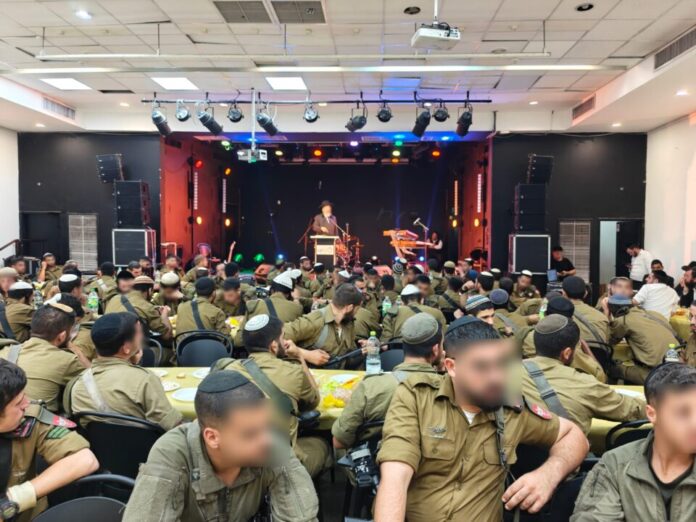
The siyum haShas — the traditional ceremony marking the conclusion of Talmud study — took place at the Gvanim Community Center in Beit Shemesh. As reported by VIN News, the event brought together an array of attendees: the bereaved families, current and former military leaders, local officials, and prominent rabbinic figures, including Sephardic Chief Rabbi David Yosef and former Ashkenazic Chief Rabbi David Lau.
The gathering was not only a religious milestone but also a moment of public commemoration for the soldiers’ sacrifice. Military colleagues, family members, and members of the broader community stood side by side, united by the memory of the fallen and the act of Torah study completed in their names.
Rabbi David Lau led the conclusion of the final tractate, delivering remarks that underscored the spiritual depth of the battalion’s undertaking. As reported by VIN News, Rabbi Lau praised the soldiers for their devotion to Torah learning despite the demands of their military service, calling their accomplishment a testament to their dual dedication — defending the State of Israel while engaging in sacred study.
Addressing the bereaved families directly, Rabbi Lau assured them that their sons’ memories would remain cherished by the nation. “Your sons’ legacy lives not only in the courage they showed on the battlefield but in the words of Torah that will be repeated in their merit for generations,” he said.
Rabbi David Yosef, in his address, encouraged the soldiers to continue embodying the balance between spiritual and physical bravery. According to the information provided in the VIN News report, he emphasized that protecting the Jewish people requires both the shield of military strength and the enduring foundation of Torah wisdom.
The evening’s program also incorporated elements designed to honor the soldiers’ lives through song and shared reflection. Singer Avi Ilson, accompanied by musical director David Nahshon, provided music that intertwined moments of solemnity with expressions of hope. VIN News reported that the combination of music, Torah learning, and personal tributes created an atmosphere of unity, resilience, and mutual support among all present.
Family members, some visibly moved to tears, expressed gratitude for the way the battalion chose to honor their loved ones — not only through formal military ceremonies but through a project that reflected the soldiers’ personal and communal values.
The Netzah Yehuda Battalion, founded in 1999, is known for accommodating religiously observant soldiers, providing frameworks that allow for rigorous Torah study alongside full military duties. This unique identity was central to the decision to commemorate the fallen through the completion of the Shas.
The battalion’s culture fosters a dual commitment: soldiers are trained to excel in combat while maintaining a strong adherence to religious practice. The Talmud project, therefore, was not only a tribute but an extension of the battalion’s defining ethos.
Completing the Shas is a monumental undertaking, requiring the study of tens of thousands of lines of complex legal and ethical discourse. Traditionally, such a siyum is celebrated as a moment of spiritual elevation and communal pride.
In this case, the report at VIN News emphasized that the battalion’s accomplishment was doubly significant — both as a collective act of learning completed in record time and as a gesture of memorialization for comrades-in-arms. The repetition of the full cycle reinforced the depth of the soldiers’ commitment, ensuring that each name would be linked to a complete body of Torah learning.
For the families of Musgadian, Noll, Amar, and Frech, the ceremony marked both a painful reminder and a source of comfort. Their sons had joined the battalion together in March 2025, trained together, and ultimately fell in the same conflict. The unity that marked their service was mirrored in the battalion’s unified approach to honoring them.
The VIN News report noted that for many attendees, the event underscored the inseparability of personal mourning from national remembrance in Israel’s military culture. The soldiers’ sacrifice, while deeply personal to their families, is recognized as part of the broader story of defending the nation.
In concluding the ceremony, both rabbinic and military leaders expressed the hope that the battalion’s act of remembrance would inspire similar initiatives in other units and communities. The Netzah Yehuda Organization pledged to continue supporting projects that integrate spiritual and military commitments, ensuring that the legacy of the fallen soldiers endures in living practice.
The evening closed with a collective recitation of Kaddish, the traditional mourner’s prayer, followed by music that blended sorrow with determination. For those in attendance, the memory of the four soldiers was now bound to the enduring words of the Talmud — a legacy written not only in the history of the battlefield but in the pages of sacred study.
Biographical Supplement: Fallen Soldiers Honored by Netzah Yehuda Battalion
1. Staff Sergeant Noam Aharon Musgadian (20), Jerusalem
A beloved member of the Netzah Yehuda Battalion, Staff Sgt. Noam Aharon Musgadian embodied humility, quiet leadership, and unwavering kindness. According to the Israel Defense Forces Hall of Courage biography, he joined the battalion in August 2023 with a strong sense of purpose—telling family, “If I’m not going combat, then I won’t enlist at all.” Despite never attending a formal leadership course, Noam emerged as a natural leader, stepping in to shoulder the responsibility of platoon command when needed and earning a certificate of excellence shortly before his death
His brother recalled Noam’s ever-present smile and modest nature—he never talked about his actions, not because he had nothing to say, but because he didn’t want to worry anyone. Tragically, Noam was killed while evacuating wounded comrades following an IED explosion in Beit Hanoun. His final words reportedly were: “I feel useful again.” His parents remember him as selfless and thoughtful—always giving, always caring.
2. Staff Sergeant Meir Shimon Amar (20), Jerusalem
Staff Sgt. Meir Shimon Amar, also 20, hailed from Jerusalem and served in the Netzah Yehuda Battalion. He was killed in the same deadly attack in Beit Hanoun. As reported by JNS and other outlets, his loss deeply affected both his family and the broader battalion community
3. Sergeant Moshe Nissim Frech (20), Jerusalem
Sgt. Moshe Nissim Frech was 20 and originally from Jerusalem. Frech had studied at a hesder yeshiva in Haifa, a program that integrates Torah study with shortened military service. His rabbi described him as “the tall, modest kid who radiated a good heart and an infinitely gentle soul.” Despite his quiet nature, Frech’s integrity and humility inspired those around him
4. Staff Sergeant Moshe Shmuel Noll (21), Beit Shemesh
Staff Sgt. Moshe Shmuel Noll, aged 21 and a resident of Beit Shemesh, was laid to rest in a moving funeral attended by hundreds of mourners. Held in Ramat Beit Shemesh, his funeral included deeply felt eulogies, songs like Ani Ma’amin, and Israeli flags, creating an atmosphere of powerful communal grief and solidarity. Led by his father, Rabbi David Noll, the ceremony was marked by expressions of pride and pain, honoring his transformation from a modest young man into a committed soldier
The Fatal Incident
All four—Musgadian, Amar, Frech, and Noll—served in the Netzah Yehuda Battalion when they were killed during a coordinated Hamas ambush on July 7, 2025, in Beit Hanoun, Gaza. They were struck by either IEDs or follow-up gunfire while advancing on foot. Also killed in the attack was Sgt. 1st Class (res.) Benyamin Asulin (28) from Haifa, who served in the Gaza Division’s Northern Brigade. Fourteen additional soldiers were wounded in the incident.
Among these young men, Musgadian stood out for his leadership despite his youth and lack of formal training; Frech for his gentle soul and moral strength; Amar for his steadfast presence; and Noll for his personal growth and commitment to duty.
The Netzah Yehuda Battalion commemorated their sacrifice through the joint completion of the entire Talmud twice—a tribute that intertwined spiritual remembrance with national service. Their memory was held aloft not only by their families and commanders, but through the words they learned and the legacy they left behind.
