



|
Getting your Trinity Audio player ready...
|
By: Fern Sidman
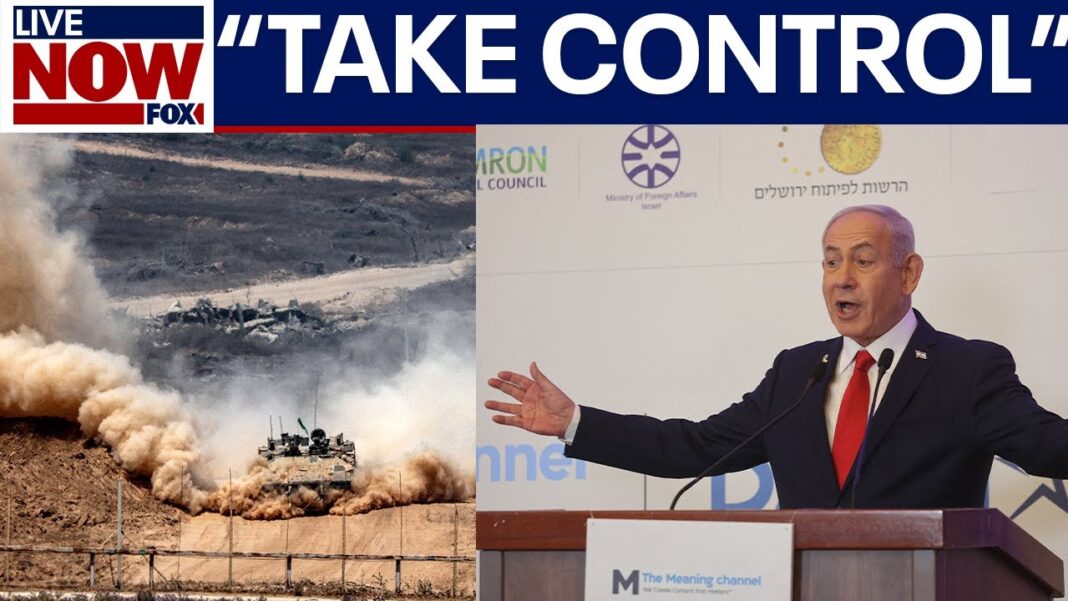
In a bold assertion of Israel’s national security doctrine, Prime Minister Benjamin Netanyahu declared on Thursday that Israel plans to take control of the entire Gaza Strip — a decisive shift aimed at eradicating Hamas’s terror infrastructure and securing long-term regional stability. His remarks, made during an interview with Fox News and reported by The New York Times, underscore the Israeli government’s growing conviction that half-measures will no longer suffice in the face of sustained Hamas aggression.
“We intend to,” Netanyahu responded when asked whether Israel would assume full control over Gaza. “We want to liberate ourselves and the people of Gaza from the awful terror of Hamas,” he said, outlining a vision in which Israel would root out Hamas and then transfer civilian governance to responsible Arab actors.
The prime minister’s declaration comes amid a diplomatic deadlock over ceasefire talks and the continued captivity of Israeli hostages seized on October 7, 2023, during Hamas’s unprecedented cross-border massacre that claimed over 1,200 lives and plunged the region into conflict. As The New York Times report on Thursday noted, efforts to broker a truce have faltered, with both sides trading blame.
In his interview, Netanyahu made clear that while Israel does not wish to permanently govern Gaza, it must ensure that no future threat can arise from the enclave. “We don’t want to keep it,” he emphasized. “We don’t want to govern it. We don’t want to be there as a governing body. We want to hand it over to Arab forces.”
This distinction is critical to Israel’s strategic calculus. Netanyahu’s remarks reflect a growing consensus among senior government officials that any post-Hamas Gaza must not repeat past failures — namely, the vacuum left after Israel’s 2005 withdrawal that Hamas exploited to entrench its rule and launch thousands of rockets at Israeli population centers.
While Netanyahu’s plan has not been spelled out in full, Israeli officials suggest that military occupation — whether temporary or partial — may be necessary to dismantle the terror group’s infrastructure and prevent its reemergence. Sources cited by The New York Times indicate that the Israeli military believes it could seize the remaining Hamas-controlled areas of Gaza within months, though long-term administration may require several years of security oversight.
The proposal is not without internal debate. According to The New York Times report, IDF Chief of Staff Lt. Gen. Eyal Zamir has expressed reservations about the toll that a full occupation could take on Israel’s military readiness and on its reservist corps. Zamir reportedly favors a more limited military footprint, focused on encircling and isolating Hamas strongholds rather than assuming direct governance.
Still, the military has affirmed its loyalty to the democratic chain of command. In a statement released Thursday, General Zamir acknowledged the disagreements, but reaffirmed the IDF’s commitment to carrying out any directive issued by the government. “The culture of debate is a vital component of the IDF’s overall culture — both internally and externally,” Zamir said, as quoted by The New York Times. “We will continue to express our position without fear.”
The prime minister’s proposal represents the most significant strategic divergence between the civilian and military leadership since General Zamir’s appointment in February. Initially seen as more aligned with Netanyahu’s worldview, Zamir has more recently drawn criticism from right-leaning coalition figures who favor a more aggressive posture.
Even so, Netanyahu’s comments reflect a belief that Israel must act unilaterally if necessary to achieve its fundamental war aims: the dismantling of Hamas’s military and political control, the return of all hostages, and the restoration of long-term security along Israel’s southern border.
Critics — including Hamas itself — have decried Netanyahu’s remarks as a provocation. In a statement on Thursday, the Iranian-backed terror group accused the prime minister of reversing course on negotiations and revealing Israel’s “true motives.” But from the perspective of Jerusalem, such reactions confirm Hamas’s intransigence and its enduring commitment to violence rather than coexistence.
The New York Times reported that the Israeli security cabinet convened Thursday evening to deliberate the proposed military expansion. While no final decision has yet been announced, Netanyahu’s public stance is widely viewed as a signal to both domestic and international audiences that Israel is preparing to finish what it started.
Any military advance into Gaza will be closely watched by allies and adversaries alike. The Trump administration has continued to express concerns over civilian casualties and the humanitarian situation in Gaza. Yet even U.S. officials acknowledge that Israel has a right to defend itself against terror entities that embed themselves within civilian infrastructure and violate every norm of warfare.
Israeli leaders, meanwhile, have maintained that the war is not against the people of Gaza but against the terror syndicate that has used the Strip as a launchpad for jihad. “We have no quarrel with Gaza’s civilians,” Netanyahu said. “Our enemy is Hamas — and Hamas alone.”
As the military assesses operational logistics and the cabinet weighs next steps, one thing appears increasingly clear: Israel’s leadership believes that Hamas must not be merely degraded but destroyed. With Netanyahu now articulating a more expansive vision for post-war Gaza, Israel is positioning itself not merely to respond to terror — but to ensure it never rises again.
As The New York Times report observed, Netanyahu’s declaration marks a turning point — not only in military strategy, but in the wider arc of Israel’s national security doctrine. The stakes are enormous, but so is the resolve of a country determined to safeguard its futu
