



|
Getting your Trinity Audio player ready...
|
By: Fern Sidman
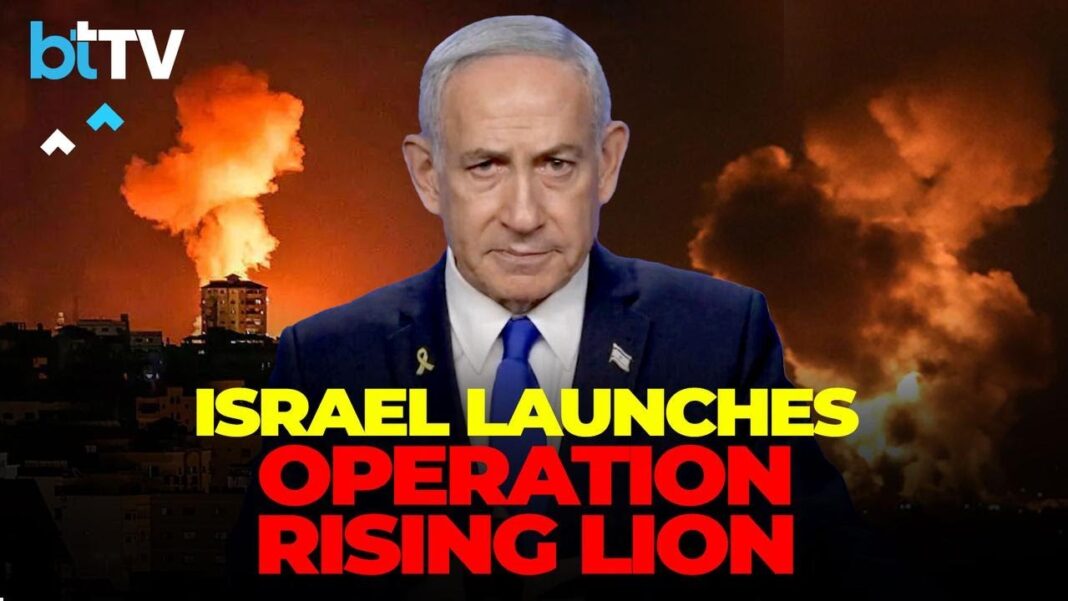
In a solemn and defiant address delivered in the pre-dawn hours Friday, Israeli Prime Minister Benjamin Netanyahu confirmed that the Israel Defense Forces (IDF) had launched a series of targeted strikes deep inside Iranian territory, hitting what he described as the “heart” of Tehran’s nuclear enrichment and weaponization infrastructure. The early morning speech, broadcast across national channels and cited in a report in The New York Times, marked a pivotal moment in the long-simmering shadow war between Israel and the Islamic Republic of Iran.
“We struck at the heart of Iran’s nuclear enrichment program. We struck at the heart of Iran’s nuclear weaponization program,” Mr. Netanyahu declared, his voice resolute against the somber backdrop of an increasingly volatile Middle East. “We also struck at the heart of Iran’s ballistic missile program,” he added.
According to the information provided in The New York Times report, the initial wave of Israeli attacks targeted the Natanz nuclear facility—one of Iran’s most fortified and symbolically critical installations—alongside missile depots, military laboratories, and command-and-control hubs linked to the Islamic Revolutionary Guard Corps. The Times further reported that Israel’s air campaign included precision strikes on residences and meeting sites of senior Iranian officials, as well as direct hits on top nuclear scientists believed to be key to Iran’s alleged effort to achieve a nuclear weapons capability.
Though the full extent of the damage remains unknown, Israeli military sources speaking to The New York Times suggested the strikes were designed not merely to degrade infrastructure, but to send a clear and irreversible message to Tehran: Israel will not allow a nuclear-armed Iran to emerge under any circumstances.
Netanyahu, in his remarks, left no doubt about the gravity of the moment. “We can’t leave these threats for the next generation,” he said. “If we don’t act now, there won’t be a next generation.”
This bold statement, reported by The New York Times, reinforced the Prime Minister’s central thesis: the Iranian nuclear program is not a regional security problem—it is an existential one. The timing of the Israeli operation, named unofficially by IDF sources as part of a broader campaign against Iranian aggression, comes after more than 20 months of sustained conflict with Iran-backed entities such as Hamas in Gaza and Hezbollah in Lebanon.
Perhaps the most emotionally charged portion of Netanyahu’s address was his invocation of the Holocaust, a rhetorical move that carried both symbolic weight and policy clarity. “We are the descendants of those who rose from the ashes,” he said. “We carry their memory. And we carry the duty to ensure that what happened then will never happen again.”
His reference, according to the report in The New York Times, was not mere hyperbole. In recent years, senior Iranian leaders have openly denied the Holocaust while simultaneously vowing to bring about the destruction of the Jewish state. The Prime Minister’s invocation of genocide, then, was not abstract—it was deeply personal, and politically potent.
“Together, with God’s help, we will ensure Israel’s eternity,” Netanyahu concluded.
Back home, the Israeli public braced for reprisal. As reported by The New York Times, bomb shelters were opened across cities and towns, and the Defense Ministry declared a nationwide state of emergency. Citizens were urged to remain close to fortified rooms and prepare for incoming missile and drone attacks, which Israel’s security services assess as likely.
Indeed, early warnings and air raid sirens were already sounding across the country by early on Friday morning, a signal of the high alert under which the IDF now operates.
Iran, for its part, has yet to confirm the full list of casualties or the damage to its strategic assets. However, state media acknowledged that key nuclear sites had been struck, and unverified reports circulating on Iranian social media suggest high-level figures in the defense and scientific communities may have been killed.
The timing of the operation also comes amid reports, cited by The New York Times, that Israel consulted with Washington prior to the strikes. While the United States did not participate directly, administration officials have reiterated their support for Israel’s right to self-defense, even as they urge restraint to avoid broader regional escalation.
Netanyahu’s decision to escalate now, analysts suggest, reflects both strategic necessity and political calculation. As he faces increasing domestic scrutiny and mounting international pressure, the Prime Minister appears determined to define his leadership through the lens of national security and historic legacy.
“He’s not just thinking about Iran,” one defense analyst told The New York Times. “He’s thinking about how history will remember him—as the man who stopped the bomb.”
Whether the Israeli strikes succeeded in permanently crippling Iran’s nuclear ambitions remains to be seen. But Netanyahu has made one thing crystal clear: this was not a one-time message. It was the opening salvo in what he described as a protracted campaign that will last “as many days as it takes.”
With the region now perched on the edge of wider war, all eyes remain on Tehran’s response—and on whether this moment will mark a turning point in one of the most dangerous rivalries in modern geopolitics.
For Israel, the message is unwavering: never again, and never on our watch.
