



|
Getting your Trinity Audio player ready...
|
By: Fern Sidman
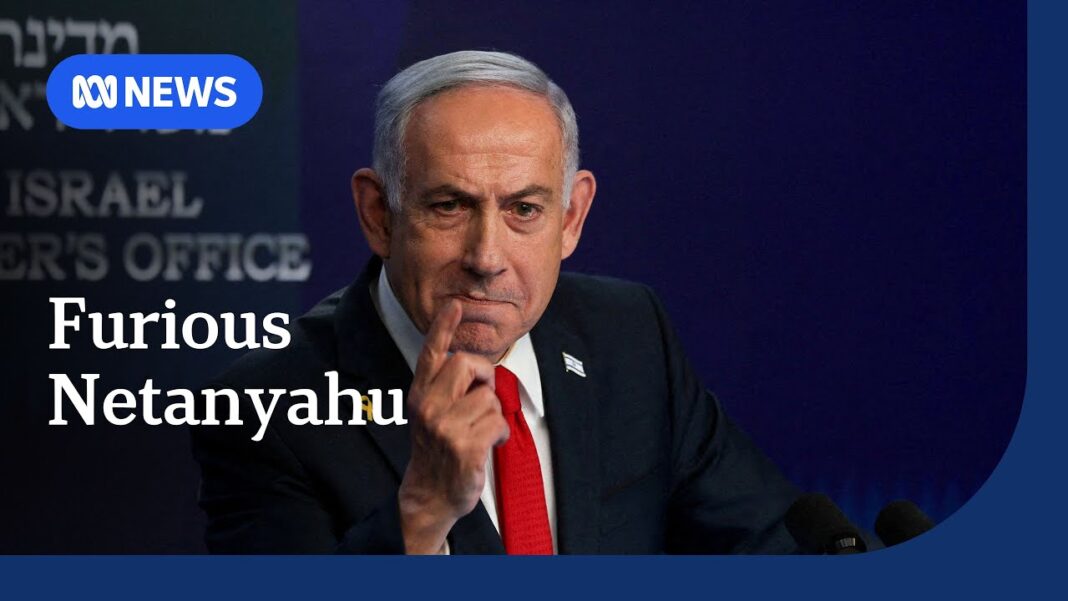
Israeli Prime Minister Benjamin Netanyahu delivered an impassioned address on Sunday evening following the release of disturbing hostage videos by Hamas, vowing to intensify Israel’s campaign until the captives are freed and Gaza can no longer pose a threat. His remarks, carried widely in Israeli media and highlighted in a report at Israel National News (INN), underscored the government’s growing belief that Hamas has abandoned any interest in a negotiated settlement.
“Dear citizens of Israel, like you, I too was shocked yesterday. I saw the horrific videos of our precious sons, Rom and Evyatar. I called their families and embraced them on behalf of myself, my wife, and all of you,” Netanyahu said in his nationally broadcast remarks, quoted extensively in the Israel National News report.
The Prime Minister drew a stark comparison between the condition of the hostages and their captors. “You see them wasting away in a dungeon. But the Hamas monsters surrounding them — they are well-fed, with thick arms. They have everything they need to eat. They are starving our boys the way the Nazis starved the Jews,” he declared.
According to the information provided in the INN report, Netanyahu accused Hamas of orchestrating the videos not as a step toward negotiation but as a tool of psychological warfare. “They don’t want a deal — they want to break us with these horror videos, with the false and grotesque propaganda they spread around the world. But we will not break,” he continued.
The Prime Minister emphasized that the images had only strengthened his determination. “I am filled with even greater determination — to free our kidnapped sons, to eliminate Hamas, and to ensure that Gaza will never again pose a threat to the State of Israel.”
Earlier on Sunday, a senior Israeli official told Israel National News that government assessments now conclude Hamas is not seeking a hostage deal. Instead, the official explained, Israel intends to escalate military operations in Gaza in the hope of securing the captives’ release through force rather than negotiation.
“We are in talks with the Americans,” the official said, according to the report at INN. “There is a growing understanding that Hamas does not want a deal, and therefore the Prime Minister is pushing for the hostages to be freed through military victory — combined with the entry of humanitarian aid into areas outside the combat zones and, as much as possible, outside Hamas’s control.”
This assessment reflects a pivot in Israel’s posture, signaling a willingness to sustain and expand military pressure even as international actors call for restraint. INN reported that Netanyahu’s comments were deliberately framed as both a rallying cry for Israelis and a message to world leaders that the government sees no alternative but victory.
Netanyahu also turned to the global stage in his remarks. On Sunday evening, he spoke with Julien Lerisso, head of the International Committee of the Red Cross (ICRC) delegation in the region, urging the humanitarian body to press for immediate medical aid and food supplies to reach the hostages.
“Hamas’s lie of starvation echoes around the world, while the real, systematic starvation is being inflicted on our hostages, who are suffering brutal physical and psychological abuse,” Netanyahu told Lerisso, in comments cited by Israel National News.
The Prime Minister called on the ICRC and other international organizations to intervene, warning that the treatment of hostages amounts to a clear violation of international law. “The world cannot stand idly by in the face of these shocking images, reminiscent of Nazi crimes,” Netanyahu said.
He further demanded that the international community explicitly denounce Hamas and Islamic Jihad, and halt both direct and indirect support for them. Netanyahu stressed that the groups’ actions are not only acts of terrorism but also contraventions of the Geneva Conventions, which govern the treatment of prisoners in armed conflict.
The repeated comparisons to Nazi atrocities, highlighted throughout Netanyahu’s speech, underscored the government’s framing of the crisis as both a humanitarian and existential struggle. As the Israel National News report observed, this rhetorical strategy serves to remind Israelis of the historical trauma of the Holocaust while emphasizing the urgency of confronting Hamas as a genocidal threat.
Netanyahu’s direct outreach to hostage families — and his choice to publicly share his conversation with them — also conveyed a message of solidarity. According to the information contained in the INN report, the Prime Minister’s references to “our precious sons” reinforced his position that the hostages represent not only private families but the entire nation’s collective responsibility.
As the situation develops, the Israeli government appears committed to a dual-track approach: intensifying military operations in Gaza while simultaneously pressing international organizations to address the humanitarian plight of the hostages.
Israel National News reported that additional ACIP-style cabinet discussions are expected this week to formalize next-stage military actions. Meanwhile, Israel’s diplomatic channels continue to stress to Washington and European capitals that Hamas’s release of hostage videos demonstrates its lack of interest in good-faith negotiations.
For Israelis, Netanyahu’s message was unequivocal: the images of emaciated hostages are intended to sow despair, but instead, they have hardened the government’s resolve. “We will not break,” he declared — a refrain that now appears to anchor Israel’s evolving strategy.
