



|
Getting your Trinity Audio player ready...
|
By: Fern Sidman
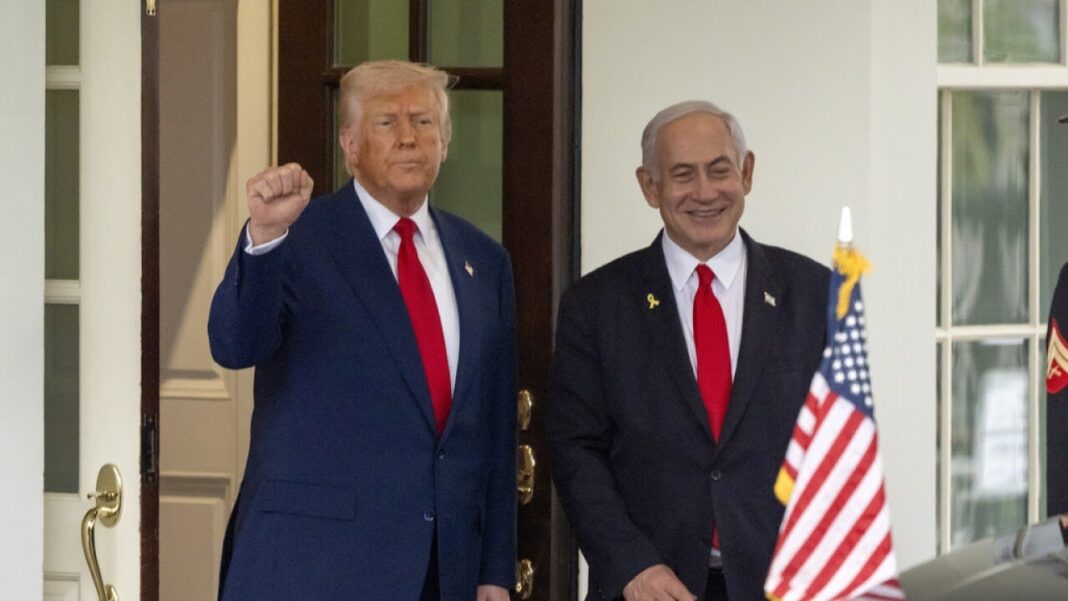
In a scene laden with symbolism and strategic portent, Israeli Prime Minister Benjamin Netanyahu arrived Monday afternoon at the gilded gates of Mar-a-Lago to confer with President Donald Trump, a meeting that a report on Israel National News (INN) has described as one of the most consequential diplomatic encounters since the end of the June war. The gathering was neither ceremonial nor perfunctory. It was a working session between two leaders who, in their own telling, believe they have not merely weathered history but reshaped it.
At the outset, Trump set the tone with characteristic bluntness when speaking with a gaggle of reporters outside his Palm Beach estate. He declared his intention to accelerate the transition to Phase Two of the Gaza peace framework, a move that signals a shift from ceasefire management to long-term stabilization. Yet the president was unequivocal about the precondition: Hamas must be disarmed.
“I want to move to Phase 2 as quickly as possible,” Trump said, according to the Israel National News report, “But there must be a disarming of the Hamas terrorist organization.”
Trump reserved some of his most emphatic language for Netanyahu himself. “He’s a wartime prime minister,” the president told reporters, lauding his Israeli counterpart in front of assembled reporters. “He’s done a phenomenal job. He’s taken Israel through a very dangerous period of trauma. Israel, with other people, might not exist right now.”
INN reported Trump as going even further, suggesting to reporters in his comments that Israel’s survival hinged on Netanyahu’s leadership. “If you had the wrong prime minister, Israel right now would not exist,” Trump said. “We worked together and we were extremely victorious.”
The remarks reflect not merely personal admiration but a shared narrative: that the war in Gaza and the broader regional confrontation were existential tests that only resolute leadership could withstand.
If Gaza represents the immediate front, Iran remains the looming horizon. The Israel National News report emphasized that Trump used the Mar-a-Lago press briefing to reiterate his red lines with startling clarity.
“Now I hear that Iran is trying to build up again,” the president told reporters. “And if they are, we’re gonna have to knock them down. We’ll knock the hell out of them. But hopefully that’s not happening.”
When pressed by reporters on whether he would back Israeli military action should Tehran persist in advancing its nuclear and ballistic missile programs, Trump’s answer was unambiguous: “Yes.”
“Missiles, yes, the nuclear, fast,” he said. “We’ll do it immediately.”
INN analysts noted that these statements go beyond diplomatic signaling; they reassert the strategic alignment between Washington and Jerusalem at a time when Iran is reportedly rebuilding aspects of its arsenal following the June conflict.
Amid talk of disarmament, deterrence, and war, the questions asked by reporters also turned toward the intimate tragedy of hostages still held—or, in some cases, already lost—in Gaza. According to the information provided in the Israel National News report, Trump was asked about the possibility of advancing to the next phase of the ceasefire before the return of the last remaining Israeli hostage, Ran Gvili.
Trump’s response was personal and poignant. Calling Ran a “wonderful young man,” he acknowledged the presence of Gvili’s parents who were inside Mar-a-Lago. “He’s the only one left, and we’re doing everything we can to get his body back,” the president said.
This moment crystallized the dual character of the Mar-a-Lago summit: a negotiation about grand strategy, interlaced with the raw grief of families whose lives remain suspended between hope and mourning.
Netanyahu, for his part, returned the praise with equal fervor. “We’ve never had a friend like President Trump in the White House. It’s not even close,” he told the press assemblage, as reported by Israel National News. “I think Israel is very blessed to have President Trump leading the United States and leading the free world at this time. I think it’s not merely Israel’s great fortune. I think it’s the world’s great fortune.”
This rhetorical symbiosis, INN noted, is more than flattery. It reflects a convergence of worldview in which American power and Israeli security are presented as mutually reinforcing pillars of global stability.
The Israel National News report explained that Phase Two of the Gaza plan is expected to extend beyond the immediate cessation of hostilities into the architecture of post-war governance. It involves the demilitarization of Hamas, the reconfiguration of administrative authority in Gaza, and the deployment of international mechanisms to prevent the enclave from reverting to a launchpad for terror.
Trump’s insistence on disarmament underscores Washington’s determination that any political arrangement must be anchored in hard security guarantees. For Netanyahu, who has repeatedly vowed that Hamas will never again rule Gaza, the alignment is nothing short of strategic validation.
The Mar-a-Lago dialogue also casts new light on the Iranian file. INN has repeatedly warned that while Tehran’s nuclear infrastructure was severely degraded in the June war, its ambitions remain intact. Trump’s readiness to endorse immediate action if Iran resumes enrichment or missile development reinforces Israel’s assessment that deterrence must be backed by credible force.
For Jerusalem, this is not merely a question of nuclear thresholds but of regional hegemony. A resurgent Iran, armed with ballistic missiles and bolstered by proxies from Lebanon to Yemen, would fundamentally alter the balance of power.
The Israel National News report observed that the optics of the meeting resonate deeply within Israel’s domestic political sphere. Netanyahu, who has faced sustained criticism at home, emerges from Mar-a-Lago not as a beleaguered leader but as a statesman welcomed by the most powerful ally Israel has ever known.
Internationally, the summit sends a different message: that the Trump-Netanyahu axis remains a central gravitational force in Middle Eastern diplomacy. For European capitals and regional actors alike, the encounter serves as a reminder that any recalibration of policy toward Gaza or Iran must account for this formidable partnership.
Yet for all the confidence exuded at Mar-a-Lago, the Israel National News report cautioned that the path to Phase Two will be strewn with obstacles. Hamas’s willingness to disarm is deeply uncertain, while Iran’s calculus remains opaque. Even the retrieval of Ran Gvili’s body, an issue Trump framed with heartfelt urgency, is contingent on negotiations with actors who have repeatedly demonstrated contempt for humanitarian norms.
Still, the meeting between Trump and Netanyahu has redefined the diplomatic horizon. It has fused personal rapport with strategic resolve, human grief with geopolitical ambition.
As the INN report noted, one conclusion is inescapable: the Mar-a-Lago summit was not an epilogue to war but a prologue to a new chapter in the long and volatile struggle for Israel’s security and the region’s future.