



|
Getting your Trinity Audio player ready...
|
Netanyahu-Trump Meeting Yields Warning to Iran; Says Hamas Must Disarm
By: Fern Sidman
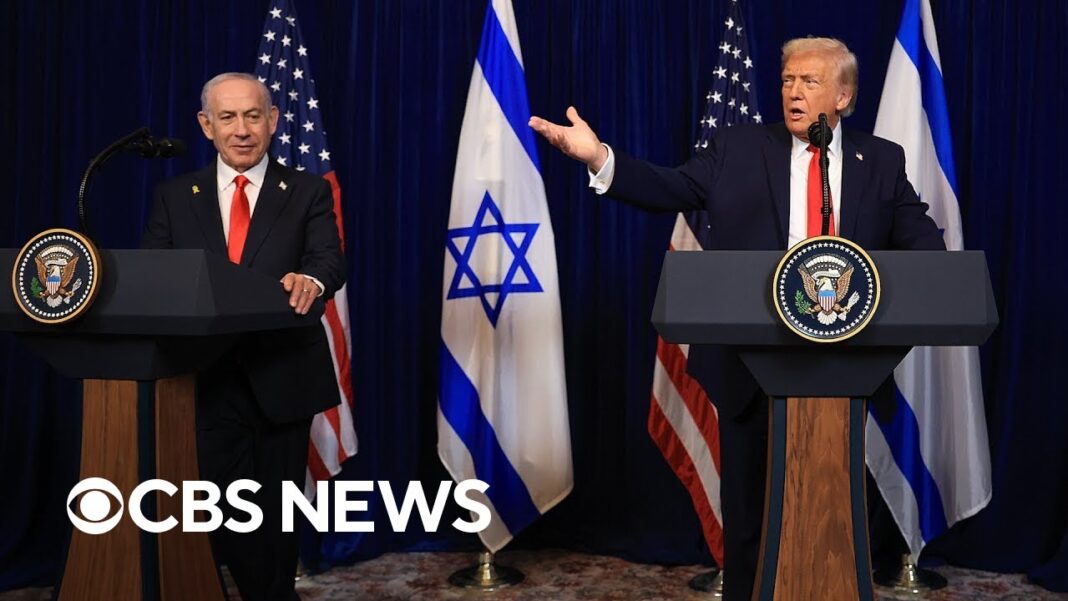
Prime Minister Benjamin Netanyahu’s visit to President Donald Trump at the president’s Mar-a-Lago estate in Florida on Monday unfolded less like a routine diplomatic courtesy call and more like a strategic summit intended to redraw the boundaries of the post-war Middle East. As Israel National News reported repeatedly throughout the day, the encounter produced a series of blunt declarations from the American president that resonated far beyond the gilded halls of the Palm Beach resort, signaling both renewed urgency on Gaza and an unmistakably hawkish posture toward Tehran.
At the press conference following the closed-door talks, Trump delivered a stark warning to Hamas, the Islamist terrorist organization still entrenched in parts of Gaza. According to the information provided in the Israel National News report, the president insisted that the group must abide by its commitments to disarm under the existing ceasefire framework or face catastrophic consequences.
“If they don’t disarm — as they agreed to do — then there will be hell to pay for them,” Trump said, his language deliberately unvarnished. “It’ll be horrible for them, really, really bad for them. I don’t want that to happen, but they made an agreement that they’re going to disarm.”
Trump made clear, as the Israel National News report noted, that he wants to advance rapidly to the second phase of the Gaza peace plan. While details of that phase remain tightly held, the central precondition, in Trump’s formulation, is Hamas’s complete demilitarization.
At the outset of the meeting he said he hoped to move to Phase Two “as quickly as possible,” but stressed that such progress was inconceivable without the removal of Hamas’s military capabilities. This emphasis underscored Washington’s continued insistence that any durable settlement in Gaza must rest on the eradication of armed Islamist rule.
For Netanyahu, who has repeatedly argued that Israel cannot coexist with a rearmed Hamas, Trump’s comments were a diplomatic windfall. The Israel National News report described the prime minister as visibly gratified by the American leader’s unwavering alignment with Jerusalem’s red lines.
Trump reserved some of his most effusive remarks for Netanyahu personally. In comments carried extensively by Israel National News, he described the Israeli leader as a “war-time prime minister” who had guided his nation through “a very dangerous period of trauma.”
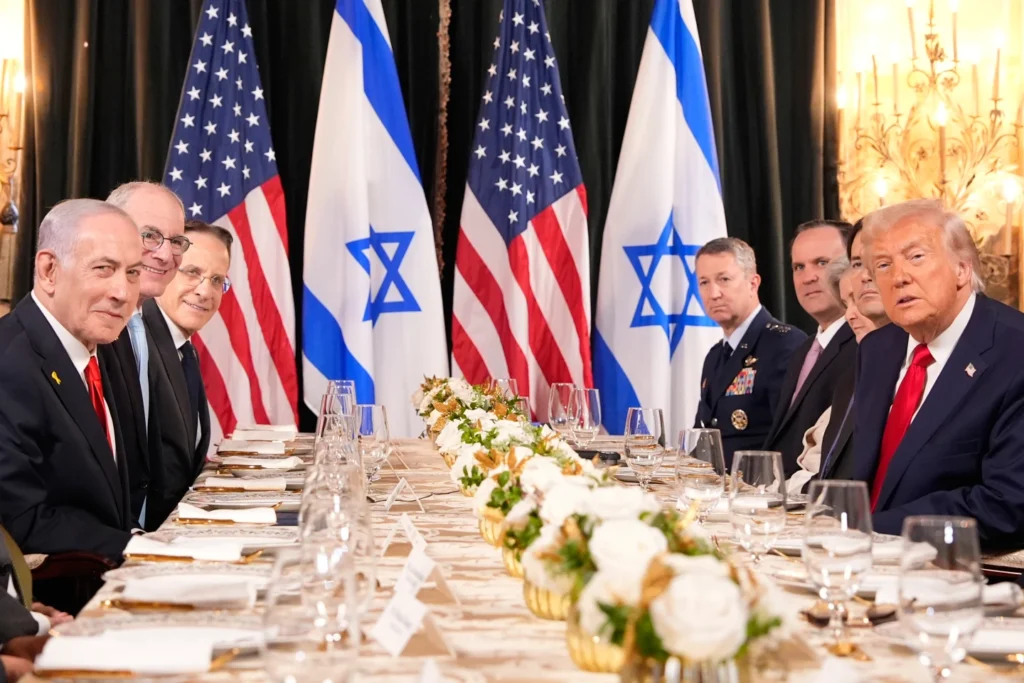
“If you had the wrong prime minister, Israel right now would not exist,” Trump asserted. “We worked together and we were extremely victorious.”
The language was striking, suggesting not merely support but a narrative of shared triumph between Washington and Jerusalem. Netanyahu reciprocated in kind, telling reporters that Israel had “never had a friend like President Trump in the White House,” and added that Trump’s leadership constituted “not merely Israel’s great fortune, but the world’s great fortune.”
If Gaza framed the immediate agenda, Iran loomed as the strategic horizon. Israel National News reported that Trump expressed concern that Tehran might be rebuilding its nuclear program in the aftermath of the June conflict.
“I hear Iran is trying to build up again, and if they are, we have to knock them down,” he told reporters while welcoming Netanyahu to his Mar-a-Lago estate in Florida. “We’ll knock the hell out of them.”
Newsmax reported that Trump also said he remained opento negotiating a “deal,” which he called “much smarter.”
Asked whether he would support an Israeli strike should Iran continue advancing its nuclear and ballistic missile programs, Trump’s answer was unequivocal.
“Yes,” he said. “Missiles, yes, the nuclear, fast. We’ll do it immediately.”
INN analysts note that these statements go beyond diplomatic signaling; they reassert the strategic alignment between Washington and Jerusalem at a time when Iran is reportedly rebuilding aspects of its arsenal following the June conflict.
The Israel National News report emphasized the gravity of this exchange, interpreting it as a rare public commitment by an American president to endorse preemptive Israeli military action against Iran if diplomatic avenues fail.
For Jerusalem, this is not merely a question of nuclear thresholds but of regional hegemony. A resurgent Iran, armed with ballistic missiles and bolstered by proxies from Lebanon to Yemen, would fundamentally alter the balance of power.
Beyond war and peace, Trump also gestured toward a broader diplomatic horizon. On the Abraham Accords, the normalization framework he launched during his first term, Trump told reporters that Saudi Arabia had been “very good” and predicted that Riyadh would eventually sign onto the agreements.
“At some point Saudi Arabia will sign the Abraham Accords,” Trump said, adding that the agreements “will be expanded fairly quickly” as more countries move toward normalization of relations with Israel, as was reported by Newsmax on Monday.
Trump described Saudi Arabia as a key regional player and said relations between Riyadh and Israel are already improving.
Newsmax reported that he credited earlier U.S. diplomatic efforts with laying the groundwork for broader Middle East cooperation and said more nations — both in and outside the region — are prepared to join the accords.
The Abraham Accords, first signed in 2020, normalized relations between Israel and several Arab nations. Trump said discussions with new potential signatories are ongoing and framed the expected expansion as central to long-term regional stability.
Such a development, were it to occur, would dramatically reshape regional alignments and further isolate Iran, reinforcing the sense that Trump views the Middle East not as a static theater of intractable conflict but as a landscape still open to grand bargains.
One of the most emotionally charged moments of the press conference concerned Ran Gvili, identified as the last remaining Israeli hostage in Gaza. According to the information contained in the Israel National News report, Trump referred to Gvili as a “wonderful young man” and spoke directly to his parents, who were present.
“He’s the only one left, and we’re doing everything we can to get his body back,” Trump said.
The phrasing, somber and precise, suggested that hopes for Gvili’s survival had faded, yet it also spoke volumes about the administration’s commitment to resolving the issue before moving deeper into subsequent phases of the ceasefire.
During the meeting, Netanyahu and Trump took a call from Israeli Education Minister Yoav Kisch, who announced that Trump would be awarded the Israel Peace Prize. The American president responded that he would consider traveling to Israel to accept the honor, a gesture that Israel National News characterized as symbolic of the intimacy between the two leaders.
But the summit was not without controversy. Trump told reporters that he had asked Israeli President Isaac Herzog about issuing a pardon for Netanyahu and that Herzog had replied “that it is on the way.”
The statement prompted an immediate rebuttal from the President’s Office in Jerusalem. In a carefully worded response cited in the Israel National News report, Herzog’s office clarified that no such direct conversation had occurred, and that only a preliminary inquiry had been conveyed weeks earlier by a Trump representative.
“Any decision on the matter will be made in accordance with the established procedures,” the statement read, emphasizing institutional process over presidential fiat.
The episode highlighted the delicate constitutional boundaries within Israel, even as Trump’s remark suggested his readiness to intervene in Netanyahu’s legal travails.
Netanyahu, who has faced sustained criticism at home, emerges from Mar-a-Lago not as a beleaguered leader but as a statesman welcomed by the most powerful ally Israel has ever known.
Prior to his meeting with Trump, Netanyahu met with Secretary of State Marco Rubio to discuss regional security, economic cooperation, and the fight against antisemitism. Both leaders emphasized the importance of continued cooperation to promote peace and stability in the Middle East, in line with the vision of President Trump’s 20-Point Peace Plan.
Netanyahu also met with War Secretary Pete Hegseth at the Four Seasons Hotel in Palm Beach ahead of the meeting with Trump at Mar-a-Lago.
Hegseth was joined by US Chairman of the Joint Chiefs of Staff Gen. Dan Caine.
Internationally, the summit sends a different message: that the Trump-Netanyahu axis remains a central gravitational force in Middle Eastern diplomacy. For European capitals and regional actors alike, the encounter serves as a reminder that any recalibration of policy toward Gaza or Iran must account for this formidable partnership.
Taken together, the Mar-a-Lago summit represented more than a cordial reunion. As Israel National News observed throughout its coverage, it functioned as a strategic communiqué, broadcasting to adversaries and allies alike that the Trump-Netanyahu axis remains a formidable force.
To Hamas, the message was unambiguous: disarm or face annihilation. To Iran, it was a warning that nuclear brinkmanship may provoke immediate retaliation. To Saudi Arabia and the broader Arab world, it was an invitation to re-enter the Abraham Accords’ orbit. And to Israelis still reeling from months of trauma, it was reassurance that their prime minister enjoys not merely support but veneration from a powerful ally.
Yet for all the confidence exuded at Mar-a-Lago, the report at Israel National News cautioned that the path to Phase Two will be strewn with obstacles. Hamas’s willingness to disarm is deeply uncertain, while Iran’s calculus remains opaque. Even the retrieval of Ran Gvili’s body, an issue Trump framed with heartfelt urgency, is contingent on negotiations with actors who have repeatedly demonstrated contempt for humanitarian norms.
Still, the meeting between Trump and Netanyahu has redefined the diplomatic horizon. It has fused personal rapport with strategic resolve, human grief with geopolitical ambition.
Whether these declarations will translate into concrete policy shifts remains to be seen. But as the Israel National News report suggested, the meeting’s rhetorical ferocity alone has already altered the diplomatic weather, reminding the region that when Trump and Netanyahu stand together, they speak not in euphemisms, but in ultimatums.