



|
Getting your Trinity Audio player ready...
|
By: Fern Sidman
In a pair of high-stakes meetings in Washington this week, Israeli Prime Minister Benjamin Netanyahu and President Donald Trump engaged in intensive discussions over the crisis in Gaza and the aftermath of a landmark Israeli-American air campaign against Iran’s nuclear infrastructure. As reported by The Algemeiner on Wednesday, the meetings reflected a convergence of strategic urgency and diplomatic ambition, with both leaders aiming to resolve the Gaza hostage crisis while charting a new regional architecture in the wake of what Netanyahu called “the great victory we achieved over Iran.”
Netanyahu’s remarks, shared on the social media platform X, confirmed that his talks with Trump focused heavily on securing the release of the hostages still held by Hamas in the Gaza Strip—an issue that has galvanized Israeli public opinion since the October 2023 terror onslaught that left 1,200 Israelis dead and 251 taken captive. “We are not relenting, even for a moment,” Netanyahu said, affirming that the IDF’s ongoing military pressure on Hamas remains integral to negotiations.
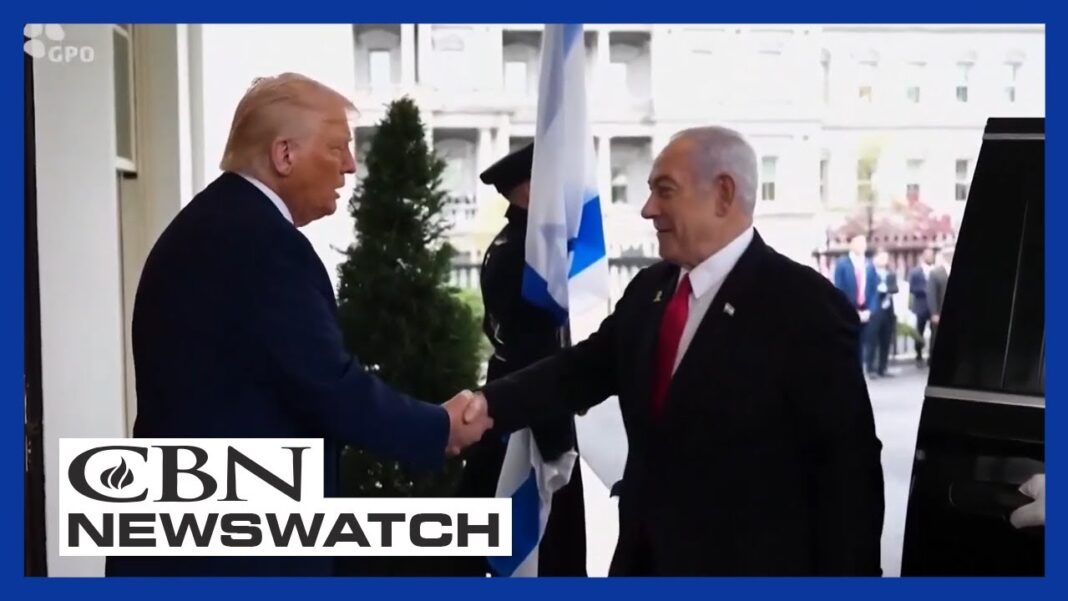
According to the information provided in The Algemeiner report, this was the third visit Netanyahu has made to the United States since Trump began his second term in January. The Israeli premier met with Trump for two consecutive days—first over dinner Monday evening, and then again on Tuesday at the White House in a meeting closed to the press. Later that day, Netanyahu also held brief consultations with Vice President JD Vance and visited the U.S. Capitol for bipartisan meetings with congressional leaders. He is expected to return to the Capitol on Wednesday for further talks with Senate officials.
Steve Witkoff, the president’s Middle East envoy and a close Trump confidante, offered a cautiously optimistic outlook on ceasefire negotiations. Speaking during a Cabinet meeting Tuesday, Witkoff confirmed that “the number of unresolved issues has dropped from four to one,” and suggested that an agreement could be reached by the end of the week. As The Algemeiner report highlighted, the proposed deal would include a 60-day cessation of hostilities and the return of 19 hostages—10 alive and nine deceased.
A Qatari delegation, which has been mediating indirect negotiations between Israel and Hamas, reportedly met with top White House officials prior to Netanyahu’s arrival. While the White House declined to comment on the report, The Algemeiner report noted that Doha’s role has become increasingly central as it tries to bridge the final gaps between the two sides.
Despite movement on the diplomatic front, Netanyahu emphasized that Israel’s campaign in Gaza remains far from over. “We still have to finish the job,” he said. “Release all our hostages, and eliminate and destroy Hamas’ military and government capabilities.” His remarks reflect the delicate balance Israel’s leadership must maintain: projecting a readiness to end the conflict under certain conditions, while preserving military pressure to weaken Hamas and maintain leverage in negotiations.
The Gaza war, now entering its twenty-first month, has become one of the longest and most politically complex conflicts in Israel’s modern history. As The Algemeiner has reported, the initial October 7th attack by Hamas was the bloodiest day in Israel’s history, triggering a sweeping military response that has since targeted Hamas’s command centers, tunnel networks, and weapons caches throughout the coastal enclave. The IDF’s campaign, coupled with mounting international scrutiny over civilian casualties, has pushed both sides toward the negotiating table, though significant hurdles remain.
Among them is the intransigence of Hamas, which continues to demand a permanent cessation of hostilities before agreeing to any hostage releases. Israel, on the other hand, maintains that no ceasefire will be finalized until every last hostage is returned and Hamas is permanently dismantled—both militarily and politically. As The Algemeiner report noted, this impasse has defined the past several months of on-again, off-again negotiations.
Beyond Gaza, Netanyahu’s meetings with Trump took on a broader regional significance, touching on the strategic aftermath of the recent Israeli-American military strikes on Iran. The air campaign—launched in late June—targeted key nuclear sites in Fordow, Natanz, and Isfahan using B-2 Spirit bombers and advanced munitions. The strikes marked the most direct U.S.-Israeli military cooperation against the Islamic Republic in over a decade, and were described by Netanyahu as a “decisive blow” to Tehran’s nuclear ambitions.
“The great victory we achieved over Iran opens new strategic possibilities for the region,” Netanyahu said following his White House visit. “It creates momentum for expanding the circle of peace.” He pointed specifically to the Abraham Accords, the 2020 normalization agreements between Israel and several Arab nations brokered under Trump’s first term, as the framework for renewed diplomatic engagement.
“We are working on this with full vigour,” Netanyahu posted on X, referring to potential new signatories to the Accords. The Algemeiner has previously reported that Saudi Arabia, Oman, and Mauritania are among the nations rumored to be in exploratory discussions with U.S. and Israeli officials.
Observers note that Trump’s re-election and his hawkish stance toward both Hamas and Iran have emboldened Israeli efforts to reframe the conflict not only as a battle for national survival, but as part of a wider ideological and strategic confrontation across the Middle East. Witkoff reinforced this view, stating that “the defeat of Iran’s nuclear program has created the breathing room necessary to recalibrate the region toward peace, prosperity, and deterrence.”
Still, the domestic and international pressures facing Israel are far from resolved. With around 50 hostages still in Gaza—20 of whom are believed to be alive—families of the abducted have become a moral voice of urgency in Israeli society. The report in The Algemeiner indicated that rallies demanding their release have continued in Tel Aviv, Jerusalem, and overseas, with loved ones pleading for a resolution before further lives are lost.
The Biden administration’s previous attempts to mediate were widely seen as stalled by internal disagreements and diverging priorities. In contrast, Trump’s direct and unapologetically pro-Israel approach has re-energized diplomatic channels and placed fresh pressure on Hamas’s Qatari interlocutors.
As The Algemeiner report emphasized, the next 72 hours may prove decisive. A ceasefire agreement could signal a turning point in the conflict, offering a temporary reprieve to Gaza’s war-weary civilians and a long-overdue lifeline to the hostages’ families. But if talks collapse—over the final unresolved issue, or a new act of violence—the war could drag on with renewed intensity.
In the meantime, Netanyahu’s message to both allies and adversaries remains unchanged: Israel will not be deterred. “We will pursue justice, we will free our people, and we will not allow Hamas—or anyone else—to ever threaten our sovereignty again,” he said.
For now, the world watches and waits. And as The Algemeiner observed, the stakes—for Israel, for the hostages, and for the future of the Middle East—could not be higher.

IMO Witkoff is a Qatari agent with Trump‘s knife in his hand behind Netanyahu‘s back. Poor Netanyahu is in the lion’s den. He is putting on a good show, willing to pay any public relations price, while immovably sticking to Israel’s essential interests. But machiavellian Trump is more than willing to sacrifice Israel’s security interests for his personal ones as he continues his absurd quest for “peace” with the Muslim monsters.
The weight of the Jewish state’s and people’s future rests on Netanyahu’s shoulders. And our enemies are at war with us – including assimilated American Jews, the Democrat party, the Israel’s treasonous judiciary’s enemy deep state, the corrupt treasonous leftist and military general staff, Israel’s hateful propaganda enemy “news” media (epitomized by tiny antisemite Haaretz which is loved by our enemies) and the committed leftist Nazis (like Ehud Barak).
The “hostage families” persist for their own mixed reasons, but they are a huge obstacle to finally finishing off the Muslim monsters used as a blackmail by Qatari and Trump’s agent Witkoff, and even now are being used outrageously to free hundreds or thousands of blood-soaked committed muslim monsters to murder again.
This evil blackmail must end! No more negotiations. Hamas needs to be completely destroyed, not “weakened”. The hostages must finally be accepted as necessary casualties while Israel finally eliminates all of the muslim monsters throughout Israel, and deprives Trump of that threatening knife.