



|
Getting your Trinity Audio player ready...
|
By: Fern Sidman
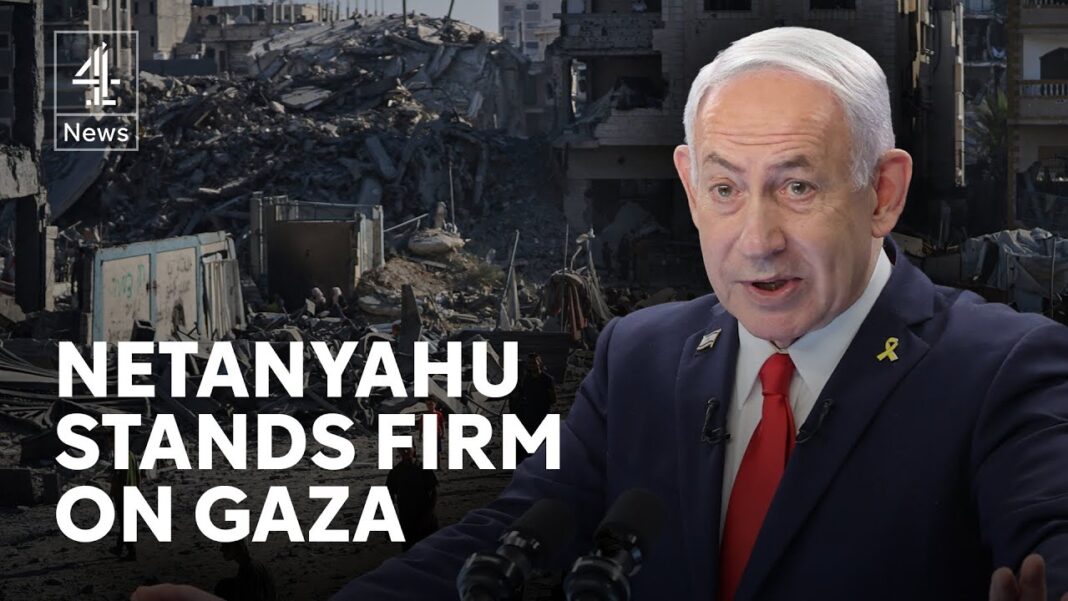
Israeli Prime Minister Benjamin Netanyahu has once again clarified the contours of what his government considers an acceptable end to the war in Gaza. Speaking on Saturday night, the premier announced that Israel would only support an agreement with Hamas if it results in the simultaneous release of all remaining hostages and the fulfillment of several non-negotiable conditions. The Jewish News Syndicate (JNS) reported on Sunday that Netanyahu’s statement represents an unambiguous rejection of partial agreements that could leave hostages behind and Hamas’s military apparatus intact.
“We will agree to an agreement in which all the hostages are released at once and according to our conditions for ending the war, which include the disarmament of Hamas, the demilitarization of the Strip, Israeli control of the perimeter, and the establishment of a governing authority that is neither Hamas nor the Palestinian Authority, and that will live in peace with Israel,” Netanyahu declared in a message conveyed by his office late Saturday.
According to the information provided in the JNS report, these conditions reflect not only the prime minister’s insistence on restoring Israel’s deterrence but also his broader strategic vision for Gaza’s future. In his view, the war must conclude with a transformed security and political reality—one that prevents Hamas from reconstituting its power and ensures that Gaza does not once again become a launchpad for terrorism.
Netanyahu’s statement came against the backdrop of renewed discussion about the viability of a phased agreement. According to Israel’s Channel 12 News, members of the Israeli negotiating team have indicated that Hamas’s position has shifted in recent days in a way that could permit a return to discussions based on the framework proposed earlier this year by U.S. envoy Steve Witkoff. That outline envisioned a staged process, beginning with a partial release of hostages and a temporary cessation of hostilities.
As JNS reported, Israel’s defense establishment has expressed support for exploring such a phased deal, viewing it as a pragmatic step that could save lives and reduce pressure on the military. Certain ministers within Likud, alongside senior security officials, have urged the government not to close the door on the possibility of partial arrangements.
Yet Netanyahu, joined by Strategic Affairs Minister Ron Dermer, Finance Minister Bezalel Smotrich, and National Security Minister Itamar Ben-Gvir, has maintained that Israel should only endorse an agreement that secures the total release of hostages and the realization of Israel’s strategic objectives. In their view, partial agreements risk entrenching Hamas’s leverage and prolonging the conflict without resolving the core issues.
The plight of the hostages remains the most emotionally charged aspect of the war. According to official Israeli figures cited by JNS, 251 individuals were abducted by Hamas and other terrorist groups during the October 7, 2023 invasion of southern Israel. That assault left approximately 1,200 people dead and ushered Israel into a new phase of existential conflict.
As of now, Israeli authorities believe that 50 hostages remain in Gaza, with only about 20 presumed alive. The others are either confirmed dead or their fate is unknown. Hamas also continues to hold the body of IDF Lt. Hadar Goldin, killed in 2014 during Operation Protective Edge, as a bargaining chip.
For the families of the captives, Netanyahu’s insistence on an “all-for-all” deal has been both reassuring and agonizing. On one hand, it ensures that their loved ones will not be abandoned in a staggered arrangement. On the other, it means that ongoing military operations could delay or complicate the possibility of an immediate return. JNS has documented the mounting public pressure on the government, as rallies across Israel demand swift action to bring the hostages home.
Diplomatic maneuvering continues in parallel to Israel’s internal deliberations. A Qatari delegation arrived in Egypt over the weekend, part of what the JNS report described as an “accelerated attempt” to restart negotiations. Qatar, which has long served as a conduit between Hamas and international actors, is once again positioning itself as a critical intermediary in the fragile talks.
The involvement of multiple parties—the United States, Egypt, and Qatar—reflects the complex regional web in which the hostage negotiations are embedded. While the U.S. envoy Steve Witkoff’s framework remains the reference point, the shifting demands of Hamas and the hardening stance of Netanyahu’s government have complicated the path forward.
As diplomacy stutters, Israel’s military preparations continue apace. According to reports highlighted by JNS, the Israel Defense Forces convened a high-level meeting at the Southern Command on Saturday night, where operational plans for a Gaza City offensive were presented to IDF Chief of Staff Lt. Gen. Eyal Zamir. These plans are expected to be refined and then presented to Defense Minister Israel Katz for final authorization.
Already, the IDF has expanded operations in the Zeitoun quarter of Gaza City, focusing on targeting terrorist infrastructure, including tunnel systems, explosives, and gunmen. The military confirmed that it is preparing to relocate civilians from combat zones to southern Gaza in advance of the offensive, underscoring the scale of the operation that is likely to unfold in the coming days.
The report at JNS emphasized that the IDF’s approach seeks to balance military necessity with humanitarian considerations, a balance complicated by Hamas’s documented strategy of embedding fighters and weapons within densely populated civilian areas.
The Israeli Security Cabinet remains divided over how to balance immediate humanitarian imperatives with long-term strategic objectives. Some argue that a partial deal could save the lives of hostages believed to be alive, while others contend that such a move would represent a strategic capitulation.
Netanyahu’s political survival is deeply intertwined with the resolution of this debate. His right-wing allies, including Smotrich and Ben-Gvir, have signaled that they would consider a partial deal tantamount to betrayal, while moderates warn that continued inflexibility could erode Israel’s international standing and deepen domestic unrest.
The hostage crisis and Gaza war have also shaped Israel’s foreign relations. Western governments, particularly the United States, have urged restraint while also affirming Israel’s right to self-defense. The U.S. has backed efforts to mediate a phased deal, believing that even incremental progress could reduce regional tensions.
At the same time, Israel has emphasized that any agreement must not leave Hamas in a position to rearm or consolidate its political hold on Gaza. As Netanyahu’s office made clear, the future governance of Gaza must fall to an entity “neither Hamas nor the Palestinian Authority,” a stipulation that reflects deep skepticism about both factions’ ability to coexist peacefully with Israel.
JNS has observed that this position calls attention to Netanyahu’s broader regional strategy: to dismantle Iran’s network of proxies, weaken Hamas, and create the conditions for new governing structures that do not threaten Israel’s security.
The debate over partial versus total deals is not merely procedural; it cuts to the heart of Israel’s long-term strategy. Accepting a phased deal could offer immediate relief but risk leaving Hamas partially intact, thereby undermining the war’s stated goals. Pursuing an “all-for-all” deal, by contrast, may maximize Israel’s leverage but risks prolonging the conflict and endangering hostages.
Netanyahu’s conditions—disarmament, demilitarization, perimeter control, and new governance—mirror Israel’s broader war aims. Yet the practicalities of enforcing such conditions remain daunting. Who would govern Gaza in Hamas’s absence? How would demilitarization be verified? These unanswered questions make the resolution of the crisis particularly elusive.
The announcement by Prime Minister Netanyahu on Saturday night crystallizes Israel’s current predicament. The government remains committed to securing the release of all hostages and dismantling Hamas, even as international mediators push for more incremental solutions. The IDF continues to prepare for major offensives, while families of hostages brace for prolonged uncertainty.
As divisions sharpen within Israel’s political and security establishment, the choices made in the coming weeks will determine not only the fate of the hostages but also the broader trajectory of the war. Netanyahu’s insistence on a comprehensive deal reflects his conviction that anything less would leave Israel vulnerable to future attacks. Whether that stance can withstand the combined pressures of domestic politics, international diplomacy, and the ticking clock of the hostage crisis remains one of the defining questions of this conflict.
