



|
Getting your Trinity Audio player ready...
|
By: Fern Sidman
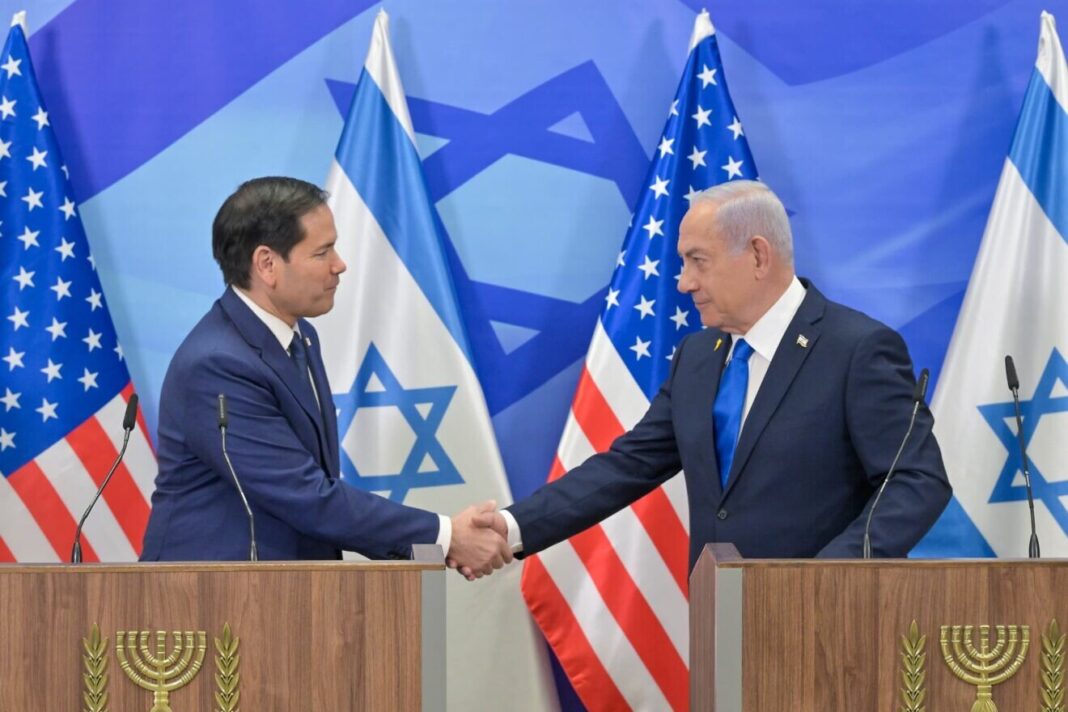
A rare glimpse into the delicate mechanics of Israeli-American diplomacy emerged this week as reports surfaced of a direct and unusually tense exchange between Prime Minister Benjamin Netanyahu and United States Secretary of State Marco Rubio over the highly controversial composition of the Gaza Executive Board. According to information provided in a report that appeared on Tuesday at Israel National News and other Israeli media outlets, the conversation revealed simmering disagreements at the highest levels regarding the shape of Gaza’s “day after” arrangements—and underscored Israel’s growing unease over the inclusion of Qatar and Turkey in any postwar governing structure.
The episode began Saturday night, when the Prime Minister’s Office issued a carefully worded public statement announcing that Netanyahu had instructed Foreign Minister Gideon Sa’ar to formally convey Israel’s objections to Washington. The statement appeared to suggest that the matter would be handled through conventional diplomatic channels, with Sa’ar leading the engagement on Israel’s behalf.
Yet, as Israel National News and Channel 12 later reported, the reality was considerably more complex. Behind the scenes, Netanyahu himself had already bypassed this procedural framework and initiated a direct conversation with Rubio—an indication of how seriously Jerusalem views the issue. Sources close to the talks told Israel National News that the prime minister opted to personally manage the contacts with Washington while publicly allowing Sa’ar to appear as the point man, a maneuver apparently designed to soften the domestic political sensitivity surrounding the dispute.
The controversy centers on the formation of a new international mechanism known as the Gaza Executive Board, a body intended to operate under the broader “Board of Peace” framework unveiled by the Trump administration. The executive board is envisioned as the practical governing organ that would supervise reconstruction, security coordination, and civil administration in Gaza following the cessation of hostilities. While Israel supports the general concept of an international structure to manage Gaza’s future, the identities of several proposed participants have sparked intense concern.
As Israel National News reported, Jerusalem reacted with particular alarm to the inclusion of Turkey and Qatar—two nations long viewed by Israeli officials as enablers and patrons of Hamas. Both countries have historically provided political, financial, and diplomatic backing to the Gaza-based terror organization, and their potential involvement in Gaza’s postwar governance has been widely criticized within Israel’s security establishment.
During the reported phone call, Netanyahu made clear that Israel had serious reservations about the board’s makeup. However, according to sources cited by Israel National News, the prime minister’s sharpest criticism was not directed at the specific identities of the board members themselves, but rather at the manner in which the decision had been announced. Netanyahu reportedly expressed frustration that the composition of the body was publicized without prior coordination with Israel, leaving Jerusalem in the uncomfortable position of reacting to a fait accompli.
This procedural grievance, while diplomatic in tone, reflected a deeper strategic concern: Israel fears that once Qatar and Turkey are formally embedded in Gaza’s governing framework, their influence will be extremely difficult to counterbalance. The Israel National News report emphasized that Israeli officials worry such a scenario could effectively re-legitimize actors perceived as hostile to Israel’s security interests.
According to Channel 12’s account, which was widely cited by Israel National News, Rubio responded to Netanyahu in firm terms. The secretary of state reportedly clarified that Washington had no intention of reversing the decision and that the participation of Qatar and Turkey in Gaza’s postwar arrangements was already settled. Two individuals familiar with the conversation told Israeli media that Rubio made it clear the United States considered their involvement essential and non-negotiable.
Faced with this reality, Netanyahu was said to have expressed disappointment but ultimately recognized that Israel’s room for maneuver was limited. Once the executive board’s composition had been publicly unveiled by Washington, walking it back would have risked a broader diplomatic rupture—something Jerusalem appears keen to avoid at a moment of intense regional volatility.
The Israel National News report further detailed the envisioned structure of the executive board. According to the reports, the body will assign specific portfolios to its members, covering a wide array of responsibilities: stabilization of Gaza, development of governance capacity, coordination of regional relations, oversight of reconstruction efforts, promotion of investment, and management of large-scale financing and capital mobilization. In essence, it is designed to function as the central engine of Gaza’s recovery and transformation.
From Israel’s perspective, however, the concern is not merely administrative. Many Israeli analysts cited by Israel National News argue that any postwar framework must guarantee the permanent demilitarization of Gaza and the complete dismantling of Hamas’s infrastructure. Jerusalem fears that Qatar and Turkey, both longtime advocates of engagement with Hamas, could use their positions to dilute those objectives.
This anxiety has been echoed by senior figures within Netanyahu’s governing coalition. Finance Minister Bezalel Smotrich publicly declared that “countries that resuscitated Hamas cannot be the ones that replace it,” a sentiment strongly reflected in coverage by Israel National News. National Security Minister Itamar Ben-Gvir issued similar warnings, arguing that Gaza does not need international oversight but rather a decisive Israeli-led strategy to eliminate remaining terror elements.
Despite these internal pressures, Netanyahu appears to be treading carefully. The Prime Minister’s Office reiterated after the call that the conversation with Rubio was part of “ongoing contact” between the two leaders. The Israel National News report noted that this phrasing suggested a desire to contain the disagreement rather than escalate it into a full-blown diplomatic confrontation.
The broader geopolitical context adds another layer of complexity. The United States views Qatar and Turkey as critical regional players whose cooperation will be essential to stabilizing Gaza and mobilizing reconstruction funds. Washington also values their leverage over various Palestinian factions, a dynamic that American policymakers believe could help prevent the reemergence of Hamas as a dominant force.
Yet for Israel, the memory of October 7 and the subsequent war remains painfully fresh. As Israel National News has repeatedly emphasized in its coverage, Israeli officials are deeply skeptical of any arrangement that could empower states seen as sympathetic to Islamist movements. The debate over the Gaza Executive Board thus reflects a fundamental clash of perspectives between Washington’s multilateral vision and Jerusalem’s hard-earned security instincts.
The episode also sheds light on Netanyahu’s personal diplomatic style. By directly engaging Rubio while allowing Sa’ar to publicly front the issue, the prime minister signaled both his determination to protect Israeli interests and his awareness of domestic political sensitivities. The Israel National News report observed that the dual-track approach allowed Netanyahu to assert control over the negotiations without undermining his foreign minister.
As the situation continues to evolve, it remains unclear whether Israel will ultimately be able to influence the board’s operations from within or whether it will find itself reluctantly accepting a structure it distrusts. For now, the United States appears committed to moving forward, even as Israeli unease simmers beneath the surface.
What is certain, as Israel National News has reported, is that the battle over Gaza’s future has entered a new and intricate phase—one in which diplomatic maneuvering may prove just as consequential as military strategy. The tense Netanyahu-Rubio conversation serves as a reminder that even among close allies, the path to postwar stability is rarely smooth, and never simple.
With the Gaza Executive Board poised to begin its work in the coming months, Israel will be watching every step with vigilance—and with a firm determination to ensure that, whatever international arrangements emerge, they do not come at the expense of Israel’s long-term security.