



By: Aryeh Savir
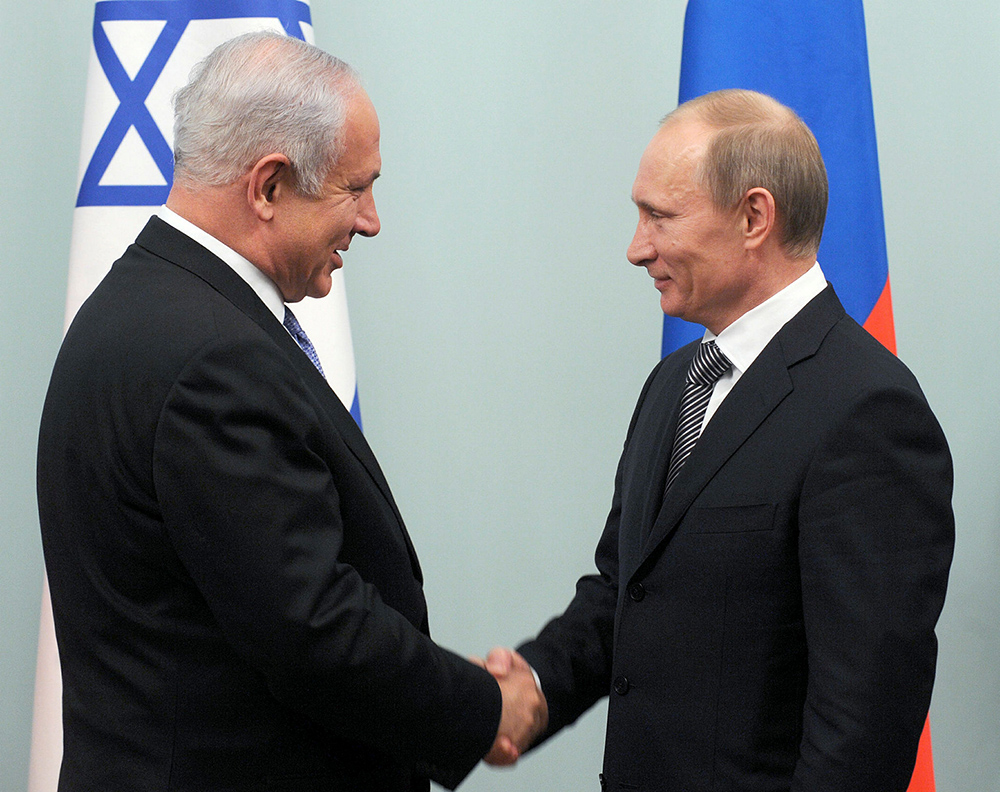
Prime Minister Benjamin Netanyahu spoke on Monday evening with Russian President Vladimir Putin, conveyed holiday greetings to him and to the citizens of Russia on the occasion of Novy God, and wished him a good civil year.
The two discussed “the situation in Syria, developments in the region and the actions necessary to increase stability in it,” Netanyahu’s office stated.
The Kremlin stated that the two discussed “topical issues of Russian-Israeli relations in various spheres and reaffirmed their mutual intention to promote comprehensive bilateral cooperation, including in the context of countering the spread of the coronavirus.”
“The region’s problems with an emphasis on certain developments in Syria were also discussed,” the statement said.
Putin also “warmly congratulated Netanyahu and all Israelis on Hanukkah.”
The two have met and spoken by phone several times during the past years to coordinate activities in Syria, where Russia has deployed significant forces and still backs Syrian President Basher al-Assad’s regime.
The IDF and the Russian army in Syria maintain a line of communication to prevent clashes between the two militaries. Israel warns Russian troops of a pending strike in Syria of they are in the vicinity of the attack.
Jerusalem is interested in Moscow curbing Iran’s operations in the country, as it has significant sway on the goings-on in the war-torn country.
Putin also sent a letter to Netanyahu on the occasion of the new year, stating Russia “attach[s] much significance to friendly relations with Israel.”
“We look forward to extending our joint work next year to build up the entire range of bilateral ties, as well as interaction in addressing urgent issues of the regional and global agenda,” the letter reads.
“This will surely meet the core interests of our peoples and comply with the security and stability needs in the Middle East,” the missive added.
In another development, on December 10th, TPS reported that Russia’s Ambassador to Israel Ambassador Anatoly Viktorov was summoned to the Foreign Ministry following an interview with the Jerusalem Post in which he claimed that Israel, and not Iran, is the problem in the Middle East.
“The problem in the region is not Iranian activities. It’s a lack of understanding between countries and non-compliance with UN resolutions in the Israel-Arab and Israel-Palestinian conflict,” Viktorov asserted in the interview published earlier in the day.
He also claimed that “Israel is attacking Hezbollah; Hezbollah is not attacking Israel.”
The head of the Foreign Ministry’s Strategic-Diplomatic Department Alon Bar met with Viktorov and vehemently protested his remarks.
(TPS)
