



|
Getting your Trinity Audio player ready...
|
By: Fern Sidman
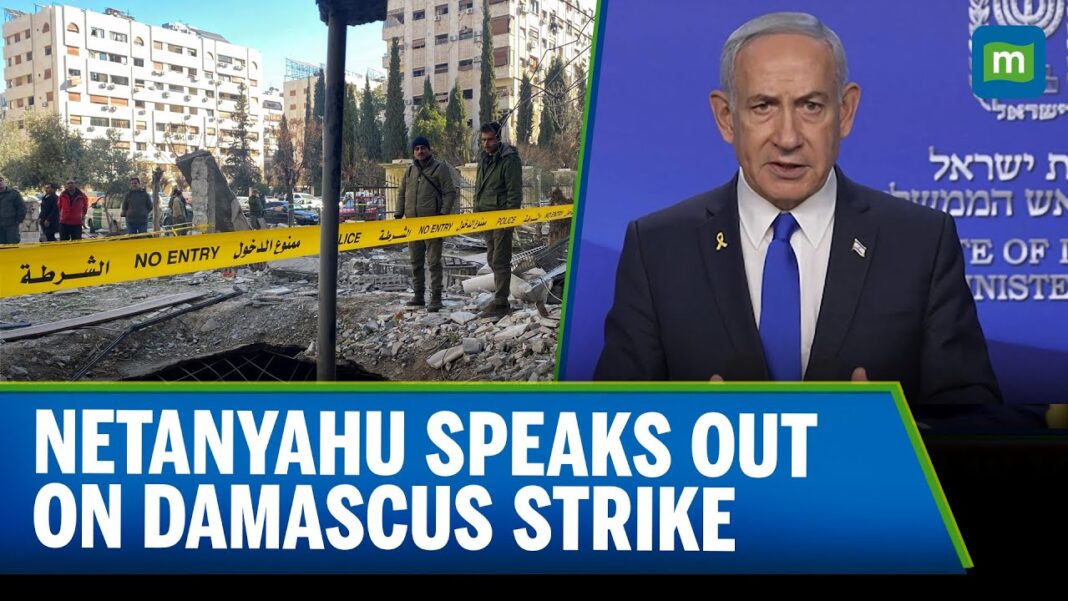
Israeli Prime Minister Benjamin Netanyahu on Thursday articulated Israel’s two overriding strategic objectives in southern Syria: securing the demilitarization of the region south of Damascus and safeguarding the embattled Druze community in that area. As The Algemeiner reported on Thursday, Netanyahu’s statement came on the heels of a series of Israeli airstrikes targeting Syrian regime positions in and around Damascus—actions the Israeli leader said were necessitated by violations of Israel’s red lines by Syria’s Islamist-led government.
“We have set forth a clear policy: demilitarization of the region to south of Damascus, from the Golan Heights and to the Druze Mountain area. That’s rule number one,” Netanyahu declared in a statement cited by The Algemeiner. “Rule number two is protecting the brothers of our brothers, the Druze at the Druze Mountain.”
Netanyahu accused the Syrian regime of blatantly disregarding both principles. According to the Israeli premier, Syrian government forces deployed south of Damascus into zones Israel insists must remain free of military presence, while also initiating violent operations against the Druze population in the area. “The [Syrian] regime sent troops south of Damascus, into the region that has to be demilitarized, and began slaughtering the Druze. That we could not accept in any way,” Netanyahu said, as quoted in The Algemeiner report.
In response, Netanyahu confirmed that he had ordered the Israel Defense Forces (IDF) to take decisive action. “I therefore directed the IDF to take action—and take powerful action. The Air Force attacked both the gangs of murderers and the armored vehicles,” he said. Netanyahu added a third target to the operation, authorizing airstrikes on Syria’s Ministry of Defense in Damascus itself.
Israel launched a series of powerful airstrikes on Wednesday that struck the Syrian Ministry of Defense and inflicted damage near the presidential palace. The strikes followed urgent appeals from Druze leaders in southern Syria who accused the Damascus regime of waging what they termed “a war of extermination” against their community. According to the information provided in The Algemeiner report, these leaders had warned of mounting atrocities in the predominantly Druze city of Sweida.
The escalation came amid fierce clashes between Druze militias and regime forces. The conflict was sparked earlier in the week when tensions between local Druze fighters and Bedouin groups—Sunni Muslim communities with longstanding disputes with the Druze—erupted into violence. The Syrian government dispatched troops to Sweida ostensibly to restore order, but their intervention only inflamed the situation further.
Israel’s military response reflected longstanding Israeli commitments to prevent hostile forces from entrenching themselves along its northeastern frontier and to protect the Druze—an ethnoreligious group with close ties to Israel’s own Druze minority. Netanyahu reiterated this policy on Thursday, declaring, “We will not allow Syrian army forces to enter the region south of Damascus, and will not allow any harm to the Druze at the Druze Mountain,” according to the report in The Algemeiner.
Netanyahu’s statement came just hours after Syrian government forces and Druze leaders agreed to a ceasefire. According to the information contained in The Algemeiner report, Netanyahu credited Israel’s military action with forcing the ceasefire and the withdrawal of regime troops from southern Syria. “As a result of that powerful action [the Israeli strikes], a ceasefire came into force, and the Syrian forces retreated back to Damascus. That is important,” Netanyahu asserted. “This is a ceasefire that was reached through strength. Not by making requests, not by begging—through strength.”
Syrian President Ahmad al-Sharaa responded swiftly, accusing Israel of exacerbating instability in Syria under the pretext of defending the Druze. In a televised speech on Thursday, Sharaa condemned Israel’s airstrikes and alleged that Israel sought to turn Syria into a “theater of chaos.”
“The Israeli entity is trying to turn our land into a theater of chaos,” Sharaa said. Sharaa portrayed Israel’s actions as part of a broader conspiracy to dismantle Syria and sabotage the new government’s attempts at national reconciliation. “Since the regime fell, Israel has sought to dismantle Syria,” Sharaa claimed, referring to the ouster of former Syrian leader Bashar al-Assad.
Sharaa also accused Israel of targeting civilian infrastructure and undermining Syria’s sovereignty. “Syria is not a testing ground for foreign conspiracies,” he stated. “We, the people of Syria, know who is trying to drag us into war and divide us. They want to ignite a conflict on our soil to split our homeland and spread destruction.”
In his speech, Sharaa addressed Syria’s Druze minority directly, reiterating their integral role within the Syrian state. As reported by The Algemeiner, Sharaa underscored the government’s commitment to protecting the Druze and preserving national unity. “You are an inseparable part of our nation. Syria will never be a place for division or internal strife,” he declared. “Protecting your rights and freedoms is a top priority. We reject any effort to lure you into siding with foreign interests.”
Sharaa’s remarks appeared aimed at undercutting Israeli influence among the Druze while presenting the government as a protector of minority rights—a narrative skeptically viewed by Israel and Druze leaders alike.
The latest ceasefire was brokered by the United States following mounting international pressure, The Algemeiner reported. The agreement marked a renewed attempt to resolve the volatile situation in southern Syria, following the collapse of a previous ceasefire. Under the new arrangement, regime forces agreed to withdraw from the region, transferring security responsibilities to local Druze militias—a development seen as both a concession and a necessity amid widespread resistance to Syrian government troops in the area.
The ceasefire’s durability remains uncertain, with both sides accusing each other of violations and ulterior motives. However, for the moment, it has halted a dangerous escalation that risked dragging the region into wider conflict.
The Algemeiner provided background on Syria’s shifting political landscape, noting that Ahmad al-Sharaa assumed power following the collapse of Bashar al-Assad’s regime—a fall precipitated by a rebel offensive led by the Islamist coalition Hayat Tahrir al-Sham (HTS), formerly linked to al-Qaeda.
While Israel has maintained a cautious stance toward the new Syrian leadership, Israeli officials have expressed conditional interest in exploring diplomatic relations with Damascus if its government proves capable of maintaining stability and curbing jihadist influence.
The United States—under the administration of President Donald Trump—has played an active role in shaping the post-Assad Syrian order. The US lifted sanctions on the new Syrian government and has advocated for normalized relations between Israel and Syria. US Special Envoy for Syria Thomas Barrack recently called for a non-aggression pact between the two countries, expressing optimism about the prospects for peace.
The Algemeiner report emphasized that while formal peace remains elusive, the latest ceasefire and Israeli military intervention underscore a complex web of shifting alliances, competing interests, and evolving strategies in the post-Assad era.
As Netanyahu’s statements reflect, Israel’s involvement in southern Syria is driven by a mix of security imperatives and commitments to allied communities such as the Druze. Israeli leaders have consistently viewed the southern Syrian corridor as a critical buffer zone—one they are determined to prevent from falling under hostile control.
At the same time, Syria’s transitional government faces the monumental task of consolidating power, rebuilding war-torn regions, and addressing longstanding sectarian tensions—challenges that are complicated by the specter of Israeli military action and the expectations of the international community.
With the ceasefire in effect and regime forces reportedly withdrawing, the immediate crisis appears to have abated. Yet, as The Algemeiner report indicated, the underlying dynamics—Israel’s security red lines, Syrian regime ambitions, and Druze anxieties—remain unresolved, setting the stage for further scrutiny by regional observers and global powers alike.

Once again Pres. Trump shows the world his personal incompetence and that of his cabinet in misjudging people.