



|
Getting your Trinity Audio player ready...
|
By: Tzirel Rosenblatt
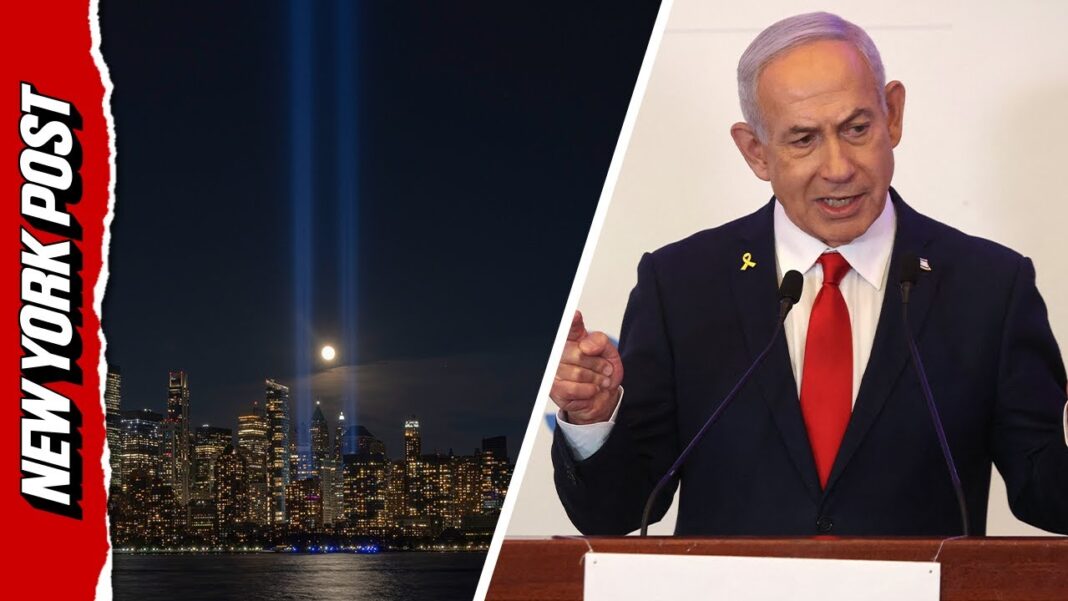
Prime Minister Benjamin Netanyahu on Thursday invoked the memory of the September 11, 2001, terrorist attacks in the United States as he defended Israel’s unprecedented strike inside Qatar targeting Hamas leaders responsible for the October 7, 2023, massacre. The remarks, delivered in a charged address that sought to frame Israel’s campaign in the context of a broader global struggle against radical Islam, immediately reverberated across diplomatic, political, and media landscapes.
As reported by The Jewish News Syndicate (JNS) on Thursday, Netanyahu drew a deliberate parallel between the American experience after 9/11 and Israel’s own trauma following Hamas’s brutal assault nearly two years ago. “We remember September 11. On that day, Islamist terrorists committed the worst savagery on American soil since the founding of the United States,” Netanyahu declared. “We also have a September 11. We remember October 7. On that day, Islamist terrorists committed the worst savagery against the Jewish people since the Holocaust.”
The premier’s framing, as the JNS report noted, is not merely rhetorical. By invoking 9/11, Netanyahu sought to align Israel’s recent strike against Hamas leaders in Qatar with the United States’ post-9/11 campaign against al-Qaeda. “What did America do in the wake of September 11? It promised to hunt down the terrorists who committed this heinous crime, wherever they may be,” he said. “And it also passed a resolution in the Security Council of the U.N., two weeks later, that said that governments cannot give harbor to terrorists.”
“Yesterday, we acted along those lines. We went after the terrorist masterminds who committed the October 7 massacre. And we did so in Qatar, which gives safe haven, it harbors terrorists, it finances Hamas, it gives its terrorist chieftains sumptuous villas, it gives them everything,” Netanyahu continued.
He emphasized that Israel’s operation followed the same model used by the United States when it pursued al-Qaeda in Afghanistan and later eliminated Osama bin Laden in Pakistan. “Now, the various countries of the world condemn Israel. They should be ashamed of themselves,” he said. “What did they do after America took out Osama bin Laden? Did they say, ‘Oh, what a terrible thing was done to Afghanistan or to Pakistan?’ No, they applauded. They should applaud Israel for standing up to the same principles and carrying them out.”
The prime minister concluded with a stark warning to Qatar and other states offering refuge to extremists: “You either expel them or you bring them to justice. Because if you don’t, we will.”
Netanyahu’s remarks come as Israel continues to grapple with the enduring shock of the October 7 massacre, when Hamas gunmen crossed into Israel, killing more than 1,200 people, abducting over 250, and unleashing atrocities that many Israelis describe as the darkest day since the Holocaust. By directly linking that assault to America’s 9/11, Netanyahu reinforced his longstanding argument that Hamas is not merely Israel’s problem but part of a global jihadist movement intent on destroying Western civilization.
As the JNS report observed, the comparison resonates with many Israelis who see October 7 not only as a national tragedy but also as a defining moment in the global fight against Islamist terror.
Several members of Israel’s Knesset echoed the prime minister’s message in interviews with JNS. Likud Party lawmaker Ariel Kallner described the comparison as both “appropriate and essential.”
“This comparison between Oct. 7 and 9/11 is appropriate in that Hamas’s goal on Oct. 7 was to destroy Israel. The percentage of the Israeli population that was murdered on Oct. 7 is greater than the percentage of Americans murdered on 9/11,” Kallner told JNS.
He noted that while the U.S. enjoyed broad international support after 9/11, Israel faces skepticism and even condemnation, particularly from European leaders constrained by electorates with large Muslim populations and from what he described as a “progressive worldview” eroding the West’s moral clarity. “What we need to do is destroy Hamas. It is more justified for Israel to do so than any other country in the world—and of course, what the U.S. did after 9/11 is justified, and the right way to fight evil and radical Islam,” he said.
Religious Zionism Party lawmaker Simcha Rothman, who chairs the Knesset’s Constitution, Law and Justice Committee, also drew a direct analogy to al-Qaeda. “The terrorists who conducted this attack on Israel should be treated no better than Al-Qaeda,” he told JNS.
Rothman emphasized that Israel, unlike the U.S., does not wield the same superpower status, which explains why countries feel freer to criticize its actions. “Those who would never have dared to support anyone attacking America because they feared American power now feel free to do so when it comes to Israel,” he said.
Another voice highlighted by JNS was Religious Zionism Party lawmaker Ohad Tal, who insisted that Netanyahu’s comparison was “correct and precise.” “Israel stands on the front line of the Western and free world against radical Islam,” he said.
“Facing the forces of evil and barbarism—from Iran to the Muslim Brotherhood and their supporters—Israel’s security forces are fighting with strength, bravery, and determination. The terror that struck this week in Jerusalem is the same terror that strikes in Paris, London, and Berlin. And it is the same terror that finds refuge in Doha,” Tal explained.
While many world leaders hesitated, Tal praised the Trump administration for its unequivocal support. “While the nations of the world are confused and fail to grasp these simple facts, President Trump and the United States stand with us, unshakably and courageously,” he said.
The broader historical framing matters. On September 11, 2001, 19 al-Qaeda hijackers commandeered four commercial airliners. Two planes destroyed the Twin Towers of New York’s World Trade Center, another struck the Pentagon, and a fourth crashed in Pennsylvania after passengers fought back. Nearly 3,000 people were killed in the worst terrorist attack on American soil.
As the JNS report noted, Netanyahu’s choice to explicitly invoke 9/11 underscores his argument that Israel’s October 7 massacre belongs in the same tragic continuum of radical Islamist violence. For Netanyahu, the lesson is clear: just as America pursued al-Qaeda across borders and oceans, Israel must have the right to pursue Hamas’s leadership wherever they hide—including in Doha.
While Netanyahu’s remarks were welcomed by members of his coalition and by many Israeli commentators, international reactions have been far more critical. Several European governments expressed concern over Israel’s strike in Qatar, warning that it risked destabilizing diplomatic mediation channels. Yet, as the JNS report indicated, Netanyahu’s retort was unapologetic: those who harbor terrorists cannot be considered neutral mediators.
In the eyes of Israel’s leadership, Qatar is not an honest broker but a patron of Hamas. The Gulf state has hosted the group’s political bureau for years, provided financial lifelines, and given Hamas leaders lavish accommodations. Netanyahu’s comments thus sought not only to justify Israel’s actions but to challenge the legitimacy of Qatar’s global posture as a mediator.
Israeli Foreign Minister Gideon Sa’ar also weighed in, invoking the memory of 9/11 on social media. “Remember 9/11. Remember the victims. We stand together in our shared fight for freedom and against terror,” he tweeted, echoing Netanyahu’s theme of linking Israel’s struggle to America’s.
As reported by JNS, Sa’ar’s statement was a call for renewed unity with the United States and other Western allies at a time when global opinion appears divided.
Netanyahu’s speech represents one of the most forceful attempts yet to situate Israel’s war against Hamas within the global narrative of the post-9/11 era. By likening the October 7 massacre to America’s 9/11, he reframed Israel’s controversial strike in Qatar not as a rogue act but as part of a moral and strategic continuum embraced by the United States two decades earlier.
As the JNS report emphasized, Israeli lawmakers across party lines have endorsed this framing, arguing that Hamas represents the same jihadist menace as al-Qaeda and that Israel must be given the same latitude the U.S. was afforded after 2001.
Still, the divergence between global criticism of Israel and the applause America received after 9/11 highlights Israel’s unique vulnerability. For Netanyahu, however, the lesson remains clear: Israel cannot rely on international approval to safeguard its citizens. Instead, it must act with the same determination America showed after 9/11, hunting terrorists wherever they hide and sending a message to nations like Qatar that harboring them comes with consequences.
“Expel them or bring them to justice,” Netanyahu warned. “Because if you don’t, we will.”
