



|
Getting your Trinity Audio player ready...
|
By: Fern Sidman
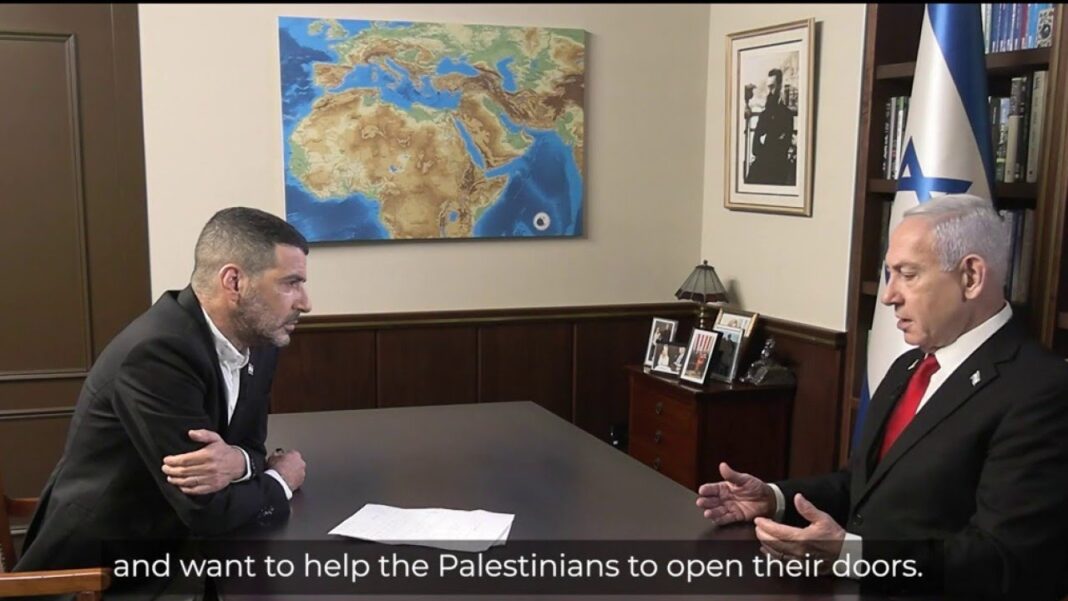
In an exclusive interview with i24News, Prime Minister Benjamin Netanyahu described Israel’s recent strike on Iran’s nuclear program as a “historic operation” that would have proceeded even without U.S. backing, asserting that the action neutralized two of Israel’s most dangerous threats — Tehran’s atomic ambitions and its ballistic missile capabilities.
Netanyahu told i24News that from the outset, his decision to act was unwavering. “With or without approval, we’re doing it,” he said. He confirmed that he ultimately secured cooperation from U.S. President Donald Trump, but stressed that Israeli leadership had already resolved to proceed regardless. “Fortunately, we have a very sympathetic president… but the decision was made to proceed regardless, because it is in our soul,” Netanyahu explained.
According to Netanyahu, the operation successfully set Iran’s nuclear program back “a good few years,” even though Tehran still retains approximately 400 kilograms of enriched uranium. He acknowledged that the program was not completely dismantled but emphasized that Iran is now “not in a position to advance” toward a nuclear weapon in the immediate term. “It’s a necessary condition but not sufficient to produce nuclear bombs,” he said, noting that the destruction of enrichment facilities and missile sites was a critical blow.
The prime minister told i24News that the strike on Iran was part of a broader regional campaign aimed at dismantling coordinated threats against Israel. This campaign included the targeted killings of Hezbollah leader Hassan Nasrallah, Hamas leader Ismail Haniyeh, senior Hamas commander Mohammed Deif, and the Sinwar brothers in Gaza.
“We defeated Iran, which came to destroy Israel with atomic bomb, we eliminated two enormous existential dangers,” Netanyahu said, characterizing the simultaneous neutralization of nuclear and missile capabilities as a rare convergence of strategic victories.
Addressing media reports that his government had been “dragging its feet” in Gaza, Netanyahu insisted that the security cabinet overwhelmingly backed his push to shorten operational timetables and press for a decisive victory.
“Our goal is to end the war, defeat our enemies, and secure the release of all hostages — both the living and the dead — in one final deal,” Netanyahu told i24News. “I’m not going back to partial agreements. They misled us. I want them all.”
Netanyahu also dismissed claims of persistent friction between the civilian leadership and the military high command, saying disagreements are both “legitimate and necessary” in the decision-making process, but that once directives are given, they are executed.
The prime minister alleged that some criticisms emanating from former officials and members of the Kaplan protest movement amounted to harmful disinformation. He revealed that certain senior officers had opposed major operations that ultimately went ahead — including the entry into Rafah, the so-called “pager operation,” and the strike that killed Nasrallah.
According to Netanyahu, these dissenting voices reflected risk-averse thinking that could have undermined Israel’s ability to act decisively against its enemies. Nonetheless, he told i24News, such debate remains part of the democratic and military tradition, as long as it does not obstruct execution of approved plans.
Netanyahu reiterated his support for allowing Gaza civilians to leave the territory, drawing comparisons with large-scale refugee movements in Syria, Ukraine, and Afghanistan. “Why should Gaza be closed?” he asked, noting that Israel has been in talks with several countries to accept displaced persons.
This approach, he suggested, could reduce civilian casualties while enabling Israel to maintain operational momentum. However, he stopped short of detailing which states were involved in such discussions.
Throughout the i24News interview, Netanyahu emphasized the role of President Donald Trump in facilitating the recent operation, contrasting his cooperation with what he characterized as the more restrictive approach of the Biden administration.
He pointed to his earlier work with Trump on the Abraham Accords and their current alignment in confronting Iran. According to Netanyahu, had Israel fully yielded to Washington’s pressure during the Biden presidency, major operations — including the recent strike — might have been postponed or prevented entirely.
Netanyahu closed the interview with a warning about the mounting diplomatic costs of a protracted conflict. International criticism, amplified by images from Gaza and accusations against Israel in global forums, could erode Israel’s strategic standing if the war is allowed to drag on.
“Not to linger, not to brag, not to wait — we need to go for a decision,” he told i24News, framing a swift and decisive conclusion as essential to safeguarding both military gains and diplomatic capital.
Netanyahu’s remarks underscore that Israel’s confrontation with Iran and its proxies is unfolding across multiple arenas. The elimination of senior militant leaders in Lebanon and Gaza, combined with strikes on Iran’s nuclear and missile facilities, represents a synchronized effort to blunt offensive capabilities before they can be deployed.
The i24News interview revealed a prime minister determined to sustain the initiative, even amid internal debates and external pressures, while signaling that Israel is prepared to act unilaterally when core security interests are at stake.
 |
|

Since the mainstream media, including much
in Israel, is primarily leftist and treasonous, constantly engaged in anti-Israel and anti-Netanyahu propaganda and lies, Netanyahu is required to set the record straight. It is unfortunate that the Democrat Biden government’s hostility and obstruction of Israel’s military defense is described as merely a “more restrictive approach”. Israel cannot afford another Democrat enemy in the White House.
By any measure, Israel has been fabulously successful. Unfortunately, contrary to Trump‘s assertions, it appears that Iran’s nuclear weapons program has not been fully destroyed
and only been set back for a period of time. It will be necessary for Israel to be always vigilant and take military action again against Iran in the future. I am concerned that this will occur while Israel still has a strong majority patriotic government and a unified committed public.