



|
Getting your Trinity Audio player ready...
|
By: Fern Sidman – Jewish Voice News
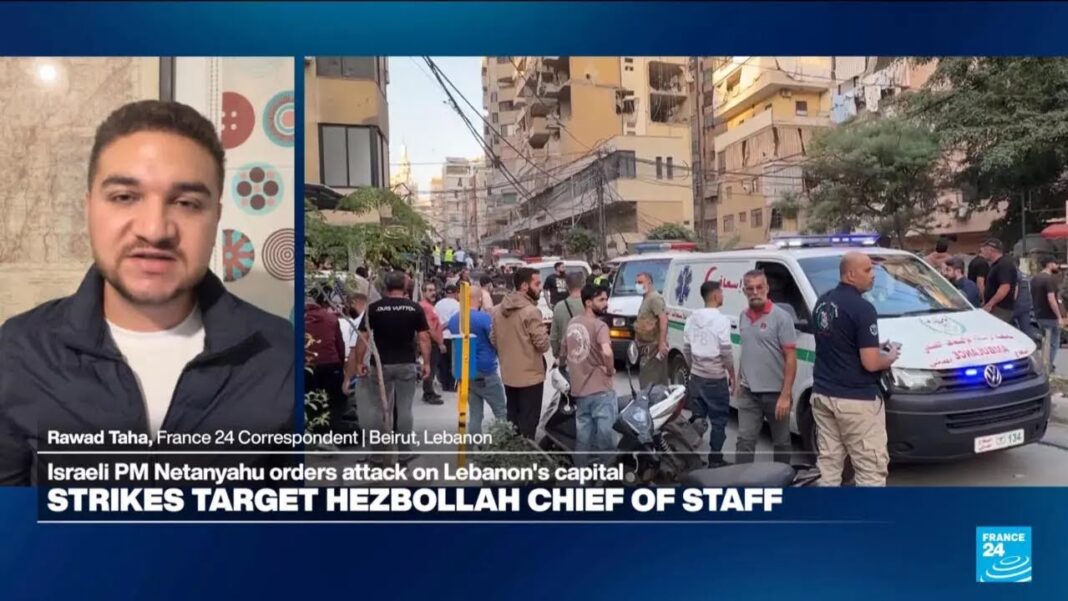
Israeli Prime Minister Benjamin Netanyahu delivered a forceful and somber address on Sunday, hours after the Israel Defense Forces confirmed the elimination of Haytham Ali Tabataba’i, the military chief of staff of Hezbollah and one of the most wanted terrorist operatives in the Middle East. The strike, which Israeli officials described as a precision operation following months of intelligence work, marks one of the most significant blows dealt to the Shi’ite militia since the elimination of Hassan Nasrallah and the crippling of Hezbollah’s missile infrastructure earlier this year.
As reported on Sunday by Israel National News, Netanyahu used the moment to reaffirm Israel’s strategic doctrine concerning Hezbollah: that the Iranian-backed militia will not be permitted to reconstitute the capabilities it has lost through the ongoing, multi-front confrontation. The prime minister’s remarks signaled not only an operational victory but a declaration of intent regarding the broader regional dynamics now unfolding.
According to the information provided in the Israel National News report, Tabataba’i was not merely a senior figure within Hezbollah—he was central to the organization’s most dangerous operational plans. Serving as chief of staff, he was responsible for orchestrating the group’s military structure, overseeing its elite Radwan Force, and managing cross-border operational planning against Israel. His elimination, Israeli officials say, leaves a gaping vacuum in Hezbollah’s command hierarchy.
“A few hours ago, the IDF eliminated Haytham Ali Tabataba’i,” Netanyahu announced. “Tabataba’i was a mass murderer. His hands were full of the blood of many Israelis and Americans; it is not for no reason that the United States offered a five-million-dollar prize for his head.”
Hezbollah’s Radwan Force—Tabataba’i’s primary command—has long been viewed as the group’s spearhead unit. As Israel National News has frequently documented, the force was tasked with a chilling long-term objective: to infiltrate northern Israel, seize Israeli communities in the Galilee, and carry out mass killings and kidnappings. Israeli intelligence officials have described the plan as Hezbollah’s “Galilee Conquest Doctrine,” a catastrophic scenario that Israel has spent years preparing to counter.
“Tabataba’i served as a senior commander in the Radwan Force,” Netanyahu said. “This is the force that planned to conquer the Galilee and slaughter many of our citizens.”
In his remarks, Netanyahu highlighted that Tabataba’i had recently been overseeing Hezbollah’s desperate attempts to rearm, reconstitute stockpiles, and rebuild operational capacity after suffering devastating losses during Operation Pager—the unprecedented Israeli campaign targeting Hezbollah’s missile arsenals, command centers, and senior leadership.
According to the information contained in the Israel National News report, Operation Pager resulted in the destruction of large portions of Hezbollah’s long-range missile infrastructure and decimated the organization’s command echelon, including the death of longtime leader Hassan Nasrallah. Israel has described the operation as one of the most effective counter-terrorism initiatives it has executed in the northern arena in decades.
“Recently, he led Hezbollah’s renewed efforts to rearm,” Netanyahu explained. “This was, of course, after the heavy blows that Hezbollah was dealt in the Pager Operation, the damage to its missile supply, and, of course, the elimination of Nasrallah.”
The prime minister praised the IDF and security services for their exacting work: “I thank the IDF and the security forces who conducted a professional, precise, and successful operation today.”
Netanyahu emphasized that Israel’s policy toward Hezbollah is both unwavering and guided by a long-term strategic framework. Drawing on the security lessons of the past two decades—from the 2006 Lebanon War to Iran’s deepening entrenchment in the Levant—the prime minister reiterated that Israel will not tolerate a scenario in which Hezbollah regains its offensive capabilities.
“The policy I am leading is absolutely clear,” he said. “Under my leadership, the State of Israel will not allow Hezbollah to rebuild its power, and we will not allow it to pose a threat to the State of Israel again.”
As the Israel National News report pointed out, this formulation is consistent with Israel’s newly articulated security doctrine: not merely neutralizing threats in the present but preemptively preventing any future return to adversarial capacity. This approach is also intended to send a message to Tehran, Hezbollah’s chief patron, that Israel is prepared to sustain high-intensity operations until Hezbollah’s military architecture is dismantled beyond recovery.
Netanyahu did not limit his comments to Hezbollah itself. He placed responsibility squarely on the Lebanese government, insisting that Beirut must fulfill its international obligations to disarm militias operating within its territory.
“I expect the Government of Lebanon to fulfill its commitment to disarm Hezbollah,” he declared. “Because only in this way can a better future be made possible for every citizen in Lebanon, and only in this way can good and secure neighborly relations be established between Israel and Lebanon.”
This marks a continuation of Israel’s long-standing argument that Lebanon’s failure to enforce UN Security Council Resolution 1701 has allowed Hezbollah to arm itself with a missile arsenal larger than that of most sovereign states.
Netanyahu’s remarks suggest that Israel now views the disarmament of Hezbollah not merely as a diplomatic expectation but as a prerequisite for regional stability.
In a significant policy shift, Netanyahu used the occasion to praise President Trump for his decision to formally designate the Muslim Brotherhood as a terrorist organization—a move that has sweeping implications for counterterrorism cooperation between Israel and the United States.
As reported by Israel National News, the Muslim Brotherhood serves as the ideological backbone for Islamist movements throughout the Middle East and beyond, including Hamas. Its ability to inspire and shape extremist ideology has made it a long-standing adversary of the State of Israel.
“On this occasion, I also want to commend President Trump on his decision to outlaw and designate the ‘Muslim Brotherhood’ organization as a terrorist organization,” Netanyahu said. “This is an organization that endangers stability throughout the Middle East and also beyond the Middle East.”
Israel, he noted, has already designated parts of the Brotherhood as terrorist entities and is working toward a broader classification. The United States’ decision aligns American policy with Israeli security assessments in a way that strengthens the bilateral fight against Islamist extremism.
The elimination of Tabataba’i represents not only the death of a senior commander but the symbolic collapse of a strategic pillar within Hezbollah’s military structure. Analysts cited by Israel National News say that Hezbollah is now facing a profound crisis: the loss of leadership, depletion of weapons stockpiles, compromised command-and-control capabilities, and the erosion of public legitimacy within Lebanon.
Hezbollah’s attempt to rearm under Tabataba’i’s supervision was fraught. Israel intercepted multiple arms shipments, targeted logistical nodes, and undermined cross-border smuggling operations. The militia has struggled to recruit experienced operatives following the heavy casualties sustained during the recent conflict.
Tabataba’i’s death compounds this struggle and signals to remaining Hezbollah commanders that Israel retains deep operational penetration into the group’s hierarchy.
Tehran—which designed, funded, and trained Hezbollah as part of its long-term strategy of encircling Israel with hostile proxies—has viewed the group as its most successful foreign policy asset. Yet, as Israel National News has documented, Iran’s regional ambitions have been repeatedly frustrated in recent months. Hezbollah’s missile arsenal has been severely degraded and its leadership has been decapitated. Moreover, its elite Radwan Force has been crippled and its ability to threaten Israel’s northern border has collapsed.
Netanyahu’s remarks were crafted not only for the Israeli public but as a direct message to Tehran: Israel will not tolerate a rebuilt Hezbollah, nor will it allow Iran to use Lebanon as a staging ground for future aggression.
Domestically, Netanyahu’s address reinforces his government’s security posture as one rooted in deterrence, decisive action, and operational continuity. As repeated by Israel National News, the prime minister’s strategy has centered on weakening Iranian proxies, preventing the reconstitution of terrorist infrastructure, and strengthening alliances with the United States and regional partners.
The elimination of Tabataba’i gives Netanyahu a moment of strategic clarity—an example he can point to as the embodiment of his security doctrine.
Israel’s confrontation with Hezbollah is far from over, but the elimination of Haytham Ali Tabataba’i marks a decisive moment in the campaign. From the standpoint of military capability, ideological leadership, and operational coordination, Hezbollah has suffered a blow from which analysts say it will struggle to recover.
Netanyahu’s message is that Israel’s long-term security policy will not waver. There will be no return to the conditions that allowed Hezbollah to flourish. There will be no tolerance for rearmament. And there will be no compromise on the safety of Israel’s northern border.
In a region defined by shifting alliances and unpredictable threats, Netanyahu’s speech served as both a declaration and a warning: Israel will shape its security future through strength, vigilance, and preemptive action—not wishful thinking.
The death of Tabataba’i is one chapter in that doctrine. But it is a chapter whose consequences will reverberate from Beirut to Tehran, and from Washington to Jerusalem, for years to come.