



|
Getting your Trinity Audio player ready...
|
By: Fern Sidman
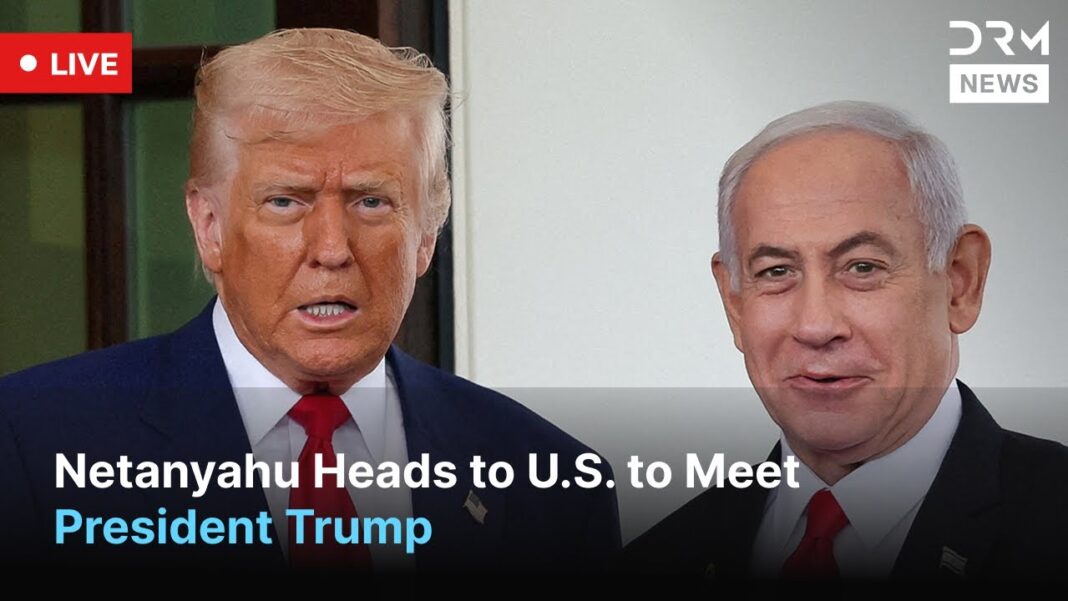
Israeli Prime Minister Benjamin Netanyahu departed Ben-Gurion International Airport on Sunday aboard the official state aircraft, Wing of Zion, for a critical diplomatic mission to Washington—his third in-person meeting with President Donald Trump since the launch of Operation Rising Lion, the joint U.S.-Israeli military campaign that dealt a historic blow to Iran’s nuclear infrastructure.
As reported by The Jewish News Syndicate (JNS), the visit comes at a pivotal juncture in the region’s geopolitical realignment. Netanyahu is expected to coordinate closely with Trump on a potential ceasefire agreement with Hamas, tied to the return of remaining Israeli hostages still held in Gaza. Yet, the prime minister made clear before his departure that Israel’s war aims—particularly the elimination of Hamas’s governing capabilities and ensuring Iran’s nuclear program remains incapacitated—remain non-negotiable.
“In my conversation with President Trump, I will first of all thank him for his very strong support for Israel. We have never had such a friend in the White House,” Netanyahu told journalists on the tarmac.
The prime minister was unequivocal in attributing the recent strategic success to the unprecedented cooperation between Israeli and American forces. Operation Rising Lion, launched in tandem with Trump’s Operation Midnight Hammer, targeted dozens of Iranian military and nuclear sites, severely degrading Tehran’s capabilities.
“Our joint efforts have brought about a tremendous victory over our common enemy—Iran,” Netanyahu said, noting that updated Israeli intelligence assessments suggest that Iran’s nuclear program has been pushed back by several years.
As emphasized in the JNS report, the Israeli defense establishment has long feared a confrontation with Iran might spiral into a broader regional war. That fear has now been supplanted by confidence in Israeli deterrence, bolstered by American military resolve and the performance of all branches of the IDF.
Still, Netanyahu cautioned that Israel must “remain vigilant” against future Iranian attempts to reconstitute its weapons program. “Preserving the achievement is our first obligation,” he said.
Netanyahu also made clear that his talks in Washington would not only focus on the immediate conflict in Gaza but also on broader diplomatic ambitions—including a new phase in the Abraham Accords, the Trump-brokered normalization agreements that have already reshaped Israel’s standing in the Arab world.
“We have already transformed the face of the Middle East beyond recognition, and we now have the opportunity and the ability to change it even further,” Netanyahu said. “A great future awaits the State of Israel, the people of Israel, and the entire region.”
According to the information provided in the JNS report, Israeli officials hope to leverage recent military victories and Trump’s diplomatic momentum to expand normalization talks to additional Arab states—especially in the Gulf and North Africa.
Despite the optimism surrounding his U.S. visit, Netanyahu emphasized that Israel’s war against Hamas is far from over. “Israel will not let the Gaza Strip again pose a threat,” he declared. “Hamas will not remain there.”
The war in Gaza, now stretching into its 21st month, has left 50 Israeli hostages still unaccounted for, including 20 believed to be alive and 30 confirmed deceased, according to IDF figures. Netanyahu reaffirmed that their return remains a central mission of Israel’s ongoing campaign.
“To date, we have freed 205 out of 255 hostages, including 148 alive. Twenty living hostages remain, and 30 deceased. I am determined—and we are all determined—to bring them all back,” the prime minister said.
JNS has tracked the ongoing negotiations closely, noting that a Qatari- and U.S.-backed ceasefire proposal was met last week with what Hamas termed a “positive” response. However, Netanyahu’s office later rejected changes proposed by the terror group, calling them “unacceptable.”
“An Israeli negotiation team has been sent to Qatar with clear instructions,” Netanyahu stated. “I believe that the conversation with President Trump can certainly help advance this outcome that we all long for.”
As the JNS report emphasized, the personal rapport between Trump and Netanyahu remains a cornerstone of U.S.-Israel strategic coordination. Trump, who has long styled himself as the most pro-Israel president in U.S. history, is expected to pressure Qatar to lean on Hamas and ensure that the terms of the hostage deal are upheld.
In a statement issued late Friday, Trump signaled his own high expectations for the meeting, saying he was “very optimistic” about achieving a breakthrough, while warning Hamas: “I hope, for the good of the Middle East, that Hamas takes this deal, because it will not get better — IT WILL ONLY GET WORSE.”
While Netanyahu is likely to welcome Trump’s pressure on Hamas, he is also expected to seek American guarantees that any ceasefire does not undercut Israel’s long-term military objectives or allow Hamas to regroup. “Ceasefire cannot mean surrender,” one senior Israeli official told JNS.
As the Wing of Zion touched down in Washington Monday morning, the stakes of this visit could not be higher. JNS analysts note that the outcome of Netanyahu’s talks with Trump could shape not only the immediate prospects of hostages and ceasefires, but the entire regional balance of power—from Tehran to Riyadh to Gaza.
With the memory of October 7 still seared into the Israeli public consciousness and regional actors watching closely, Netanyahu arrives in Washington as both a wartime prime minister and an architect of a new Middle East.
“This is a moment of strategic opportunity,” a senior Israeli diplomat told JNS. “But it is also a test of resolve. The choices made this week may determine the shape of the region for a generation.”
Prime Minister Netanyahu’s third face-to-face meeting with President Trump represents more than just another diplomatic summit. It is a defining moment for Israeli-American partnership, the fate of hostages in Gaza, and the broader vision of a Middle East no longer held hostage by terror or nuclear blackmail.

I have been reading this outrageous nonsense for years. I cannot believe that Israel’s government is being played like this by the hostage families and domestic traitors. In a war people die. There is NOTHING to negotiate! There is no point in “cease-fires”. The US is also being played to the hilt by Hamas sponsor: terrorist Qatar, has apparently has bought off disgusting Steve Witkoff.
I find it hard to believe that Israel cannot flood out, burnt out, and decisively kill everyone in all the tunnels, and kill every known Hamas supporter! Every remaining “hostage“ needs to be put out of their misery. Nothing should be left alive in any tunnel. It is the civilized thing to do.
And then Israel should get on with the business of killing every Gazan who does not voluntarily leave: Mass them all at the Egyptian border and force them across into Sinai. Kill any Egyptians who prevent this.
So the way to end Hamas is to kill our own innocent people and start a war with Egypt?
Just twisted.
It is also time to fire the general staff of Israel’s military who have been committing treason. Replace them with the next generation of patriotic military leaders who will not betray their country. And of course, PURGE Israel‘s judiciary and “deep state” of everyone who is engaged in sedition against the Netanyahu government, and enabled October 7.