



|
Getting your Trinity Audio player ready...
|
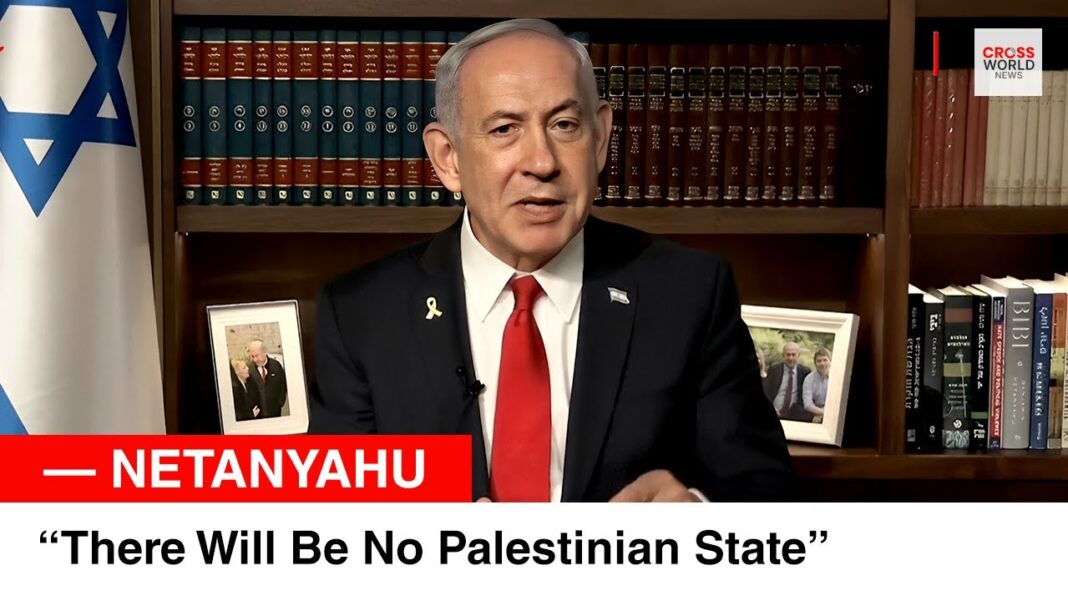
Netanyahu Declares “There Will Be No Palestinian State” as Israel Signs Historic Expansion Agreement in Ma’ale Adumim
By: Fern Sidman
Israeli Prime Minister Benjamin Netanyahu delivered one of his most emphatic repudiations yet of Palestinian statehood on Thursday evening, telling jubilant crowds in Ma’ale Adumim that “there will be no Palestinian state — indeed there will be no Palestinian state. This place is ours.” His remarks, reported by The Jewish News Syndicate (JNS), came as he presided over the festive signing of an “umbrella agreement” that paves the way for massive new housing construction in the strategically vital city east of Jerusalem.
The ceremony, held at the Ma’ale Adumim Cultural Center, marked a turning point in Israel’s settlement policy. The agreement commits the government to financing two entirely new neighborhoods — one of them in the controversial E1 corridor — as well as expanding a third, Mizpeh Nevo, for the first time in two decades. For Netanyahu, it was not just a bureaucratic milestone but a symbolic repudiation of decades of international pressure and diplomatic maneuvering aimed at forestalling Jewish building in Judea and Samaria.
“Tonight,” Netanyahu told the crowd of 500 waving Israeli flags, “we are realizing the doubling of the city of Ma’ale Adumim. There will be 70,000 people here in five years. That will be a huge change.”
As the JNS report noted, the umbrella agreement provides for no fewer than 7,000 new housing units — sufficient to accommodate 30,000 additional residents in a city that currently numbers around 40,000. The financial commitments are sweeping: 500 million shekels ($150 million) earmarked for infrastructure upgrades throughout the city; 700 million shekels ($210 million) for neighborhood development in E1 (3,400 units) and Tzipor HaMidbar (3,500 units); 300 million shekels ($90 million) for educational facilities; and an additional 300 units in Mizpeh Nevo.
It is E1, a 12-square-kilometer stretch of largely barren hills, that holds particular symbolic and strategic weight. As the JNS report explained, every Israeli government since Yitzhak Rabin’s in 1994 has endorsed the idea of building there. Yet relentless international opposition — especially from Europe and Washington — has kept the land untouched for three decades. Palestinians insist that Israeli construction in E1 would sever the territorial contiguity they envision for a future state, effectively rendering Palestinian statehood unviable.
For Netanyahu and his coalition, that is precisely the point. By anchoring Jewish presence in E1, Israel not only secures Jerusalem’s eastern flank but also ensures that the vision of a sovereign Palestinian state between the Jordan River and the Mediterranean Sea remains, as Netanyahu declared, “null and void.”
The atmosphere in Ma’ale Adumim on Thursday was festive and defiant. As the JNS report described, music and dancing filled the Cultural Center, residents waved flags, and local leaders hailed the day as “historic.”
Mayor Guy Yifrach delivered a heartfelt 20-minute speech, recounting his childhood in the city and his pride in its record of civic spirit and military service. He noted that Ma’ale Adumim leads Israel in the proportion of reservists reporting for duty after Hamas’s October 7, 2023 massacre, a statistic that drew repeated applause.
Crucially, Yifrach insisted that the umbrella agreement include a clause giving IDF reservists preferential access to subsidized housing. “It’s our obligation to the young generation, the generation of victory,” he said. For Yifrach, the agreement was not just a development plan but a national statement of permanence and resilience: “It is an enormous honor for Ma’ale Adumim.”
Other ministers in attendance — including Finance Minister Bezalel Smotrich, Construction and Housing Minister Haim Katz, Education Minister Yoav Kisch, Diaspora Affairs Minister Amichai Chikli, and Communications Minister Shlomo Karhi — joined Netanyahu in signing the pact. Former longtime mayor Benny Kashriel, whom Netanyahu described as “a legendary figure,” was invited onstage to share in the celebration.
Netanyahu himself framed the signing as both historic and personal. He recalled his first visit to the hills of Ma’ale Adumim in 1967 as a young soldier learning navigation. “The best place to learn to navigate — it’s here,” he said, recalling how the bare hills offered a perfect view of the terrain. He also reminisced about walking with Kashriel decades ago when the mayor pointed out where neighborhoods should someday rise.
“I said, ‘I approve,’ but between approving and executing in the State of Israel — wow! — it can take a very long time,” Netanyahu said to laughter. “That’s why something very big is happening here today.”
Unsurprisingly, the announcement has drawn sharp condemnation abroad. As JNS reported, on August 22, a group of 25 foreign ministers from Europe and other countries issued a joint statement demanding the “immediate reversal” of Israel’s E1 decision. For European diplomats, construction in E1 represents a “red line” threatening the possibility of a two-state solution.
Israel’s Foreign Ministry responded with defiance. It called the demands “an attempt to impose foreign dictates” and branded them discriminatory for seeking to halt Jewish construction while imposing no parallel restrictions on Arab building. “The historic right of Jews to live anywhere in the Land of Israel — the birthplace of the Jewish people — is indisputable,” the ministry declared. “There is no other nation in the world that has a stronger, longer-standing and better-documented connection to its land than the Jewish people has to the Land of Israel.”
Yifrach himself told JNS that he believed international pressure would ultimately prove toothless, particularly given the “friendly administration” now occupying the White House. The current U.S. leadership, he suggested, is less likely to block or penalize Israel for exercising what it regards as its sovereign rights.
For Netanyahu, the umbrella agreement is more than a municipal development plan. It is a strategic signal of finality. By explicitly linking the Ma’ale Adumim expansion to his rejection of Palestinian statehood, the prime minister underscored his belief that the long-discussed “two-state solution” is neither realistic nor desirable.
As the JNS report highlighted, Netanyahu’s remarks were met with thunderous applause: “This place is ours,” he declared, speaking to a hall filled with flag-waving residents who see their city as a bulwark of Israel’s permanence in Judea and Samaria.
The timing is also significant. The agreement was signed as the United Nations prepares for a major summit in New York where several European countries, led by France, are expected to formally recognize Palestinian statehood. Israel has blasted such moves as a “reward for terrorism,” noting that Hamas remains committed to Israel’s destruction. Against that backdrop, the Ma’ale Adumim expansion is a concrete, irreversible statement of sovereignty.
Domestically, the agreement also serves as a morale booster for Israelis after nearly two years of relentless conflict. The October 7 Hamas attack that killed more than 1,200 Israelis and saw hundreds taken hostage left deep scars. For many Israelis, expansion in Ma’ale Adumim is both a symbolic act of recovery and a tangible promise of growth.
As the JNS report observed, residents waved flags and cheered with visible pride as Netanyahu signed the pact. For them, the new neighborhoods are not merely housing units but living symbols of national resilience.
The Ma’ale Adumim umbrella agreement represents one of the most consequential settlement expansions in recent memory, and it was delivered with unmistakable defiance. Netanyahu’s words — “there will be no Palestinian state” — echo not only in the hills east of Jerusalem but across the region, signaling to allies and adversaries alike that Israel will chart its own course regardless of international objections.
As the JNS report indicated, the project is a landmark achievement for Ma’ale Adumim, the first umbrella agreement signed for any city in Judea and Samaria, and one that could double its population in just five years. International critics may condemn and foreign ministers may protest, but for Netanyahu and his supporters, the message is unambiguous: “This place is ours.”
Hopefully for the whole of the Jewish people, in Israel, and abroad, without equivocation supported by Jews still part of the Jewish people in New York,“This place is ours”.
Fantastic! Yasher Koach! Mazel tov!!