



|
Getting your Trinity Audio player ready...
|
By: Fern Sidman – Jewish Voice News
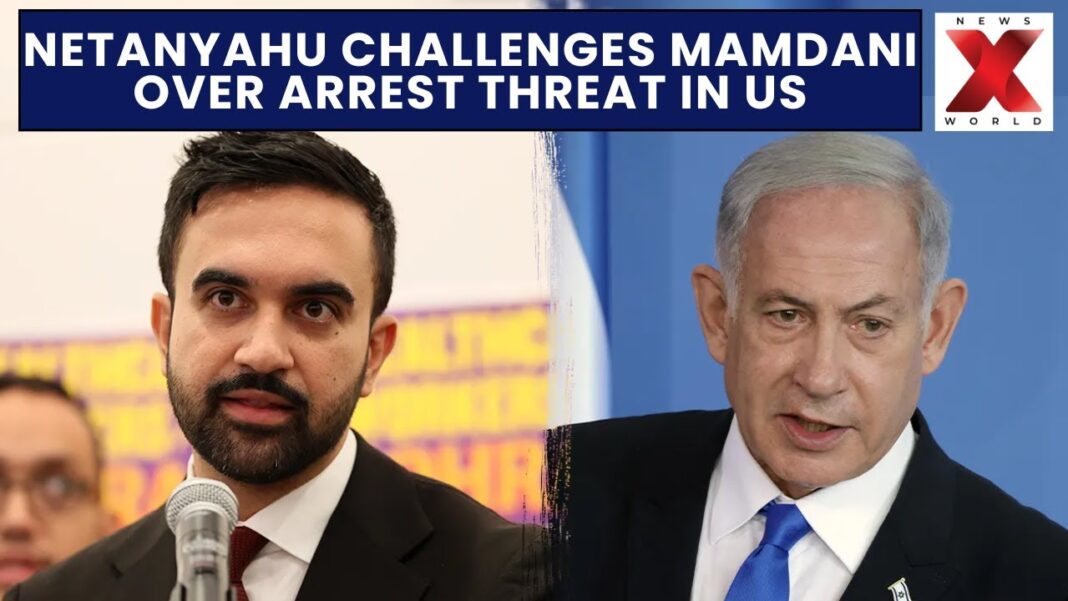
Israeli Prime Minister Benjamin Netanyahu issued his most direct challenge yet to New York’s mayor-elect Zohran Mamdani, pointedly announcing his intention to return to the city—despite the socialist firebrand’s incendiary campaign pledge to have him arrested on arrival. As The New York Post reported on Thursday, the exchange has intensified an already volatile political moment in the nation’s largest metropolis, exposing deep ideological fissures surrounding Israel, Gaza, and the future political direction of New York City.
Speaking remotely from Israel to the DealBook Summit at Lincoln Center, Netanyahu did not hedge or equivocate. His message was unmistakable.
“I’ll come to New York,” he said with a characteristic mix of steel and provocation. “Yes, of course I will.”
The Israeli leader’s declaration directly confronts Mamdani’s vow—made repeatedly during the heated mayoral campaign—to enforce any hypothetical International Criminal Court arrest warrant that might be issued against Netanyahu over Israel’s conduct in the war against Hamas. And as The New York Post report indicated, Mamdani’s threat was not rhetorical flourish; it became a defining theme of his insurgent campaign, one that animated his far-left base while alarming much of the city’s Jewish community and mainstream Democrats.
Netanyahu’s posture represents something exceedingly rare: a foreign head of government publicly taunting a newly elected mayor of New York. Yet the clash, in many ways, is unsurprising. Mamdani—long aligned with the Democratic Socialists of America—built his political ascent on an uncompromisingly anti-Zionist platform, accusing Israel of genocide and repeatedly refusing to affirm the Jewish state’s right to exist. His rhetoric has made him one of the most polarizing figures in modern New York politics.
Asked whether he would even consider meeting with the incoming mayor, Netanyahu delivered a curt but revealing answer.
“If [Mamdani] changes his mind and says that we have the right to exist, that’ll be a good opening for a conversation,” he said.
In that remark, Netanyahu laid bare the chasm separating the two men. The Israeli prime minister signaled that dialogue—let alone cooperation—is impossible with an American political leader who denies Israel’s fundamental legitimacy. It was also a pointed reminder that, despite New York’s political upheaval, Israel will not negotiate its right to defend itself or its very existence.
The confrontation is not merely rhetorical. For the city’s Jewish residents—who constitute the largest Jewish population outside Israel—the clash has heightened anxieties over what Mamdani’s mayoralty may mean for public safety, communal security, and New York’s long-standing relationship with the Jewish state. Many community leaders, quoted extensively in The New York Post report, warn that Mamdani’s extreme posture risks emboldening antisemitic extremists while fracturing trust between City Hall and the Jewish community at a dangerous moment.
Even before Mamdani’s election, New York saw a surge in antisemitic incidents following the October 7 Hamas massacre, a trend that has intensified amid the Gaza war. Orthodox neighborhoods have reported harassment, intimidation, and vandalism; college campuses have become flashpoints of anti-Israel agitation; and Jewish institutions have increased security amid warnings from law-enforcement officials.
In that context, Netanyahu’s promise to return to New York reads not just as a political challenge but as a symbolic gesture of solidarity. His message, interpreted widely in Israel and among New York’s pro-Israel communities, is that he will not be banished from the city by a mayor-elect who vilifies the Jewish state.
Mamdani’s threat to “arrest” Netanyahu rests on dubious legal grounds but unmistakable political motivations. Under U.S. law, municipalities have no authority to enforce International Criminal Court warrants—the United States itself does not recognize ICC jurisdiction over Americans or foreign officials. Yet the symbolic power of Mamdani’s threat resonated with far-left activists who have embraced the ICC’s consideration of war-crimes allegations against Israel while declining to condemn Hamas for the October 7 atrocities.
As The New York Post noted during the mayoral campaign, Mamdani has cultivated his political identity through a series of controversial, maximalist positions that include labeling Israel an apartheid state, refusing to denounce the slogan “Globalize the Intifada”, accusing Israel of genocide, and advocating the dismantling of U.S.–Israel security cooperation.
Netanyahu’s defiant statement thus cuts directly against the ideological framework on which Mamdani built his rise—a framework that sees the Israeli prime minister not as a democratic leader but as an enemy subject to international prosecution.
The political ramifications of this confrontation are likely to reverberate far beyond the ceremonial relationship between the mayor of New York and a foreign head of government. Under Mamdani’s leadership, New York City appears poised to enter unprecedented territory: a municipal government aligned with anti-Israel activism at a moment when global tensions, antisemitism, and political polarization are surging.
Observers quoted in The New York Post report warn that the symbolic break with Israel could have cascading effects on the city’s tourism, business partnerships, cultural institutions, philanthropic networks, and intergovernmental relationships. Israel remains one of New York’s most important international partners in technology, cybersecurity, medicine, and economic development. A hostile mayor, openly antagonistic to the Israeli government, risks chilling collaboration built over decades.
Netanyahu’s remarks were carefully calibrated. By stating unequivocally that he will return to New York, he is placing the onus squarely on Mamdani to decide whether his campaign rhetoric will translate into official policy. If Mamdani were to attempt even a symbolic act against the Israeli leader, he would almost certainly trigger an international diplomatic firestorm, widespread condemnation from federal officials, and backlash from the city’s powerful institutions.
If Mamdani backs down, he risks alienating the radical activists who propelled him into office.
In this way, Netanyahu—deliberately or not—has forced the incoming mayor into a corner, underscoring the political and moral impracticality of governing one of the world’s major cities with the tactics of fringe ideological activism.
As The New York Post report emphasized, the broader narrative here is not just Netanyahu versus Mamdani. It is the collision of two fundamentally divergent worldviews: one shaped by realpolitik, national security exigencies, and the lived experience of terrorism; the other shaped by a radical ideological movement that flatly rejects Israel’s legitimacy.
Netanyahu’s vow to return to New York ensures that this confrontation is far from over. Whether Mamdani moderates his stance—or escalates it—remains an open question. What is clear is that New York, under its incoming mayor, will find itself on the front lines of one of the defining geopolitical, moral, and cultural battles of our time.
And with Netanyahu now openly daring Mamdani to act on his rhetoric, the stakes for the city—and the symbolism of the moment—could hardly be higher.
Netanyahu should not be interested in talking with Mamdani. If Mamdani continues his threats against Netanyahu, Netanyahu should consider issuing a warrant for Mamdani’s arrest for making threats against Netanyahu. That should get Mamdani’s attention in a hurry.