



|
Getting your Trinity Audio player ready...
|
By: Fern Sidman – Jewish Voice News
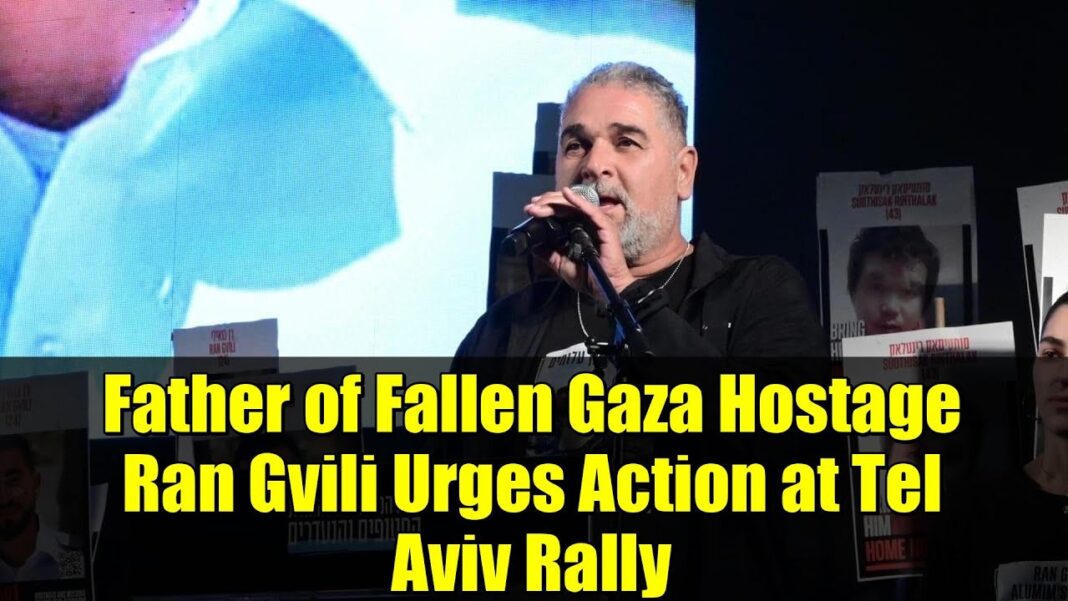
In the unrelenting shadow of the October 7, 2023 massacre, Israel continues to grapple not only with the staggering toll of the dead and the living but with the acute, haunting limbo of those whose bodies remain in Gaza—held by Palestinian terrorist organizations as political trophies, bargaining instruments, or symbols of enduring psychological warfare. Among these is Master Sgt. Ran (Rani) Gvili, an Israel Police counter-terrorism officer whose parents, Talik and Itzik, remain suspended between grief and hope as they await the return of their son’s remains.
On Friday, Prime Minister Benjamin Netanyahu phoned the parents to brief them personally on Israel’s latest efforts to recover their son. According to a statement relayed by the Prime Minister’s Office and reported by The Jewish News Syndicate (JNS) on Saturday, Netanyahu conveyed “deep appreciation” for the family’s “dignified, principled and proud conduct” throughout the past year of excruciating uncertainty. The prime minister described Ran’s heroism and sacrifice as a source of “endless pain, awe and pride” for himself, his wife Sara, and for the people of Israel.
The call was both symbolic and substantive. As JNS reported, Netanyahu took time not merely to offer condolences but to provide the Gvilis with detailed updates on the multifaceted security and intelligence efforts underway to locate and retrieve their son’s body. The message, relayed in stark yet compassionate terms, was clear: the state of Israel remains resolute in its refusal to abandon its fallen, whether living or dead.
Master Sgt. Ran Gvili’s final hours have by now become part of the growing canon of heroism associated with the defense of Israel’s besieged communities on October 7. As JNS reported, Gvili had been hospitalized awaiting surgery when he chose to leave his hospital bed, return to his unit, and head into battle to protect Kibbutz Alumim, a religious agricultural community near the Gaza border targeted in the opening wave of the assault. It was there, amid the chaos of the terrorist invasion, that he was killed in action. Palestinian gunmen seized his body—along with that of Thai agricultural worker Sudthisak Rinthalak—and transported both into Gaza.
The abduction of bodies is neither an aberration nor an afterthought of conflict for Hamas or Islamic Jihad. It is a deliberate, strategic instrument of coercion—and a tool of psychological torment—for the families of the fallen and the broader Israeli public. JNS has frequently emphasized that Israel’s ethos of mutual responsibility, rooted in centuries of Jewish historical trauma and reinforced through military doctrine, treats the recovery of the dead as an uncompromising national imperative. Thus, the Gvili family’s anguish is not theirs alone; it is a national wound.
The prime minister was not the only senior Israeli figure to reach out to the Gvili family this week. On Thursday, President Isaac Herzog also called Talik and Itzik, reaffirming the nation’s solidarity with them. “We have not forgotten them for one moment,” Herzog later wrote on social media, as reported by JNS, describing the family’s agony as “felt deeply in the hearts of the people of Israel.” He pledged full support for the IDF and security services in their efforts to locate both Ran and Sudthisak, vowing: “We will not rest nor be silent until they return home.”
Herzog’s words carried greater resonance against the backdrop of recent recoveries of other hostages’ remains. These returns—agonizing in their finality, but essential for religious, cultural, and psychological closure—have punctuated the two tears since the Hamas October 7th massacre with moments of grim resolution. The body of Dror Or, murdered at Kibbutz Be’eri, was recovered on November 25. Two weeks earlier, on November 13, Hamas handed over the remains of Meny Godard, another of those who had been abducted in the early hours of the massacre.
Also present during the family’s meetings on Friday was Ruby Chen, father of U.S.–Israeli dual citizen Itay Chen, whose story has become emblematic of the long, grueling struggle to recover Israel’s fallen soldiers. Itay, a tank commander from the IDF’s storied 77th Battalion, was killed defending the Nahal Oz post and his body was held in Gaza for 760 days before its return on November 4. As the JNS report detailed, his family’s advocacy played a persistent role in keeping the issue at the forefront of Israeli and American diplomatic attention.
Netanyahu’s efforts extended beyond the Gvili family. Later on Friday, he held a conversation with Boonyarit Vichienpuntu, Thailand’s ambassador to Israel, to discuss progress in locating the remains of Sudthisak Rinthalak. The agricultural worker, like thousands of other Thai nationals employed in Israel’s farming sector, was caught in the crossfire of Hamas’ meticulously planned assault. His death, and the desecration of his body at the hands of terrorists, has become a point of tension between Bangkok and Jerusalem.
The Thai ambassador expressed appreciation for Israel’s efforts, though the diplomatic complexities remain delicate. Thailand has its own political incentives to demonstrate concern for its diaspora workers, and Rinthalak’s case adds yet another layer to an already multi-dimensional humanitarian crisis.
In an emotional interview with the Kan public broadcaster, Itzik Gvili voiced the fear that has haunted countless Israeli families whose loved ones have vanished into enemy hands. “We pray that there won’t be another Ron Arad, another Hadar Goldin, and that we won’t carry this around for many, many years,” he said, as quoted in the JNS report. His worry is not rhetorical.
Ron Arad, the Israeli Air Force navigator captured in 1986 after bailing out over Lebanon, was handed over to Hezbollah by the Amal movement and eventually disappeared without a trace. His fate remains unknown nearly four decades later. The name “Ron Arad” has become a somber metaphor in Israel—an encapsulation of the deepest collective fear: the permanent disappearance of one’s child into the abyss of regional terror networks.
Similarly, Lt. Hadar Goldin, killed in 2014 during Operation Protective Edge, had his remains held in Gaza until their recent recovery. The prolonged uncertainty surrounding both these cases has carved deep grooves into Israel’s collective psyche. As the JNS report observed, each missing Israeli—living or dead—becomes a national obligation, a reminder of a society that refuses to allow its heroes to vanish.
The poignancy of the Gvili family’s situation is heightened by the political currents surrounding it. Israel’s unity after October 7 has been tested by profound debates over the war’s conduct, the hostages’ fate, and the government’s strategic direction. Yet the issue of recovering the bodies of the fallen remains uniquely unifying across political lines. In this sense, Netanyahu’s call to the Gvili family served not only as a gesture of compassion but as an assertion of governmental continuity—an affirmation that, regardless of political turbulence, Israel will prioritize the return of its soldiers.
The human dimension of such commitments was evident in the Gvili family’s response. According to the JNS report, they expressed “appreciation to the IDF, the security forces, the Missing and Captured Personnel Directorate and the prime minister” for their determination to bring back all hostages and the fallen. Their hope—fragile, yet unwavering—is that their son Ran will be returned soon.
The significance of these efforts extends beyond individual families. In Jewish tradition, the burial of the dead is a profound mitzvah, a religious commandment rooted in both reverence and dignity. The denial of proper burial is a desecration. As the JNS report called attention to, Hamas’s practice of abducting and withholding bodies is intentionally designed to magnify anguish and defy Israel’s moral commitments. The battle to recover the remains of Gvili and Rinthalak is therefore not only tactical but moral, touching the very core of Israel’s identity as a state that leaves no soldier behind.
The anguish experienced by the Gvili family reflects the broader trauma of a nation that continues to absorb the reverberations of October 7. Many Israelis experience each news update—each recovered body, each stalled negotiation, each vague signal from Gaza—as a reopening of barely healing wounds. Every family involved in this liminal state of “waiting” becomes a microcosm of the national experience.
The presence of Ambassador Mike Huckabee at the Gvili family’s meeting further underscored the cross-border resonance of these cases. Huckabee, as JNS emphasized in its report, reaffirmed the United States’ commitment to the “immediate and unconditional return” of both Ran and Sudthisak. His participation also signaled Washington’s determination to support Israel diplomatically at a moment when the hostage crisis has become central to the international conversation about the Gaza war.
As Israel continues its military and diplomatic operations, the question looming over the Gvili family—and over countless others—remains whether the state will succeed in retrieving one more fallen defender from the clutches of Hamas. The story of Ran Gvili is at once singular and emblematic: a man who rose from a hospital bed to defend his nation, who died protecting a vulnerable community, and whose family now bears the full weight of Israel’s promise to bring all its sons home.
In chronicling this saga, JNS has offered a consistent reminder that in Israel, the fate of each missing soldier is not an isolated tragedy but a national test of resolve. And as the Gvili family waits, the nation waits with them—unwilling to forget, unwilling to surrender hope, and unwilling to relinquish its obligation to honor the fallen.
The struggle to return the bodies of Master Sgt. Ran Gvili and Sudthisak Rinthalak is, in the end, a struggle for dignity, for closure, and for the moral foundation upon which Israel insists its society must stand.
It is a struggle that is not yet over.