



|
Getting your Trinity Audio player ready...
|
By: Fern Sidman
In a stark and sobering escalation of hostilities, the southern Israeli city of Beersheba was thrust into turmoil following a direct missile strike attributed to Iran, an attack that sent shockwaves—both literal and psychological—rippling across the region. As reported on Sunday by World Israel News, the incident left at least 11 individuals physically injured, dozens more requiring medical attention, and an entire city grappling with the immediate aftermath of sudden and violent disruption.
What initially appeared to be a localized impact quickly revealed itself to be part of a broader and more complex assault, underscoring the volatile and unpredictable nature of the current conflict environment.
According to details cited by World Israel News, the missile struck an open area within Beersheba, yet the designation of “open” belies the intensity and reach of the explosion. The blast generated a violent dispersion of debris and high-velocity fragments—described by authorities as “flying objects”—which inflicted injuries across a radius extending at least 15 meters from the point of impact.
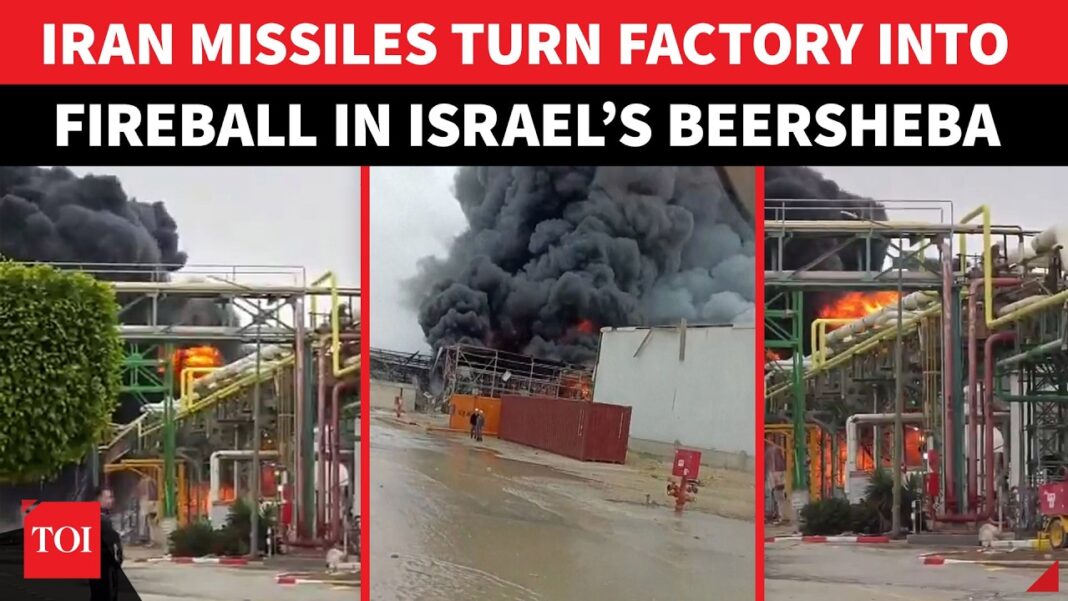
Eyewitness footage captured in the immediate aftermath depicted a towering column of dense black smoke ascending into the sky, a visual testament to the force of the detonation. The scene, as chronicled by World Israel News, bore all the hallmarks of a high-impact strike: scattered debris, shattered surfaces, and emergency personnel converging from multiple directions in a coordinated response effort.
Within moments of the strike, emergency services were activated on a large scale. The rapid deployment of first responders—paramedics, firefighters, and security personnel—reflected both the preparedness of Israeli emergency infrastructure and the gravity of the situation.
Magen David Adom, Israel’s national emergency medical service, played a central role in the response. According to figures reported by World Israel News, a total of 31 individuals were transported to Soroka Medical Center for treatment. Of these, 11 sustained physical injuries ranging from minor to moderate severity, while an additional 20 individuals were treated for acute anxiety and trauma-related symptoms.
The dual nature of these casualties—physical and psychological—highlights a critical dimension of modern warfare. Missile attacks do not merely inflict bodily harm; they generate pervasive fear, disorientation, and emotional distress that can affect far more individuals than those directly injured.
The psychological impact of the attack, as emphasized in the World Israel News report, is both immediate and enduring. The 20 individuals treated for anxiety represent only a fraction of those likely affected by the event. In urban environments, the sudden onset of sirens, explosions, and uncertainty can trigger widespread panic, particularly among vulnerable populations such as children and the elderly.
Mental health professionals have long noted that repeated exposure to such incidents can lead to chronic stress disorders, including post-traumatic stress. In Beersheba, a city that has experienced periodic security threats, the cumulative psychological burden is a matter of growing concern.
Further complicating the situation was the revelation that the strike on Beersheba was not an isolated incident. As reported by World Israel News, the broader attack involved approximately 20 separate impact sites across the city.
Among the locations affected was Turner Stadium, a prominent landmark that serves as both a sports venue and a symbol of communal life. Damage to such sites underscores the indiscriminate nature of the assault and its potential to disrupt not only infrastructure but also the social fabric of the city.
Rescue crews were forced to navigate a complex operational landscape, moving between multiple sites to assess damage, provide medical assistance, and secure affected areas. This decentralized response effort required meticulous coordination and placed considerable strain on available resources.
The physical characteristics of the explosion, as detailed in the World Israel News report, offer insight into the destructive capabilities of the missile employed. The generation of high-velocity debris suggests a warhead designed to maximize fragmentation, thereby increasing the likelihood of injury even in the absence of a direct hit on populated structures.
The reported shockwave radius—extending 15 meters or more—further indicates a substantial explosive yield. Such parameters are consistent with advanced missile systems capable of delivering significant kinetic and thermal energy upon impact.
While authorities have not disclosed specific details regarding the missile’s origin or type, the scale and precision of the attack point to a sophisticated deployment consistent with state-level capabilities.
Although officials have yet to release comprehensive assessments of structural damage, preliminary reports cited by World Israel News indicate widespread disruption extending beyond the immediate impact zones. Debris fields, blast effects, and secondary damage likely affected nearby buildings, vehicles, and public spaces.
Urban centers such as Beersheba, with their dense populations and interconnected infrastructure, are particularly vulnerable to such attacks. Even a single missile can disrupt transportation networks, strain medical facilities, and necessitate temporary evacuations.
The presence of multiple impact sites amplifies these challenges, transforming what might otherwise be a localized incident into a citywide emergency.
The strike on Beersheba must be understood within the broader context of escalating tensions between Israel and Iran. As World Israel News has consistently reported, recent weeks have seen an intensification of hostilities, with both sides engaging in actions that carry significant regional implications.
Iran’s use of missile strikes against Israeli territory represents a direct and overt form of confrontation, marking a departure from the more indirect methods often employed through proxy groups. This shift raises concerns about the potential for further escalation and the widening of the conflict.
For emergency responders, the Beersheba incident is emblematic of the challenges posed by sustained periods of conflict. The need to respond rapidly to multiple, simultaneous incidents requires not only logistical efficiency but also resilience among personnel.
Paramedics and rescue workers must operate in environments that are both physically hazardous and emotionally taxing. The constant possibility of additional strikes adds an element of unpredictability that complicates even the most routine procedures.
Despite these challenges, the response in Beersheba, as documented by World Israel News, was marked by professionalism and coordination—a testament to the training and dedication of Israel’s emergency services.
Beyond the statistics and strategic considerations lies the human dimension of the attack. Each of the 31 individuals transported to Soroka Medical Center represents a personal story—of sudden disruption, fear, and, in some cases, injury.
For residents of Beersheba, the attack is not an abstract geopolitical event but a lived experience. It affects daily routines, alters perceptions of safety, and reinforces the reality of living under the constant threat of violence.
Families must grapple with the immediate consequences while also confronting the uncertainty of what may come next.
As emergency operations continue and authorities assess the full extent of the damage, Beersheba stands as both a victim of aggression and a symbol of resilience. The city’s ability to respond swiftly and effectively to the crisis reflects a broader national capacity to endure and adapt in the face of adversity.
Yet the incident also serves as a stark reminder of the fragility of peace and the profound consequences of its absence. As the World Israel News report underscored, the events unfolding in Beersheba are part of a larger and deeply consequential conflict—one whose trajectory remains uncertain.
In the days ahead, the focus will shift from immediate response to recovery and reflection. But for now, the images of smoke rising over Beersheba, the sounds of sirens, and the stories of those affected will remain etched in the collective memory—a powerful testament to both the cost of conflict and the enduring strength of those who endure it.
