



|
Getting your Trinity Audio player ready...
|
Massive Protests in Israel Demand Government Action on Hostage Crisis; Labor Union Declares Strike
Edited by: TJVNews.com
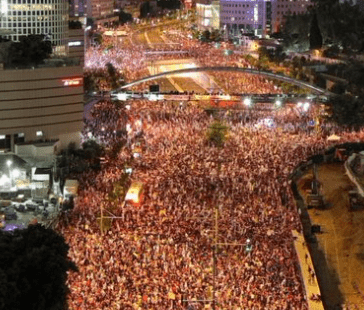
In an unprecedented display of public outrage, Israeli cities were engulfed by massive demonstrations on Sunday as citizens demanded immediate government action to secure the release of hostages held by Iranian-backed terror groups in Gaza. According to a report on Sunday in The New York Times, these protests, among the largest the nation has seen in recent years, reflect a growing frustration with the Netanyahu administration’s handling of the hostage crisis, which has dragged on for months without resolution.
Wow. Aerial video of massive protest in Tel Aviv, Israel tonight of nearly 300,000 people, demanding a ceasefire hours after bodies of 6 hostages were retrieved from Gaza tunnel. Largest rally since war: pic.twitter.com/2KtqWUk7ef
— Joyce Karam (@Joyce_Karam) September 1, 2024
The immediate trigger for these protests was the tragic announcement by the Israeli military that six hostages had been killed by Hamas terrorists in Gaza. According to reports, the hostages were shot at close range sometime between Thursday and Friday morning, as was indicated in the NYT report. The Israeli health ministry confirmed these findings, which have sent shockwaves through the nation. The news exacerbated the already tense atmosphere, as families of hostages and their supporters accused the government of failing to prioritize the lives of those captured.
The Hostages and Missing Families Forum, a group representing the relatives of the hostages, was quick to blame the Netanyahu administration for the deaths. The report in the NYT said that in a powerful statement, they claimed that “their blood was on the hands of the Israeli government,” and called on the public to “bring the nation to a halt” in protest.
As tens of thousands protest in Tel Aviv to demand Netanyahu allow a prisoner exchange/ceasefire, Israeli forces are responding with stun grenades.
Israel has been at war with its neighbors since its inception. Now it appears it may go to war with itself.pic.twitter.com/55eEI1T40p
— Wyatt Reed (@wyattreed13) September 1, 2024
In Tel Aviv, the epicenter of the protests, hundreds of thousands of people took to the streets. Protest organizers claimed that this was one of the largest demonstrations in the city’s history. The protestors, led by the families of the deceased hostages, carried six symbolic coffins through the streets, making their way to the Israeli military headquarters, as per the information provided in the NYT report. The scene was charged with emotion and anger, as demonstrators clashed with police forces on a major highway, demanding that the government act immediately to save the remaining hostages.
Jerusalem, too, saw significant unrest. Hundreds of protestors rallied at the city’s main entrance, where they were met with a heavy-handed response from the Israeli police. Skunk water, a foul-smelling crowd control weapon, was used to disperse the crowds. As was indicated in the NYT report, despite these efforts, the protestors remained defiant, expressing their anger at the government’s perceived inaction.
In smaller cities such as Rehovot, similar scenes played out. Traffic was blocked as demonstrators chanted, “We want them back living, not in coffins!” The protests were not confined to any one region, highlighting the widespread national frustration.
The protests have also had significant political ramifications. Prime Minister Benjamin Netanyahu, already facing criticism for his handling of the hostage situation, is now under immense pressure. The families of the hostages have accused him of sacrificing their loved ones for political gain, a charge that has resonated with many Israelis. The NYT report suggested that the anger and frustration of the families, who have been vocal in their demands for government action, seem to have reached a boiling point.
As tens of thousands protest in Tel Aviv to demand Netanyahu allow a prisoner exchange/ceasefire, Israeli forces are responding with stun grenades.
Israel has been at war with its neighbors since its inception. Now it appears it may go to war with itself.pic.twitter.com/55eEI1T40p
— Wyatt Reed (@wyattreed13) September 1, 2024
Adding to Netanyahu’s troubles, Israel’s largest labor union has declared a strike set to begin on Monday morning, in solidarity with the protestors. This move is expected to further disrupt the country, as the union’s members span various essential services and industries. The report in the NYT also pointed out that Yair Lapid, the leader of the opposition, has also thrown his support behind the protests, adding to the mounting pressure on the Netanyahu government.
The Families Forum has made it clear that the protests are far from over, announcing plans for additional demonstrations on Monday. The NYT also reported that social media has become a crucial tool for mobilization, with the forum and other activists using platforms like X (formerly Twitter) to rally supporters. The message is clear: the public will not rest until a deal is secured to bring the hostages home.
The anger and frustration of the hostage families are palpable. Many have directed their fury squarely at Prime Minister Benjamin Netanyahu, accusing him of failing to prioritize the lives of the captives. This sentiment was powerfully articulated by Gil Dickmann, whose cousin, Carmel Gat, was one of the six hostages found dead over the weekend. The NYT reported that in a statement on X, Dickmann implored Israelis to take action: “Whoever accepts the murder of civilians for the Prime Minister should stay home. Those who don’t: in memory of Carmel, take to the streets — stop the abandonment, bring the state to a halt, get a deal.”
Jonathan Dekel-Chen, another family member with a son, Sagui, still held hostage in Gaza, voiced his deep concern in a public interview. He criticized Netanyahu not only for endangering national security by refusing to finalize a negotiated settlement but also for “tearing apart this country by its seams,” according to the NYT report. Dekel-Chen’s words reflect a growing belief among many Israelis that the current government is more concerned with its own survival than with the safety and well-being of its citizens.
As night fell on Sunday, the streets of Tel Aviv became a battleground between protestors and the police. The situation quickly escalated, with demonstrators blocking the main highway, dismantling security barricades, and setting bonfires in the streets, the NYT report said. The Israeli police responded with force, conducting violent detentions and using water cannons to disperse the crowds.
The chaos reached new heights when Naama Lazimi, a member of the Israeli Parliament, reported on social media that police had used stun grenades at close range, knocking her to the ground. This incident has sparked outrage among many who see it as an excessive use of force against civilians exercising their right to protest.
After hours of intense demonstrations, the Israeli police announced the arrest of 29 individuals in Tel Aviv, where the protests were particularly heated, as per the NYT report. In addition to these arrests, five protesters were detained in Jerusalem and two in Haifa. The police managed to clear the main highway in Tel Aviv, but the atmosphere remained charged, with demonstrators expressing their deep frustration and despair.
The protests were visually powerful, with many participants carrying photographs of the hostages and waving yellow ribbons, a symbol of solidarity with those still held in Gaza. The yellow ribbons, fluttering in the night, served as a poignant reminder of the lives at stake and the urgency of the situation.
Among the protesters was Shiraz Angert, a 23-year-old design student who took to the streets in Jerusalem. Wearing a shirt emblazoned with the photo of Hersh Goldberg-Polin, one of the hostages whose body was recovered on Saturday, Angert voiced her sorrow and frustration. “It was possible to save them in a deal,” she said, her voice tinged with bitterness, as was reported by the NYT. “These are people who were sacrificed because we didn’t do enough.”
In Tel Aviv, Dan Levinson, a 59-year-old high school teacher, shared his perspective on the significance of the night’s protests. For Levinson, the demonstrations represented a critical juncture for the country. “I feel that tonight is the last chance for a turning point — people out in the streets tonight understand that what we have not been able to achieve so far into the war, we will not be able to ever reach unless a decision is made,” he said, as was noted in the NYT report. “If it does not happen now,” he added, “it never will.”
As the nation continues to grapple with the fallout from the hostage crisis, the path forward remains uncertain. The protests on Sunday night may represent a turning point, but whether they will lead to meaningful change is still unclear. The government’s response in the coming days will be critical in determining the direction of the crisis and the future of Netanyahu’s leadership.
