



|
Getting your Trinity Audio player ready...
|
By: Fern Sidman
French President Emmanuel Macron’s declaration that France will formally recognize a Palestinian state in September has cast a long shadow over a forthcoming high-level conference at the United Nations, designed to revive international momentum toward a two-state solution. The gathering, titled “Peaceful Settlement of the Question of Palestine and the Implementation of the Two-State Solution,” is scheduled for July 28–29 at UN Headquarters in New York. According to a report that appeared on The Jewish News Syndicate (JNS) website, the timing and agenda of the event have amplified tensions among major world powers and exposed sharp divisions within Western alliances.
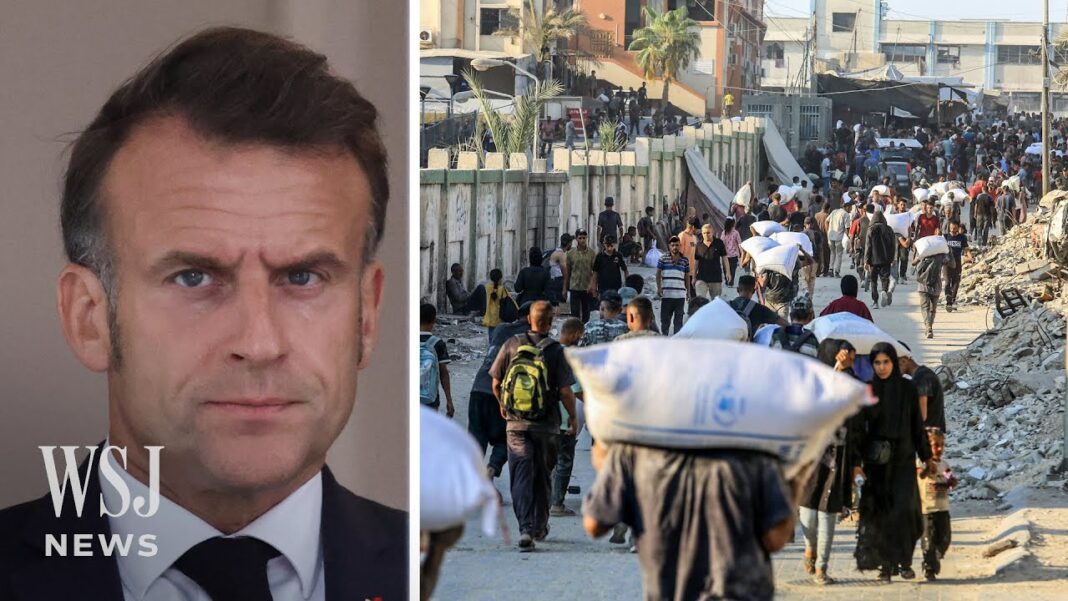
Macron’s announcement on Thursday signaled a firm French commitment to unilateral recognition of Palestinian statehood, a move that has been met with fierce resistance from both Israel and the United States. The French leader said his government would recognize Palestine during the upcoming United Nations General Assembly in September, stating that such a move was “essential” for peace. Macron’s stance comes amid rising international pressure to end the ongoing conflict in Gaza, where Hamas continues to hold hostages and engage in rocket attacks on Israeli cities.
As JNS reported, the New York conference—co-sponsored by France and Saudi Arabia—is being positioned as a pivotal step toward a formal declaration of statehood for Palestinians. However, significant friction has already emerged, particularly between European governments pushing for recognition and the U.S., which has strongly urged allies to steer clear of what it considers a counterproductive and politically coercive initiative.
On the heels of Macron’s announcement, Canadian Prime Minister Mark Carney issued a pointed rebuke of Israeli policy, stating that Canada “condemns the Israeli government’s failure to prevent the rapidly deteriorating humanitarian disaster in Gaza.” Carney further affirmed Canada’s commitment to a two-state solution and confirmed that his foreign minister would attend the New York conference. “Canada will work intensively in all fora to further that end,” Carney stated.
Meanwhile, JNS also reported that more than 220 British Members of Parliament have petitioned Prime Minister Keir Starmer and Foreign Secretary David Lammy to declare support for Palestinian statehood. They expressed hopes that the outcome of the UN conference would prompt the UK government to finally act on its “long-standing commitment” to a two-state framework.
Despite growing momentum among European nations, Washington remains staunchly opposed. JNS obtained a copy of a June U.S. diplomatic cable advising foreign governments to avoid the event altogether. The message warned that unilateral recognition of a Palestinian state “adds significant legal and political obstacles” to peace and may “coerce Israel during a war, thereby supporting its enemies.”
Tommy Pigott, principal deputy spokesperson for the U.S. State Department, confirmed at a Thursday press briefing that the United States would not participate in the conference. This position was reinforced by U.S. Secretary of State Marco Rubio, who issued a scathing statement opposing France’s plan. “This reckless decision only serves Hamas propaganda and sets back peace,” Rubio said. “It is a slap in the face to the victims of Oct. 7.”
The JNS report noted that the Trump administration, while open to a two-state framework during its first term, has shifted significantly in its stance. President Donald Trump recently floated the idea of the U.S. “taking over” Gaza, though the proposal has not garnered significant traction. U.S. Ambassador to Israel Mike Huckabee added fuel to the debate last month, telling Bloomberg that a sovereign Palestinian state is no longer a U.S. foreign policy objective. The State Department declined to clarify whether Huckabee’s position reflects official policy.
According to conference documents obtained by JNS, the two-day event will open with statements from French Foreign Minister Jean-Noël Barrot and Saudi Foreign Minister Prince Faisal bin Farhan Al Saud. UN Secretary-General António Guterres and Palestinian Authority Prime Minister Mohammad Mustafa are also expected to deliver keynote addresses. Israel has been granted an early speaking slot during the plenary session, although a spokesperson for Israel’s UN mission told JNS that the country will not participate in the event.
The conference will split attendees into working groups focused on implementing “irreversible steps” toward a two-state solution. Countries slated to participate in roundtable discussions include Brazil, Canada, Egypt, Ireland, Japan, Mexico, Qatar, Turkey, and the United Kingdom. Representatives from the European Union and the Arab League will also play key roles.
The involvement of controversial figures has raised eyebrows. Among the speakers is Mary Robinson, former president of Ireland and former UN High Commissioner for Human Rights, who has a long history of anti-Israel rhetoric. Robinson notably chaired the 2001 UN World Conference Against Racism in Durban, which the JNS report recalled became a platform for antisemitic vitriol and attacks on Jewish organizations. Also scheduled to address the event is Juan Miguel Santos, the former Colombian president who, in his final days in office, unilaterally recognized Palestinian statehood.
The concluding portion of the conference will include contributions from several UN agencies, many of which have faced criticism from Israel and the United States for perceived anti-Israel bias. Plenary remarks from high-level officials and representatives of more than 50 nations are expected to round out the proceedings. Over 60 additional countries have signed on as non-speaking participants.
The July conference is widely seen as a precursor to a more decisive showdown at the UN General Assembly on September 22, when heads of state are slated to meet for a summit on Palestinian statehood. Macron has vowed to move forward with recognition regardless of consensus, while Palestinian Authority leader Mahmoud Abbas has called on other governments to follow France’s lead.
With Saudi Arabia’s high-profile involvement and growing participation from countries like Canada and the UK, organizers hope to use the conference as a springboard for an “action-oriented outcome document” detailing the steps required to create a Palestinian state. However, the absence of the United States — and Israel’s refusal to attend — underscores the fragility of any consensus.
As the JNS report indicated, the coming weeks could be pivotal in determining whether the international community can unify behind a constructive framework for peace — or whether unilateral moves and symbolic declarations will further entrench divisions and prolong the suffering of all involved.
