



|
Getting your Trinity Audio player ready...
|
By: Chaya Abecassis
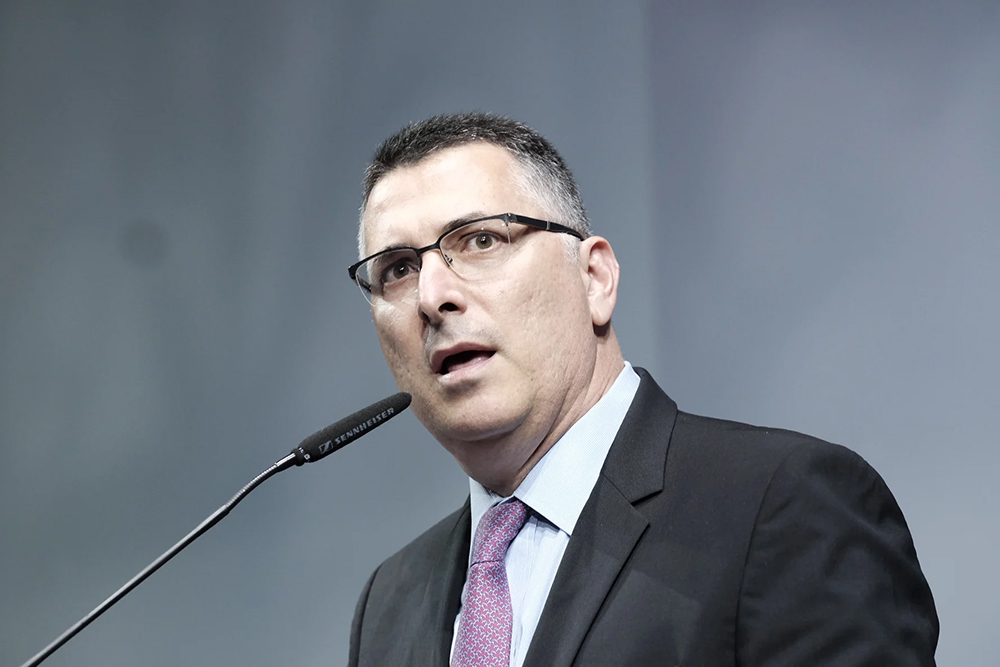
Under the glow of Hanukkah candles in the coastal city of Rishon Lezion, Israeli Foreign Minister Gideon Sa’ar delivered a speech that was anything but ceremonial. What unfolded on Sunday evening was a pointed, ideologically charged address that blended ancient symbolism with modern political urgency—one that marked a defining moment both for Sa’ar’s personal political trajectory and for Israel’s broader debate over leadership, security, and Jewish destiny in an increasingly hostile world.
The Hanukkah candle-lighting conference, attended by roughly 1,000 activists, supporters, Knesset members, and local mayors, was Sa’ar’s first major public gathering since his return to the Likud party. According to a report on Sunday at i24News, the event had been anticipated as a symbolic reentry into the party’s inner orbit. Instead, it became something far more consequential: a forceful articulation of Sa’ar’s worldview at a time of war, global antisemitism, and deep internal political fracture.
As Sa’ar lit the eighth and final candle of Hanukkah—a moment traditionally associated with culmination, endurance, and spiritual resilience—he framed his remarks around the themes of national fortitude and moral clarity under fire. i24News reported that the symbolism was deliberate. Hanukkah, after all, commemorates a small people’s refusal to surrender their identity or security in the face of overwhelming external pressure. Sa’ar’s message suggested that Israel, and Jews worldwide, now find themselves in a comparable historical moment.
Addressing Jews in the Diaspora, Sa’ar delivered one of the most direct and unapologetic calls for aliyah heard from a senior Israeli official in recent years. Antisemitism, he warned, has intensified across continents, shedding the subtlety of earlier eras and reemerging with alarming openness. Sa’ar accused many foreign governments of responding with equivocation or inertia, failing to confront what he described as a global resurgence of hostility toward Jews.
“Jews have the right to live safely anywhere,” Sa’ar said, “but history teaches us to recognize danger when we see it.” The statement encapsulated the central tension of his address: an acknowledgment of Jewish life beyond Israel paired with a stark warning that history’s lessons are often learned too late.
Over the past year, Sa’ar noted, Israel has invested substantial diplomatic capital in pushing back against what he described as a new wave of overt antisemitism. The i24News report highlighted his reference to an international conference convened in Jerusalem earlier this year, aimed at mobilizing governments, institutions, and civil society against rising anti-Jewish hatred. Yet Sa’ar made clear that diplomacy alone cannot substitute for sovereignty. The Jewish state, he argued, remains the only place where Jews can fully safeguard both their physical security and their collective identity.
From this premise flowed his most resonant appeal. Speaking directly to Jewish communities in the United Kingdom, France, Australia, Canada, and Belgium, Sa’ar urged families to consider immigration to Israel not merely as an ideological aspiration, but as a practical and moral choice. His language was deliberately familial and emotive: “come home,” he said, framing aliyah as a return rather than a departure.
The appeal struck a chord with many in attendance, particularly against the backdrop of recent antisemitic incidents in Western democracies. Yet it also underscored a growing sense of unease about the future of Jewish life in the Diaspora—a theme i24News has frequently explored in its reporting over the past year. Sa’ar’s speech suggested that Israel is not only a national project but an urgent refuge, an argument that resonates powerfully in times of crisis.
While much of Sa’ar’s address looked outward, a significant portion was devoted to Israel’s internal political struggle. In some of his sharpest language of the evening, Sa’ar launched a fierce attack on the country’s opposition leadership over their conduct during the ongoing war. Though he avoided naming opposition head Yair Lapid explicitly, i24News reported that the target of his criticism was unmistakable.
According to Sa’ar, while the government is engaged in what he called “difficult and historic decisions” to weaken Hamas, Hezbollah, and other Iran-backed threats, the opposition has chosen a path of retreat. He accused opposition figures of advocating an end to the conflict on terms favorable to Israel’s enemies—positions he characterized as dangerously short-sighted and strategically reckless.
Sa’ar was particularly scathing in his assessment of proposals to curtail military operations in exchange for hostage releases. While acknowledging the anguish of hostage families, he argued that surrendering strategic objectives under pressure would embolden Israel’s adversaries and endanger the nation’s long-term security. His conclusion was blunt: leaders who promote such policies, he said, are “unworthy of leadership.”
The remarks drew strong applause from supporters in the hall, but they also highlighted the depth of Israel’s political polarization. i24News analysts noted that Sa’ar’s speech placed him firmly within the camp that views military pressure and strategic patience as essential, even amid intense domestic and international scrutiny. The opposition, by contrast, has argued that prolonged conflict risks isolating Israel diplomatically and exacting an unsustainable human toll.
Yet Sa’ar’s message was not merely combative. Interwoven with his criticism was a broader argument about the nature of leadership in wartime. True leadership, he suggested, is defined not by popularity or rhetorical moderation, but by the willingness to make unpopular decisions in defense of national survival. The i24News report emphasized that this framing aligns closely with Likud’s traditional ethos, reinforcing Sa’ar’s reintegration into the party’s ideological core.
His return to Likud, announced weeks earlier, has already sparked speculation about future leadership contests within the party. While Sa’ar did not explicitly address his personal ambitions, The conference functioned as a de facto relaunch of his national profile. The combination of ideological clarity, wartime rhetoric, and direct engagement with the Jewish world positioned him as a figure seeking not merely relevance, but influence.
The choice of Hanukkah as the setting for this political reemergence was particularly resonant. Hanukkah’s narrative of resistance against assimilation and foreign domination has long served as a metaphor for Jewish perseverance. By lighting the eighth candle while speaking of war, antisemitism, and political resolve, Sa’ar drew a direct line between ancient struggle and contemporary reality. As the i24News report noted, the symbolism reinforced his argument that Jewish history is not a closed chapter, but an ongoing story demanding vigilance and action.
For Jews abroad, Sa’ar’s address raises complex questions. His warning about antisemitism reflects a growing consensus among Jewish leaders that the phenomenon is no longer marginal. At the same time, his call for aliyah challenges Diaspora communities and governments alike, implicitly questioning whether Jewish safety outside Israel can be guaranteed in the long term. i24News has repeatedly reported on this tension, capturing debates within Jewish communities about identity, belonging, and the meaning of security in an unstable world.
Inside Israel, the speech sharpened existing fault lines. Supporters hailed Sa’ar’s candor as a necessary corrective to what they see as opposition appeasement. Critics, however, argue that his rhetoric risks deepening divisions at a time when national unity is already under strain. i24News commentators noted that the address encapsulated the paradox of Israeli politics in wartime: the simultaneous demand for cohesion and the inevitability of fierce disagreement over strategy and values.
As the candles burned low in Rishon Lezion, one thing was clear. Gideon Sa’ar had used the occasion not merely to commemorate a holiday, but to stake out a vision—of Israel as a fortress of Jewish continuity, of leadership as an exercise in resolve, and of history as a warning that must be heeded rather than debated away. The evening was less about ritual than about reckoning.
Whether Sa’ar’s words will translate into broader political momentum remains to be seen. But in a nation shaped by symbols and survival, his Hanukkah address ensured that the eighth candle did more than illuminate the past. It cast a stark, challenging light on Israel’s present—and on the uncertain future facing Jews around the world.