



|
Getting your Trinity Audio player ready...
|
By: Fern Sidman
In the intricate choreography of Middle Eastern diplomacy, optimism is often the first casualty. Senior advisers to President Donald Trump have reportedly delivered a sobering assessment of Washington’s prospects for reaching a renewed nuclear understanding with Tehran, cautioning that history itself militates against the likelihood of success. Yet even as skepticism hardens within the White House, the machinery of negotiation continues to turn, accompanied by a conspicuous escalation of American military presence in the region. As World Israel News reported on Sunday, the dual track of diplomacy and deterrence now defines Washington’s posture toward the Islamic Republic, reflecting a strategic ambivalence born of past disappointments and present exigencies.
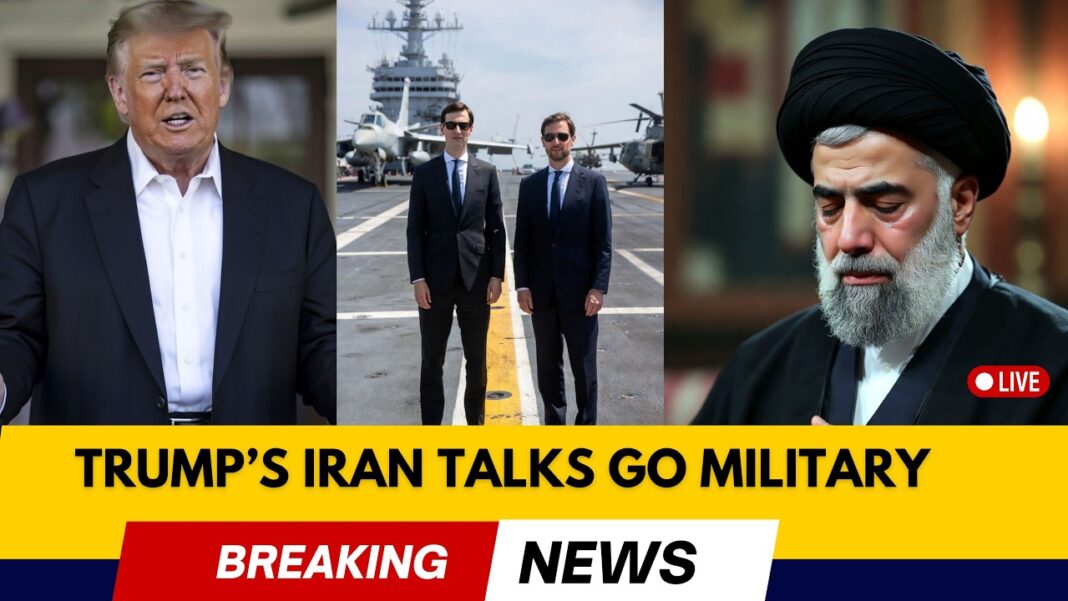
According to the information provided in the World Israel News report, two of President Trump’s closest confidants—White House special envoy to the Middle East Steve Witkoff and the president’s son-in-law Jared Kushner—recently conveyed to him their belief that the prospects of securing a nuclear accord with Iran range from “difficult to impossible.”
The warning, relayed by Channel 12 journalist Barak Ravid and attributed to a senior U.S. official, underscores the deep reservoir of mistrust that has accumulated over decades of fraught engagement with Tehran. The advisers’ counsel was not, however, an exhortation to abandon diplomacy altogether. Rather, they urged the president to persist in negotiations with a posture of rigor, arguing that only by maintaining maximal demands could Washington test whether an improbable breakthrough might yet be achieved.
The World Israel News report emphasized that the message delivered to Trump was couched in conditional terms: should Tehran accede to the stringent requirements articulated by the American delegation, the advisers suggested, the president would retain the option to weigh the merits of any agreement. The formulation—“If they agree to what we are asking for, we will give you the option and you decide”—captures the asymmetry of expectations that now frames the talks. It implies that Washington is prepared to entertain diplomacy only on terms that rectify the perceived deficiencies of past agreements, even as it privately acknowledges the improbability that Tehran will accept such constraints.
The latest round of U.S.–Iranian engagement, as World Israel News has reported, commenced on February 6 with talks in Muscat, Oman, marking the first formal negotiations since the June 2025 war. Witkoff led the American delegation, signaling the administration’s intent to invest senior political capital in the effort. The choice of Muscat, a venue long associated with discreet regional diplomacy, reflected a desire to provide a neutral stage for exploratory dialogue. Yet the early signals from the talks were muted. Both sides agreed to continue discussions, but neither announced substantive progress. Iranian officials, in particular, sought to minimize expectations, portraying the summit as little more than a forum for exchanging messages rather than a venue for meaningful breakthroughs.
The World Israel News report noted that this rhetorical downplaying by Tehran aligns with a broader Iranian strategy of calibrated ambiguity. By presenting the talks as exploratory rather than consequential, Iranian officials preserve strategic flexibility, hedging against domestic criticism while avoiding the appearance of capitulation to American pressure.
For Washington, the lack of tangible progress has reinforced the skepticism voiced by Witkoff and Kushner, lending credence to the view that negotiations may function less as a pathway to agreement than as a diagnostic tool for measuring Tehran’s willingness to compromise.
In parallel with the diplomatic overture, the United States has embarked on a visible reinforcement of its military posture in the Middle East. The U.S. Navy has dispatched a second nuclear-powered aircraft carrier, the USS Gerald Ford, to join the USS Abraham Lincoln in the region. The deployment, which will take an estimated two to three weeks from the carrier’s current position in the Caribbean, is emblematic of a strategy that couples negotiation with unmistakable signals of deterrence. The presence of two carrier strike groups in proximity to Iran conveys a message that Washington is prepared to escalate its military readiness even as it explores diplomatic avenues.
The duality of this approach—extending an olive branch while sharpening the sword—has long characterized American policy toward Iran. This pattern reflects the enduring tension between the imperatives of nonproliferation and the realities of power projection in a volatile region. The carriers’ arrival will augment an already substantial U.S. footprint in the Middle East, underscoring Washington’s determination to deter any escalation by Tehran or its regional proxies. At the same time, the military buildup risks complicating the diplomatic calculus, potentially reinforcing Iranian narratives that portray negotiations as occurring under duress.
For Israel, the stakes of these developments are existential rather than abstract. World Israel News has consistently highlighted Jerusalem’s deep-seated concern that any nuclear agreement falling short of comprehensive dismantlement would leave Iran’s strategic ambitions intact. The skepticism voiced by Trump’s advisers thus resonates strongly within Israeli strategic circles, where past agreements are widely viewed as having deferred rather than resolved the nuclear challenge. The continuation of talks, coupled with the dispatch of additional U.S. naval assets, presents Israel with a familiar dilemma: how to support diplomatic efforts that promise stability while preparing for the contingency that diplomacy may fail.
The historical precedent invoked by Witkoff and Kushner casts a long shadow over current efforts. Previous rounds of engagement with Tehran have often culminated in agreements whose implementation proved uneven and whose enforcement mechanisms were contested. The erosion of trust that followed these episodes has rendered each new diplomatic initiative more arduous than the last. In this context, the advisers’ characterization of a new deal as “difficult to impossible” reflects not merely pessimism but an institutional memory shaped by repeated cycles of hope and disappointment.
Yet the persistence of negotiations, even under such bleak assessments, speaks to the paucity of alternatives. The costs of abandoning diplomacy altogether are formidable. Without a negotiating channel, the trajectory of Iran’s nuclear program would be governed solely by coercive instruments—sanctions, cyber operations, and the implicit threat of military action. Each of these carries its own risks of escalation, miscalculation, and regional destabilization. The administration’s decision to pursue talks, however tentatively, thus reflects a recognition that even improbable diplomacy may be preferable to unmediated confrontation.
The Muscat talks, though initially inconclusive, may yet yield incremental gains. The World Israel News report pointed out that diplomatic breakthroughs often emerge from prolonged processes rather than singular summits. The continuation of dialogue provides a forum for clarifying red lines, testing intentions, and exploring technical compromises that may not be apparent in early encounters. Whether such gradualism can overcome the structural mistrust between Washington and Tehran remains an open question, one that will be shaped by events far beyond the negotiating table.
As the USS Gerald Ford steams toward the Middle East, the symbolism of the moment is difficult to ignore. The World Israel News report framed the carrier’s journey as a maritime metaphor for Washington’s broader posture: advancing toward the region with formidable power while uncertain of the destination of its diplomatic voyage. The convergence of carriers in the Middle East may deter adventurism, reassure allies, and signal resolve, yet it also heightens the stakes of any misstep in the already crowded theater of regional security.
In the final analysis, the warnings delivered to President Trump by Witkoff and Kushner encapsulate a paradox at the heart of contemporary American statecraft. Diplomacy with Iran is pursued in full awareness of its improbability, sustained less by confidence in success than by the absence of credible alternatives. Whether the current gambit will culminate in a durable accord or merely reaffirm the intractability of the Iranian nuclear question remains to be seen. What is certain, however, is that the interplay of negotiation and naval power now unfolding in the Middle East will shape the region’s strategic landscape for years to come.

Anyone with some brain activity can tell you that. The Iranian regime must suffer the same fate as the Nazi Germany regime. The Iranian regime must surrender and behave or be completely destroyed. NOTHING will be left if that is what it takes to win.