



|
Getting your Trinity Audio player ready...
|
Katz’s “Sevenfold” Threat: Israel Signals Swift Response After Houthi Drone Strike on Eilat
By: Tzirel Rosenblatt
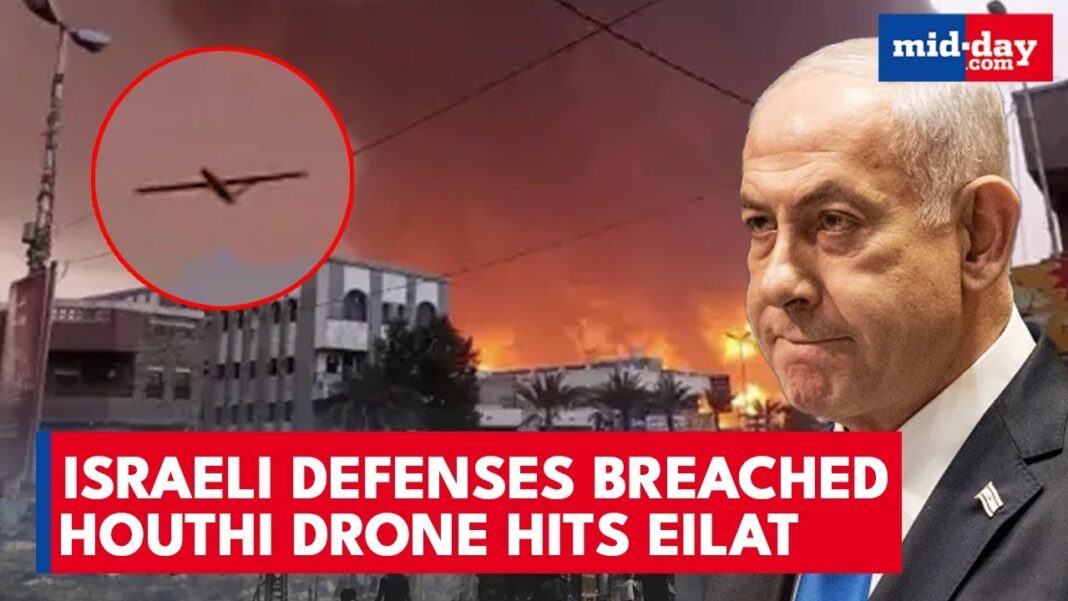
Israeli Defense Minister Israel Katz issued a blistering warning on Wednesday after a drone fired from Yemen struck the resort city of Eilat, wounding more than 20 people — including two in serious condition — in an attack that punctured the perception of Israeli invulnerability and escalated the widening regional clash now playing out far from Gaza’s borders. Katz’s terse message on X — “Whoever harms Israel will be harmed sevenfold” — was both a personal rebuke to the Houthi movement and a blunt signal that Jerusalem is prepared to markedly intensify retaliation if attacks from Yemen continue, as was reported on Wednesday in The Times of Israel.
The strike, which took place as Israelis prepared to begin Rosh Hashanah, represents the most dangerous of a series of Houthi operations directed at Israeli territory in solidarity with the Gaza conflict. The Associated Press reported that the group itself claimed responsibility, saying it fired multiple drones toward Eilat; Israeli emergency services and medical teams treated dozens of wounded civilians as the city’s hotels and waterfronts closest to the Red Sea were caught up in the shock and confusion.
Katz’s language — invoking a sevenfold reprisal — was intended to communicate both punishment and deterrence. “The Houthi terrorists refuse to learn from Iran, Lebanon, and Gaza, and will learn the hard way,” Katz wrote, framing the incident as another manifestation of an Iran-directed, regional campaign that Israel has repeatedly warned about. The Times of Israel reported that the minister’s post came amid frantic consultations inside Israel’s security establishment about how to respond without precipitating a broader conflagration across the Red Sea and Levant.
Israeli authorities said the drone struck within Eilat proper, wounding civilians and causing significant local alarm. The AP reported that the incident raised uncomfortable questions about whether Israel’s layered air-defense architecture — widely regarded as among the most sophisticated in the world — can be relied upon to stop increasingly cheap, small, and hard-to-track weaponry launched from unconventional launch sites hundreds of miles away. Israeli military spokespeople reported attempted interceptions; other reporting suggested that some defensive measures did not prevent the drone from reaching populated areas. These tactical realities complicate the strategic calculus for retaliation.
For more than a year, Israel has faced a new front in the Gaza war: Iran’s proxies and allied movements — notably Yemen’s Houthi rebels — have repeatedly sought to strike Israeli territory in a campaign of deniable, asymmetric attacks. The Houthis have framed their operations as solidarity with Palestinians in Gaza; Israeli officials characterize them as an Iranian-sponsored effort to stretch Israeli defenses and open new theaters of conflict, as was noted in a report at The Foundation for the Defense of Democracies. That dynamic has made the question of proportional response both legally and politically fraught.
Katz’s “sevenfold” rhetoric is noteworthy for three reasons. First, it spells out a promise of escalation that far exceeds a single, tit-for-tat strike; the phrase suggests cumulative, magnified reprisals intended to impose a political as well as a military price. Second, the invocation that “they will learn the hard way” echoes earlier Israeli messaging toward Lebanon’s Hezbollah and toward Gaza — both arenas where Israel has struck with force following cross-border attacks, often provoking diplomatic pushback even as Jerusalem asserted its right of self-defense. Third, the language functions as psychological warfare: by communicating both resolve and willingness to inflict heavy damage, Israel aims to deter not only the Houthis but also their regional backers from pursuing further attacks. The Times of Israel and other Israeli outlets reported Katz’s comments prominently and placed them in the context of recent Houthi operations.
Yet the effectiveness of harsh rhetoric depends on credible means to carry it out. Israel’s options include targeted strikes against Houthi launch and command nodes in Yemen, covert operations to degrade drone logistics, or pressure on states that have influence over the Houthis to pull back. All of those options have political costs. The FDD report said that striking in Yemen carries the risk of escalating into a wider regional campaign and raises legal and logistical complications; a covert campaign would require sustained intelligence access; and relying on diplomatic pressure presumes that third parties will be willing — and able — to restrain the Houthis. Israel’s leaders must weigh each path with the prospect that escalation could draw in Iran, entangle maritime commerce in the Red Sea, and unsettle fragile regional balances.
The attack on Eilat reverberated across the international community. Western capitals monitoring the conflict conveyed concern about the spike in cross-border strikes and renewed calls for de-escalation even as they denounced attacks on civilians. The AP reported that the United States and several European governments have repeatedly emphasized Israel’s right to self-defense while urging measures to avoid a broader regional conflagration. Neighboring states, too, absorbed the diplomatic shock: Eilat sits at the crossroads of tourism and trade, abutting Jordan and Egypt, whose own security calculations are directly affected by instability on the Red Sea.
The Houthis’ growing operational reach — and their willingness to target civilian hubs — also complicates the task of global shipping and humanitarian logistics in the Red Sea corridor. International shipping companies and naval task forces have altered routes or increased protective measures in recent months in response to attacks on commercial vessels, and further strikes on land amplify concerns about safe passage, rescue capabilities, and emergency response. The FDD report noted that those broader costs illustrate why Israel’s calculus cannot be framed merely as military tit-for-tat: there are political, economic, and humanitarian costs to expanded confrontation.
Domestically, Katz’s warning will be heard by a public already wearied by the second year of war and the enduring hostage crisis. Hardline voices in Israel insist that punitive, public responses are the only way to restore deterrence; dovish and pragmatic officials warn that disproportionate retaliation could inflame the conflict and compound civilian suffering — in Gaza, Yemen, and beyond. The FDD reported that the government’s decisions over the coming days will be informed by intelligence assessments of Houthi capabilities, the provenance of their weaponry (often traced to Iranian supply chains), and the degree to which external actors such as Tehran can be credibly pressured.
The Times of Israel report emphasized how Katz’s message dovetails with a broader pattern of Israeli statements aimed at deterring nonstate actors operating at Iran’s behest. But the outlet also noted the domestic imperative: every attack that kills or wounds civilians becomes a potent domestic political lever, amplifying pressure on the government to respond decisively.
Israel’s strategy — a combination of public warnings, targeted strikes, and defensive investments — faces growing stress from the diffusion of drone technology and the asymmetric repositories of power that proxies now enjoy. Katz’s statement is intended to communicate a hardened posture: an assurance to Israeli citizens that the state will respond, and a warning to adversaries that continued attacks will carry a heavy toll. Whether that posture restores deterrence, or instead draws Israel into a protracted and geographically broader conflict, will be determined not by rhetoric alone but by the operational choices made in the days ahead.
For now, Katz’s vow — stark, unambiguous and charged with historical memory — has cemented one fact: the battlefield of the Gaza war has extended well beyond its immediate borders. Attacks launched from Yemen and the responses they invite reflect an era in which regional conflicts are fought by networks of states and nonstate actors, and where the ripples of any single strike may move swiftly through the strategic center of an entire region. The next chapter will depend on whether Israel’s leaders choose calibrated retaliation, stepped-up diplomacy, or a combination of both — and whether those choices succeed in re-imposing the deterrence that Katz’s words sought to declare.

I am sorry – these terrorist proxies need to be completely eliminated. Clear Gaza then remove the Houthis permanently – Israel will be doing the world a favor even if the world does not see it that way.