



|
Getting your Trinity Audio player ready...
|
Israel’s Top General Vows Relentless Push Toward Gaza City as Hamas Shifts to Guerrilla Warfare
By: Fern Sidman
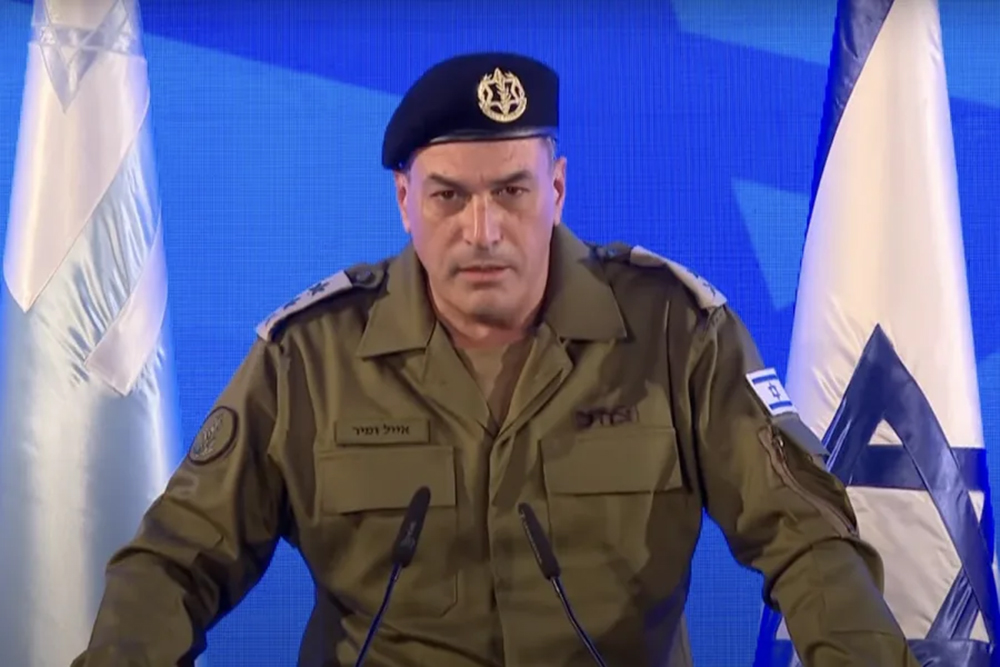
Israel’s military campaign in Gaza entered a pivotal new stage this week, as Lt. Gen. Eyal Zamir, the Israel Defense Forces’ Chief of Staff, vowed that the army will press decisively toward Gaza City. In remarks delivered Wednesday during a battlefield tour of Khan Younis, Zamir declared that Hamas has been reduced from what he described as a “terror army” to a diminished guerrilla movement, though he warned that the fight ahead would still be arduous and protracted.
As VIN News reported on Thursday, Zamir’s message was both a rallying cry to troops and a strategic statement to the Israeli public, signaling that after months of grinding combat, the IDF now views Gaza City as the critical objective in dismantling Hamas’s military infrastructure.
Standing before soldiers of the Kfir Infantry Brigade and the 188th Armored Brigade—units that had just repelled a Hamas attack on their encampment a day earlier—Zamir emphasized the stakes of the mission. “Our missions remain the release of the hostages and the defeat of Hamas,” he told the assembled troops. “We will not rest and will not stop until we complete them. Achieving these missions is essential for our future and for our values as a society.”
The symbolism of Khan Younis as the backdrop for his remarks was unmistakable. Once considered a bastion of Hamas control in southern Gaza, the area has been the scene of fierce fighting in recent weeks. By choosing that battlefield setting, Zamir sought to convey both the IDF’s momentum and its determination to carry the campaign through to Gaza City, the urban heart of the enclave and a stronghold of Hamas leadership.
According to the information provided in the VIN News report, the general’s tone was fiery and uncompromising, framing the battle not merely as a military campaign but as an existential mission for Israel’s security and moral integrity.
Perhaps the most striking element of Zamir’s remarks was his characterization of Hamas’s transformation. “From the terror army we experienced on October 7, it has become a guerrilla organization,” he asserted. The comparison reflects the IDF’s evolving assessment of Hamas’s capabilities.
On October 7, Hamas terrorists stunned Israel by breaching border defenses, launching an unprecedented cross-border assault that left more than 1,200 Israelis dead and over 250 hostages abducted into Gaza. That operation revealed an adversary that had built a highly organized force with heavy weaponry, structured command, and offensive planning capacity.
But after months of sustained Israeli operations—targeting weapons stockpiles, command centers, tunnel networks, and senior operatives—Zamir now contends that Hamas’s war machine has been degraded into decentralized bands of fighters reliant on hit-and-run tactics.
As the VIN News report highlighted, the shift from conventional-style combat to guerrilla resistance presents both opportunities and dangers for Israel. On one hand, it reflects Hamas’s severe attrition. On the other, it raises the specter of prolonged asymmetric conflict, where militants melt into the urban landscape, prolonging instability and complicating Israel’s objective of outright dismantlement.
With Khan Younis largely under IDF control, Zamir announced that the next decisive thrust will be toward Gaza City itself. The densely populated urban center, with its labyrinthine streets and vast tunnel complexes, represents the symbolic and operational heart of Hamas. It is here that Israeli intelligence believes many remaining command figures, hostages, and weapons caches are concealed.
“The capture of Gaza City is now the army’s focus,” Zamir stated, according to the VIN News report. He stressed that the IDF will apply sustained pressure, pursuing Hamas operatives “as long as necessary and wherever necessary.”
The offensive will not only test Israel’s military prowess but also its ability to manage international pressure. Civilian casualties, already a source of sharp global criticism, are likely to rise as the fighting shifts deeper into crowded neighborhoods. Israeli leaders insist that such operations are unavoidable in the campaign to root out Hamas, while reiterating that Hamas bears responsibility for embedding itself within civilian infrastructure.
Central to Zamir’s declaration was the reaffirmation that hostage rescue remains a paramount mission. 50 hostages remain in captivity, including 20 who are believed to be still alive. Families of the Israeli hostages have staged persistent demonstrations across Israel, demanding swifter action and greater transparency from the government.
By explicitly placing the hostages alongside the defeat of Hamas as the IDF’s dual objectives, Zamir sought to reassure the public that the military has not lost sight of the human dimension of the conflict. As the VIN News report indicated, the general’s statement reflects the army’s recognition that any eventual assessment of victory will hinge not only on military gains but also on the fate of those still held underground in Gaza’s tunnels.
The campaign’s intensity has required extraordinary mobilization. Zamir confirmed that 60,000 reservists have been called up for the looming Gaza City offensive. “We call them only when needed,” he said, “but I am certain they will show up until the mission is completed.”
This reliance on reserve forces reflects the IDF’s longstanding model of citizen-soldiers. While regular brigades spearhead operations, the reserves provide depth and resilience for prolonged campaigns. Many of those called up are professionals who have left jobs and families to don uniforms once again.
The VIN News report noted that Zamir’s acknowledgment of the reservists’ sacrifice carried significant weight. The IDF’s ability to sustain morale and cohesion among both regular and reserve troops will be critical as the war stretches into its next, and perhaps most difficult, chapter.
Behind the military rhetoric lies the complex interplay between Israel’s defense establishment and its civilian leadership. Zamir confirmed that the IDF is working closely with the government to prepare for the next phase of the war. That coordination includes not only tactical decisions but also broader strategic questions: What will Gaza look like after Hamas is dismantled? Who will govern the enclave?
While Prime Minister Benjamin Netanyahu has faced criticism for failing to articulate a clear “day-after” vision, Zamir’s remarks called attention to the military’s awareness that battlefield victories must be aligned with political planning. The VIN News report observed that without such planning, the risk of Hamas reconstituting itself—or of Gaza collapsing into anarchy—remains acute.
Zamir’s declaration in Khan Younis was more than an operational update. It was an assertion of Israel’s resilience and resolve in the face of an adversary that sought to shatter its sense of security on October 7. By framing Hamas as degraded and cornered, the general aimed to project confidence to both Israeli society and international observers.
Yet, as analysts cited by VIN News caution, guerrilla wars have a way of dragging on. The battle for Gaza City, while militarily winnable, may not mark the end of Hamas’s resistance. Instead, it could herald a drawn-out insurgency with unpredictable consequences.
As Israel braces for the Gaza City offensive, the words of Lt. Gen. Eyal Zamir crystallize the stakes. “We will not rest and will not stop until we complete them,” he pledged of the IDF’s missions. The message, amplified across Israeli media is that the campaign is not optional but existential—rooted in the defense of Israel’s people, its values, and its future.
With 60,000 reservists mobilized, brigades pressing forward, and commanders pledging relentless pursuit, the IDF stands at a historic juncture. Whether Hamas’s shift to guerrilla tactics marks its death knell or the start of a prolonged insurgency remains to be seen. For now, Israel’s top general has made the commitment unmistakable: Gaza City will be the battlefield on which the outcome of this war—and the contours of Israel’s security future—will be decided.
