



|
Getting your Trinity Audio player ready...
|
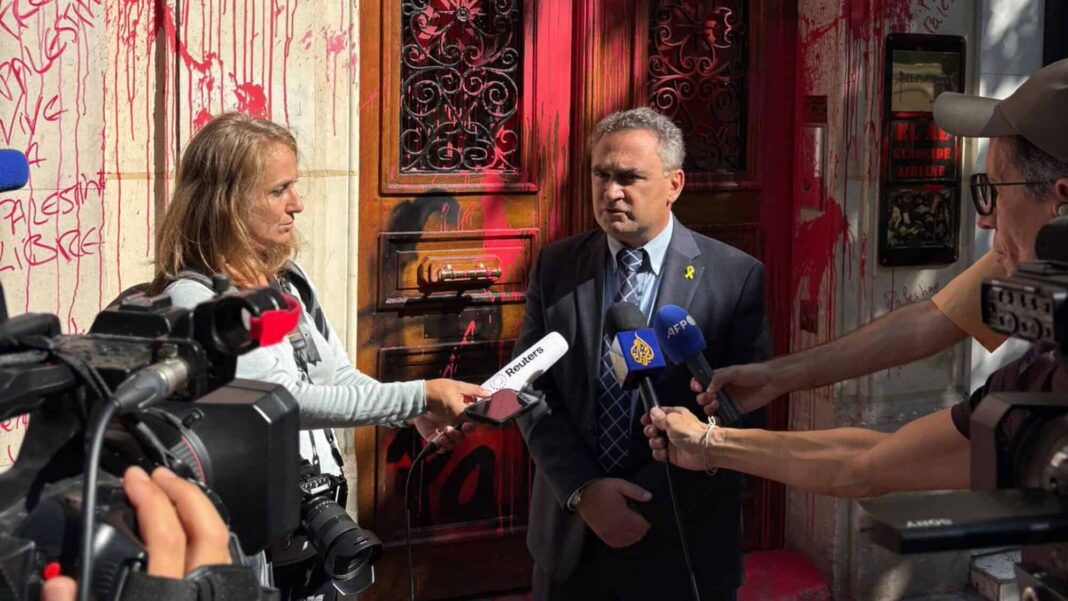
(JNS) Joshua Zarka was born in Paris in 1964 to a family of Tunisian immigrants. The family made aliyah to Jerusalem in 1975. Today, Zarka is the ambassador of Israel to France.
Relations between France and Israel have grown increasingly strained since July 24, when President Emmanuel Macron announced that Paris intends to recognize a Palestinian state at the United Nations General Assembly in September. The move, later echoed by the United Kingdom, Canada and Australia, drew sharp criticism in Jerusalem.
On Aug. 3, Israeli Foreign Minister Gideon Sa’ar condemned Macron for referring to Palestinian terrorists imprisoned in Israel as “hostages” and equating them with Israelis held captive in Gaza. Macron made the comments during a June 14 press conference in Paris.
Tensions deepened earlier this month when the Israeli embassy in Paris urged the French Foreign Ministry to address delays in renewing stay permits for El Al security staff. Media reports suggested the holdup—going back more than six months—was a form of pressure on Israel over its war against Hamas, which France has called to end.
The French ambassador to Israel, Frédéric Journès, further inflamed controversy last week, saying the conduct of the Gaza war had fueled antisemitism by giving “real antisemites” an opening to exploit public anger.
In response, Israeli Ambassador to France Joshua Zarka said a sharply worded letter Prime Minister Benjamin Netanyahu sent to Macron on Tuesday stemmed directly from Journès’s statement. “We cannot stand calmly accused of being the reasons for our misery,” Zarka told JNS. “Claiming that someone because of their choice of clothing is responsible for rape—that’s unacceptable completely.”
Antisemitic incidents have surged in France since Hamas’s Oct. 7, 2023, massacre.
At the annual dinner in July of CRIF, the umbrella group of French Jewish institutions, French Prime Minister François Bayrou catalogued centuries of attacks against Jews and denounced antisemitism as a “delirious, murderous beast” that has now assumed the face of radical Islamism. “There can be no balance in the Middle East until Israel is recognized by its neighbors and protected from the nuclear fire of those who have never ceased to proclaim their sole obsession and intention to destroy it,” he said.
Meanwhile, antisemitic incidents continue to mount. On Aug. 14, vandals felled a memorial olive tree dedicated to Ilan Halimi, a Parisian Jew tortured to death in 2006. Less than a week later, nine Jewish-owned cars in the Alpine town of Châtel were spray-painted with “Free Palestine.”
“French Jews do not feel safe today in France,” Zarka told JNS.
While noting French authorities are making efforts, he said the scale of antisemitic incidents is overwhelming. “There is a very big fear today among the Jewish community. … Jews in France are not just theoretically speaking of aliyah, they are contemplating it very seriously.”
In the interview, Zarka said Macron’s Palestinian statehood push, the rise in French aliyah, and the lack of an effective response to antisemitism all point to a troubling trend.
Still, he insisted, emigration is not the ultimate solution: “Jews should be able to live safely and without fear anywhere in the world. The answer is not aliyah. Aliyah is an option for all Jews but the answer is fighting antisemitism—fighting it with education, fighting it with response to antisemitic acts.”
JNS: The French ambassador to Israel said that the rise of antisemitism is extremely worrying and has intensified due to the manner in which the fighting in Gaza has been conducted, as this has allowed “real antisemites” to exploit the animosity of the war to ignite the wave of antisemitism that we are experiencing today everywhere. What do you say to him?
Joshua Zarka: That exact statement was made a few days ago. I believe that the letter that I was sent yesterday [Tuesday] by the Prime Minister [Netanyahu] to President Macron is a result of that unfortunate statement. We cannot stand calmly being accused of being the reasons for our misery. Claiming that someone because of their choice of clothing is responsible for rape, that’s unacceptable completely.
Q: Do you think the French government is taking the Israeli criticism seriously?
A: Yes they are. I know they are taking it seriously. I am getting phone calls and messages and I have been interviewed time and again about the statements and criticisms that come out of Jerusalem toward the French government.
Yes, they are taking it very seriously. If the question is are they taking it seriously and going to act accordingly? That’s a different question. They are taking it very seriously. Unfortunately, I am not sure that it is going to influence their policies.
Q: What do you think prompted Macron to announce recognition of a Palestinian state in September at the UNGA?
A: I think it’s a mixture of concerns about the state of the street in Paris. I think the president has a concern about what he defines as the Arab street. There is a growing influence or growing unrest among the French, mainly but not only those of Maghrebian origin, because of the importation of the conflict between us and the Palestinians.
He is very much concerned about the influence that the conflict could have in France, and therefore, he likely thought that making such a statement could help him domestically. I think it is a question of him wanting to basically invent himself internationally because of the fact that he has very low support domestically. And maybe he truly believes that he has something to contribute to making things better, when in fact what he does contributes to the instability, to destabilizing the Middle East with his initiatives.
Q: Do you think France has a problem with its Muslim population?
A: That’s a very broad question. France has a very big problem generally speaking with immigration. A problem that they have been having for many years and are trying to solve. I wouldn’t define it as a problem with the Muslim population. It’s a problem with immigration in general, and I think this problem is a problem you can see in different countries including in the United States. There are different ways of dealing with it.
Q: The French government may say one thing, but are there things going on behind the scenes that tell a different tale?
A: What gives me hope is the fact that there is very large support among the French population for Israel. I am getting a lot of support from different parts of the French political establishment that are very critical of the policy of the president. France is a friendly country. We have a very big difference currently with the policy of the president when it comes to a Palestinian state, but it doesn’t mean that France is not still a friendly country.
Q: What is the general sentiment among Jews in France today?
A: There is significant fear within the French Jewish community due to the sharp rise in antisemitism. Jews do not feel safe today in France.
I am not saying that France is not doing anything about it. What I am saying is that the volume of antisemitic acts in France is such that it is becoming almost impossible for the French Republic to deal with it properly. There is great fear today within the Jewish community about the situation on the ground. Today, Jews in France are not just speaking of aliyah theoretically, they are considering it very seriously.
Q: Do you think that there is going to be an influx of aliyah in the coming years, and would you recommend that?
A: There is an influx of aliyah. As an Israeli ambassador, I will always recommend for Jews to make aliyah. I myself, I’m an oleh chadash [new immigrant]. I was born and grew up in France, I made aliyah when I was 12 years old. So yes, I will always recommend it.
Do I think that it’s the only solution? No. Jews should be able to live safely and without fear anywhere in the world. The answer is not aliyah; aliyah is an option for all Jews but the answer is not aliyah, the answer is fighting antisemitism, fighting it with education, fighting it with a response to antisemitic acts, and so on.
Q: What do you think will happen in the next French election?
A: It’s too early to say. I will say that the next French elections are going to be critical for the stability and the future of France.
Q: Israeli Diaspora Minister Amichai Chikli has advocated forging closer ties with far-right parties. Do you think this is a good approach?
A: I think we should be able to and we should speak to all those parties that are willing to speak to us and are not by definition antisemitic. Does it mean that we have to get our support only from certain groups, no. As an ambassador, I speak and I should be able to speak to anybody from French politics who is willing to speak with me.
Q: What do you think can be done to reverse the trend?
A: First of all, we have to deal with those who are financing antisemitism, and that’s Qatar and countries similar to Qatar like Iran and Turkey. It’s not something that can be done in one day. Education, education, education. That’s basically it.
There are people in France and even in the United States and anywhere in the world who believe that Jews have horns. That’s education. There are people who are financing conspiracy theories for people to believe that Jews have horns. So we have to fight the financing of antisemitism, and we have to fight it on the education front.
