



|
Getting your Trinity Audio player ready...
|
By: Fern Sidman
In a sharply worded rebuke on Wednesday, Israeli Foreign Minister Gideon Sa’ar condemned Turkish President Recep Tayyip Erdogan for once again drawing grotesque comparisons between Israeli Prime Minister Benjamin Netanyahu and Adolf Hitler, and for accusing the Jewish state of committing “state terrorism” during its ongoing military campaign against Iran. The exchange marks yet another low point in the strained and frequently volatile relationship between Jerusalem and Ankara.
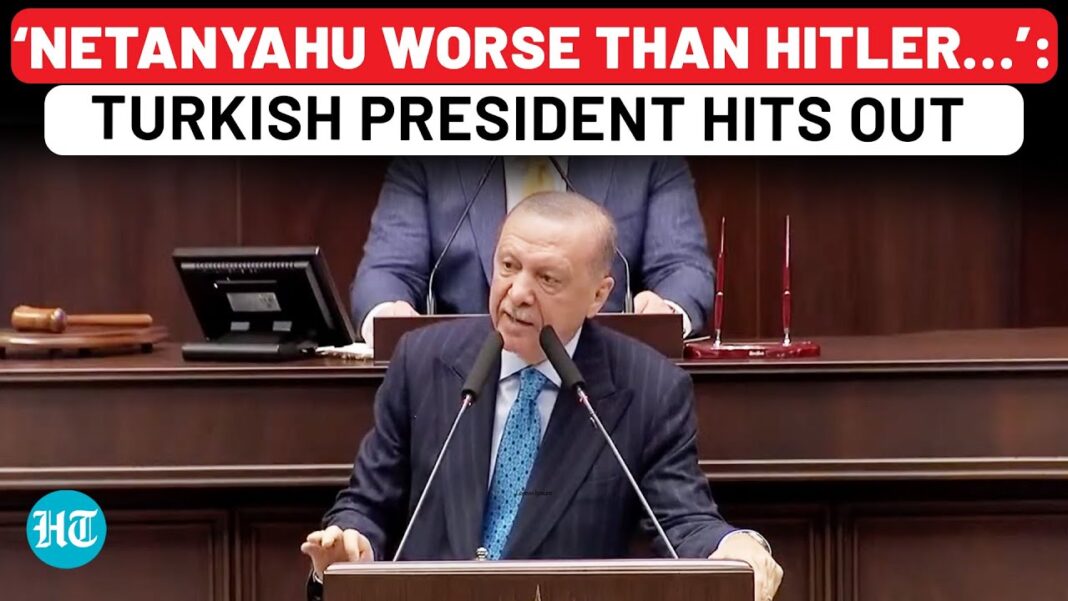
As reported on Wednesday by The Algemeiner (algemeiner.com), the diplomatic flare-up came after Erdogan delivered a fiery address to members of his ruling Justice and Development Party (AKP) in Turkey’s parliament, in which he claimed Israel’s preemptive strikes on Iran were “crazed” and illegal under international law. The Turkish president, known for his inflammatory rhetoric against Israel, asserted: “Israeli Prime Minister Netanyahu has long left Hitler behind in terms of genocide.”
Erdogan further described Iran’s right to respond militarily as “very natural, legitimate, and legal,” going so far as to accuse Israel of “thuggery and state terrorism.” His remarks sparked swift backlash from Israeli officials, with Sa’ar responding forcefully on social media platform X (formerly Twitter).
“The sultan, in his own eyes, in yet another inflammatory speech, continues to incite against Israel and against the Israeli prime minister,” Sa’ar wrote, referencing Erdogan’s increasingly authoritarian leadership style.
“Erdogan, who has set a record in suppressing the freedoms and rights of his citizens, as well as his country’s opposition, dares to preach to others,” he continued.
According to the information provided in The Algemeiner report, this latest rhetorical escalation comes amid Israel’s ongoing Operation Rising Lion, a sweeping military initiative launched last week targeting Iranian nuclear and military infrastructure. Israeli defense officials have framed the campaign as a necessary preemptive measure to prevent Iran—whose regime has openly called for Israel’s destruction—from achieving nuclear weapons capability.
The Israeli Air Force has conducted over a thousand sorties, destroying missile launch platforms, ballistic stockpiles, and reportedly killing several top Iranian commanders and nuclear scientists. As The Algemeiner report noted, the operation marks one of the most significant air campaigns in the region in decades.
Despite the gravity of the Iranian threat, Erdogan has repeatedly positioned himself as an unapologetic defender of Iran and Hamas, which is recognized as a terrorist organization by the U.S., EU, and Israel. As The Algemeiner has reported, Turkey has provided both material and ideological support to Hamas, and Erdogan has labeled its operatives as “resistance fighters.” He has hosted Hamas officials in Ankara and publicly condemned Israel’s counterterror operations in Gaza as acts of aggression rather than self-defense.
Foreign Minister Sa’ar highlighted the irony of Erdogan’s criticism, pointing to the Turkish leader’s own regional military campaigns and alleged human rights abuses.
“It is particularly ironic that someone who does not hide his imperialist ambitions, someone who invaded northern Syria and illegally holds northern Cyprus, claims to speak in the name of morality and international law,” Sa’ar posted. “A little self-awareness could be helpful.”
Erdogan’s recent comments continue a long-standing pattern of anti-Israel incitement. The Algemeiner previously documented how, in March, Erdogan openly called for Netanyahu’s death, saying he hoped “Allah will take care of him” and denouncing the Israeli leader as a “butcher” and “war criminal.” The Turkish president has also accused Israel of operating “Nazi concentration camps” and has consistently likened Israeli defensive actions to genocidal campaigns—comparisons that have been widely condemned as antisemitic and historically revisionist.
Beyond rhetoric, Erdogan has threatened to mobilize international pressure—including at the United Nations—to force Israel to halt its operations against Hamas and now Iran. His foreign ministry has repeatedly called for punitive measures against the Jewish state, while suggesting that international actors should consider the use of force to restrain Israeli military actions.
As The Algemeiner reported, this latest confrontation is emblematic of a broader geopolitical fault line, pitting Israel and its Western allies against a bloc of revisionist and Islamist regimes, including Iran, Turkey, and Qatar. While Ankara and Jerusalem have maintained diplomatic ties, relations have been strained for over a decade, especially since the 2010 Mavi Marmara incident, and have periodically deteriorated amid Israeli conflicts with Hamas.
Still, Israel remains resolute. Operation Rising Lion is expected to continue, with military officials indicating that Iran’s Fordow enrichment facility—buried deep beneath a mountain—is being evaluated as a future target. As The Algemeiner report indicated, Israeli leadership considers Iran’s nuclear program not just a regional challenge, but an existential one.
In a political climate thick with war rhetoric and increasingly sharp international criticism, Erdogan’s Hitler comparison has only hardened Israeli resolve. Foreign Minister Sa’ar’s response reflects a nation determined to defend itself—not only on the battlefield, but also on the world stage.
As The Algemeiner report observed, “In a moment of growing international volatility, Israel faces not only threats from its enemies, but vilification from supposed allies who weaponize history for political gain.”
That weaponization, many in Israel argue, only emboldens the very forces that seek to destroy it.
