



|
Getting your Trinity Audio player ready...
|
By: Fern Sidman
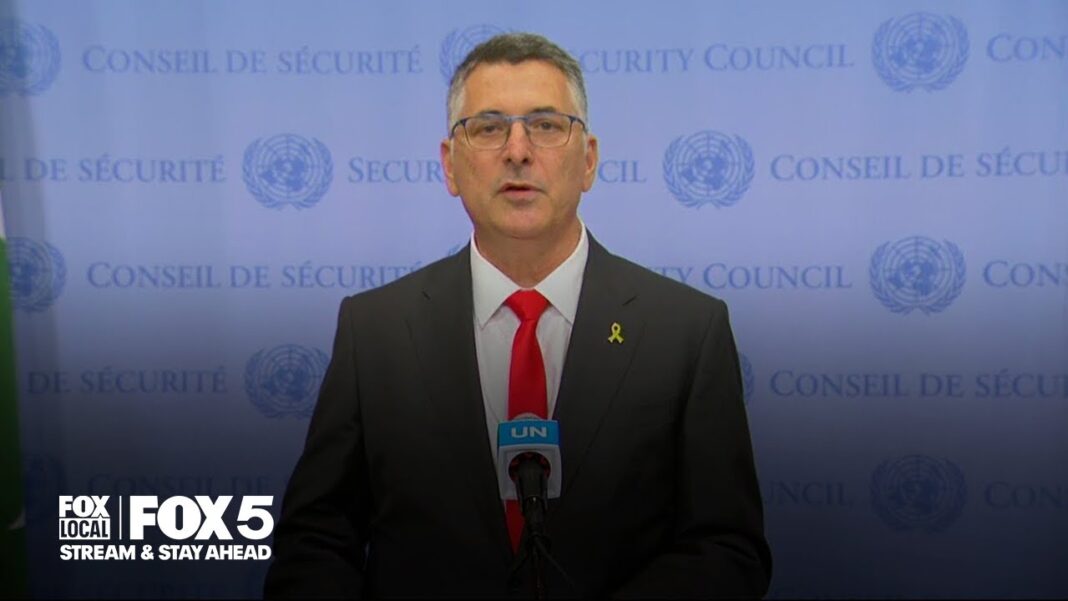
At a special meeting on Tuesday of the United Nations Security Council in New York, that was convened at Israel’s request, Israeli Minister of Foreign Affairs Gideon Sa’ar delivered one of the most forceful addresses heard at the world body in recent months. His remarks were not only a passionate appeal for the release of hostages held in Gaza but also a sweeping critique of international silence, media bias, and he alarming resurgence of antisemitism cloaked in contemporary forms.
The session, called specifically to spotlight the plight of the remaining Israeli hostages abducted by Hamas and Palestinian Islamic Jihad during the October 7, 2023 attacks, offered Sa’ar a platform to confront both the humanitarian crisis and the “upside‑down world” of international response.
Sa’ar began his remarks with a pointed accusation directed at UN Secretary‑General António Guterres. Referring to the recent release of harrowing footage showing hostages Evyatar David and Rom Braslavski in emaciated, near‑death conditions, Sa’ar noted the lack of response from the highest office of the organization.
“Do you know what Secretary‑General Guterres tweeted after the horrible images of Evyatar and Rom were released? Not a word. Deafening silence,” Sa’ar declared.
The comment called attention to Israel’s long‑standing frustration with the UN’s disproportionate criticism of Israel while downplaying or ignoring atrocities committed by Hamas and other terrorist groups. For Jerusalem, the absence of a strong denunciation after the videos emerged was another example of misplaced priorities and a double standard in international diplomacy.
Sa’ar anchored his speech in the testimony of survivors and relatives, including Ilay David, brother of hostage Evyatar. He recalled the mass atrocities of October 7: Women raped and murdered, often after torture. Children executed in front of their parents, and parents killed before their children. Families burned alive. Civilians mutilated, with reports of sexual violence so severe that investigators documented objects forcibly inserted into victims’ bodies.
Drawing from the Dinah Project report—an independent documentation of sexual violence during the Hamas invasion—Sa’ar emphasized that rape was not incidental but systemic, carried out with intent to terrorize. He highlighted the testimony of former hostage Amit Soussana, who courageously described being forced at gunpoint to commit sexual acts on her captor.
“This is the pure evil that Israel faces,” Sa’ar said, comparing Hamas’s actions to the atrocities of the Nazis and ISIS.
Central to the address was the plight of the hostages still in captivity—fewer than 50 believed alive out of the 251 abducted on October 7. Sa’ar described the deliberate starvation tactics employed by Hamas and Islamic Jihad, contrasting them with the images of well‑fed captors.
“The world saw the thick, meaty arm of the well‑fed terrorist next to Evyatar, the living skeleton forced to dig his own grave,” Sa’ar noted.
While Israel has facilitated unprecedented volumes of humanitarian aid into Gaza, Hamas has looted supplies, redirecting food and medicine to its fighters. Meanwhile, the hostages remain deprived of even basic necessities. Sa’ar stressed that despite agreements reached in the November 2023 hostage deal, the International Committee of the Red Cross (ICRC) has not been permitted to visit captives, nor has medicine reached them.
Sa’ar broadened the discussion beyond Israel’s immediate crisis, framing hostage‑taking as an international threat.
“Terror states and organizations kidnapping civilians is not just our problem. This dangerous phenomenon could happen tomorrow anywhere in the world,” he warned.
He urged the Security Council to set a precedent that hostage‑taking cannot be tolerated, calling for a united global stance to delegitimize and punish such tactics.
Turning his focus to global media, Sa’ar accused major outlets of failing to center the suffering of Israeli hostages.
Specifically citing The New York Times, he said he was dismayed to find no photo or front‑page coverage of Evyatar David after Hamas released a video of him.
“Put Evyatar and Rom front and center! Is this not news‑worthy?” Sa’ar demanded.
He described a “twisted anti‑Israel agenda” in much of the press, where responsibility for atrocities is shifted from “the kidnappers and rapists to the attacked country” and blame is moved “from the terrorists to the victims.”
For Sa’ar, this imbalance reflects a broader erosion of moral clarity, in which Israel is cast as aggressor even as it responds to unprecedented terror attacks.
Perhaps the most striking section of Sa’ar’s speech was his direct link between international attitudes toward Israel and the global resurgence of antisemitism.
“What we are witnessing today is the rise of psychotic antisemitism around the world, flamed by modern blood libels, like the darkest days in history. Jews are hunted around the world, simply because they are Jews. In Melbourne. In Amsterdam. In Paris,” he said.
The foreign minister suggested that hostility toward Israel on campuses, in demonstrations, and in international fora cannot be divorced from this broader wave of antisemitism. Eight decades after the Holocaust, he warned, antisemitism is once again in a “golden age.”
The speech returned to its core demand: international pressure on Hamas to release the hostages. Sa’ar posed a series of rhetorical questions to underline responsibility for the ongoing war:
Who initiated the war on October 7?
Who is responsible for its continuation?
Who prolongs the suffering?
His answer was unequivocal: “There is only one clear answer: Hamas.”
He concluded with a direct appeal to the Security Council: “The call on Hamas to release our hostages must be front and center on the world stage. It must not stop until they all come home. We call on the UN Security Council to finally condemn Hamas for its evil crimes, to hold it responsible, and to demand the immediate release of our hostages.”
Sa’ar’s address came at a moment of intense scrutiny for Israel, nearly two years into a war that has drawn both international condemnation and steadfast domestic resolve. His framing—contrasting Israel’s humanitarian actions with Hamas’s brutality—was aimed at shifting global discourse back to the plight of the hostages, which has been eclipsed by narratives of humanitarian crisis in Gaza.
By explicitly accusing the UN Secretary‑General of silence, and by condemning leading global media outlets, Sa’ar sharpened Israel’s long‑standing critique of clear cut institutional bias. His invocation of antisemitism added historical weight, casting the current diplomatic climate as a continuation of an age‑old scourge against Jews.
The speech also reflected Israel’s determination to maintain international focus on Hamas’s atrocities, not merely as a matter of national defense but as part of a global struggle against terrorism.
